4
Itˇs a comprehensive collection.
Some items can be found in Struveˇs
home, a detached house built
in 1934 where he has completely
redesigned the interior. “The chal-
lenge was to obtain all the lamps”,
says the college and university
teacher with pride. The original
interior fittings are examples of the
standard features of detached
and semi-detached houses up until
the 1950s. And therefore belong,
not just coincidentally, to his main
area of interest as a collector.
“My collection focuses on industrially
manufactured objects that were
installed and used in every house
and every room.” Struve is not
interested in hand crafted items but
in the products of mass production
by machinery. Heˇs referring to
those mass-produced works of art
designed during the decades
between the First World War and
the recovery and reconstruction
period that followed the Second
World War. “Iˇm interested in the
results of Bauhaus designs and the
impact that they had during the
1920s.” The prevailing ideal in those
days was that everyone should
be able to live on a certain level of
prosperity in surroundings of
first-rate design. The downside of
the mass-production approach
was the waste involved. “Houses
were modernised without any
consideration for significant histori-
cal aspects. I rescued many of
my objects from skips.” You can hear
how much it means to him to
preserve these treasures. But youˇd
be wrong to think the collection
is just an accumulation of similar
products. “As a collector, Iˇm
excited to see the constant change
in mass-produced items.”
Glass shades in different colours,
designs adapted for technical
reasons: itˇs the deviations in the
details of one and the same type
of lamp that make these items so
very special. Collector Struve is
in his element. “Iˇm constantly in
touch with colleagues when it
comes to defining the exact details
of various items in the collection,
including when they would have
been launched on the market, the
period of production and their
actual use.”
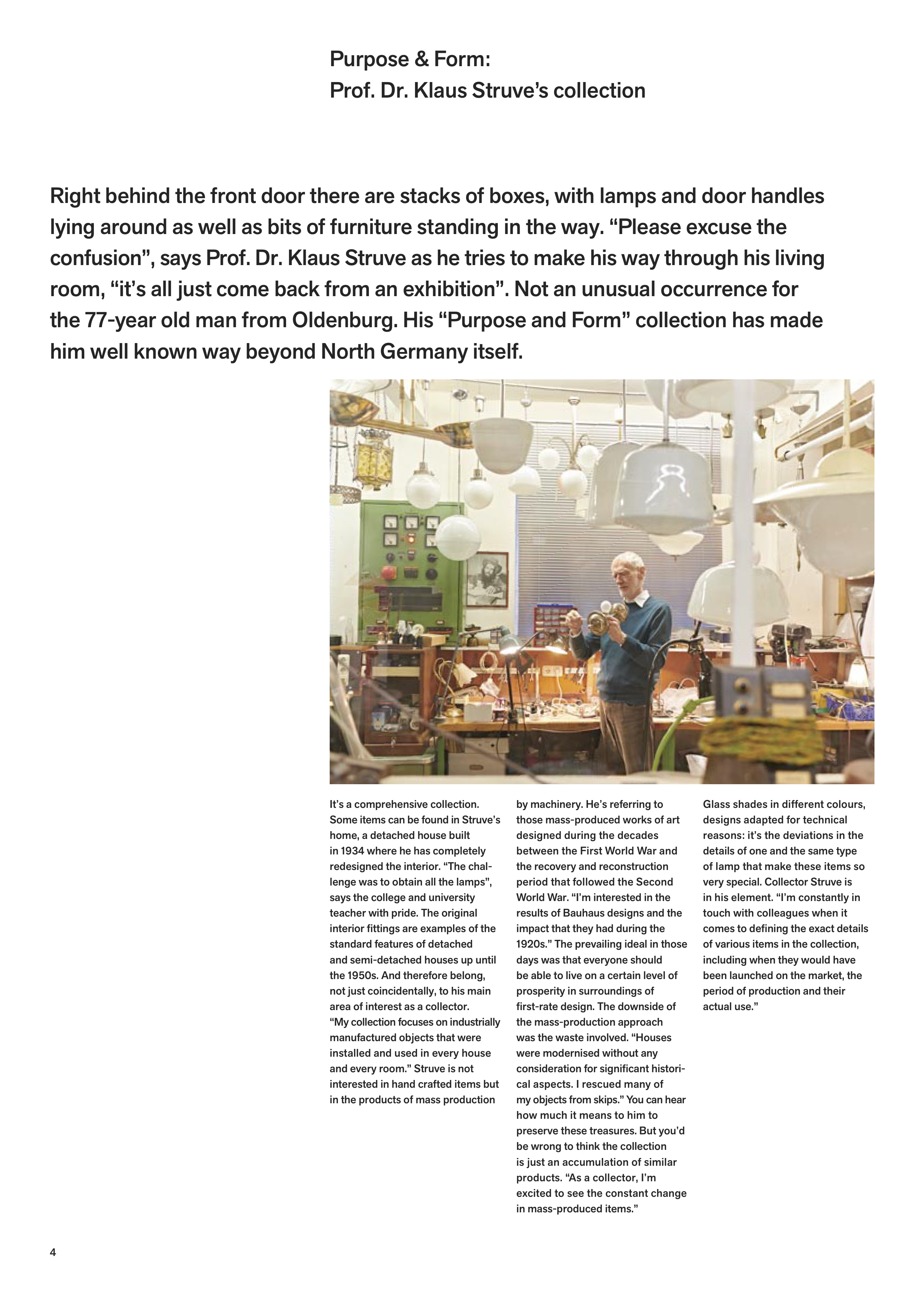
Right behind the front door there are stacks of boxes, with lamps and door handles
lying around as well as bits of furniture standing in the way. “Please excuse the
confusion”, says Prof. Dr. Klaus Struve as he tries to make his way through his living
room, “itˇs all just come back from an exhibition”. Not an unusual occurrence for
the 77-year old man from Oldenburg. His “Purpose and Form” collection has made
him well known way beyond North Germany itself.
Purpose & Form:
Prof. Dr. Klaus Struve’s collection