Square or round, rough or smooth,
dainty or hand-filling: door handles
influence the way you see a room
when you come into it, even if this
is often a subconscious thing. In
manufacturing the Gropius door
handle, TECNOLINE was not aiming
to simply reproduce the shape.
Instead of just replicating the door
handle in its outer appearance, a
mould maker was found who took
a lead model from a historical
original piece. Since then, this origi-
nal mould has been used at
TECNOLINE to create traditional
sand casting moulds, each of which
is only used just one single time.
In other words, no door handle
is identical to any other. The door
handles are produced in these
moulds using top quality brass
MS63, which is a copper/zinc alloy.
The raw parts are then sawn, barrel
finished, burnished and refined
and processed by hand in dozens
more individual steps.
“To achieve perfect quality, we
rely on our feelings and not just on
machines.
19
Handcrafting is the secret of the
unique and the unsurpassed”, says
Charlotta Schnepel, CEO at
TECNOLINE. This elaborate hand-
crafting is clearly visible in the door
fittings: the resulting patina tells
its own story with its traces and
special tactile properties, making
every door handle inimitably
unique. Raw and heavy. Durable
and perfect.
The special thing about this door
handle designed by Walter Gropius
was initially the conical handle
neck set at right angles on the square
bar. This first version was used
initially in the Municipal Theatre in
Jena, in Otte House in Berlin
and in the Fagus Factory in Alfeld,
before Walter Gropius then revised
the design shortly afterwards.
The fittings were made by the bronze
foundry S. A. Loevy in Berlin
which acquired the manufacturing
rights in 1923. It soon transpired
that this was not a successful step.
Although the Prussian Tribunal
of Art Experts acknowledged that
the door handle had a certain
aesthetic value, it concluded that
“the puritanical renunciation of
any decorative element in the basic
shapes, the strict functionality of
cylinder and square lacks the neces-
sary individuality in this specific
case” and that the door handle
“is not an idiosyncratically artistic
creation”. However, today it is
difficult to follow this functionality
argument in the verdict given
by the Prussian experts. “When we
meet customers, we always show
them original door handles by
Gropius from the 1920s and 1930s
that have so many stories to tell
going back over all the years”, says
Charlotta Schnepel with a grin.
“And it is exactly this vintage look
that customers want.” An unsur-
passed obsession with perfection
makes this quality possible.
Every piece is made step by step.
For more than thirty years,
TECNOLINE products have been
made in Germany in a family
business in the Sauerland. For old
apartments or newbuilds on the
private sector, the Design Hotel in
Vienna, the Grandhotel Hessischer
Hof in Frankfurt or the “Glocke”
concert hall in Bremen, today door
handles by Walter Gropius can
be found in all kinds of different
surroundings.
In 2013, TECNOLINE paid tribute to
the timeless classic door handle
with a special edition to mark the
occasion of the 130th birthday of
the architect and industrial designer
Walter Gropius. Besides door hand-
les by renowned designers such
as Ferdinand Kramer and Wilhelm
Wagenfeld, four models of the
Series 130 are still being made of
brass today with a range of
different surfaces finishes using the
traditional casting method. You
just donˇt want to put them down.
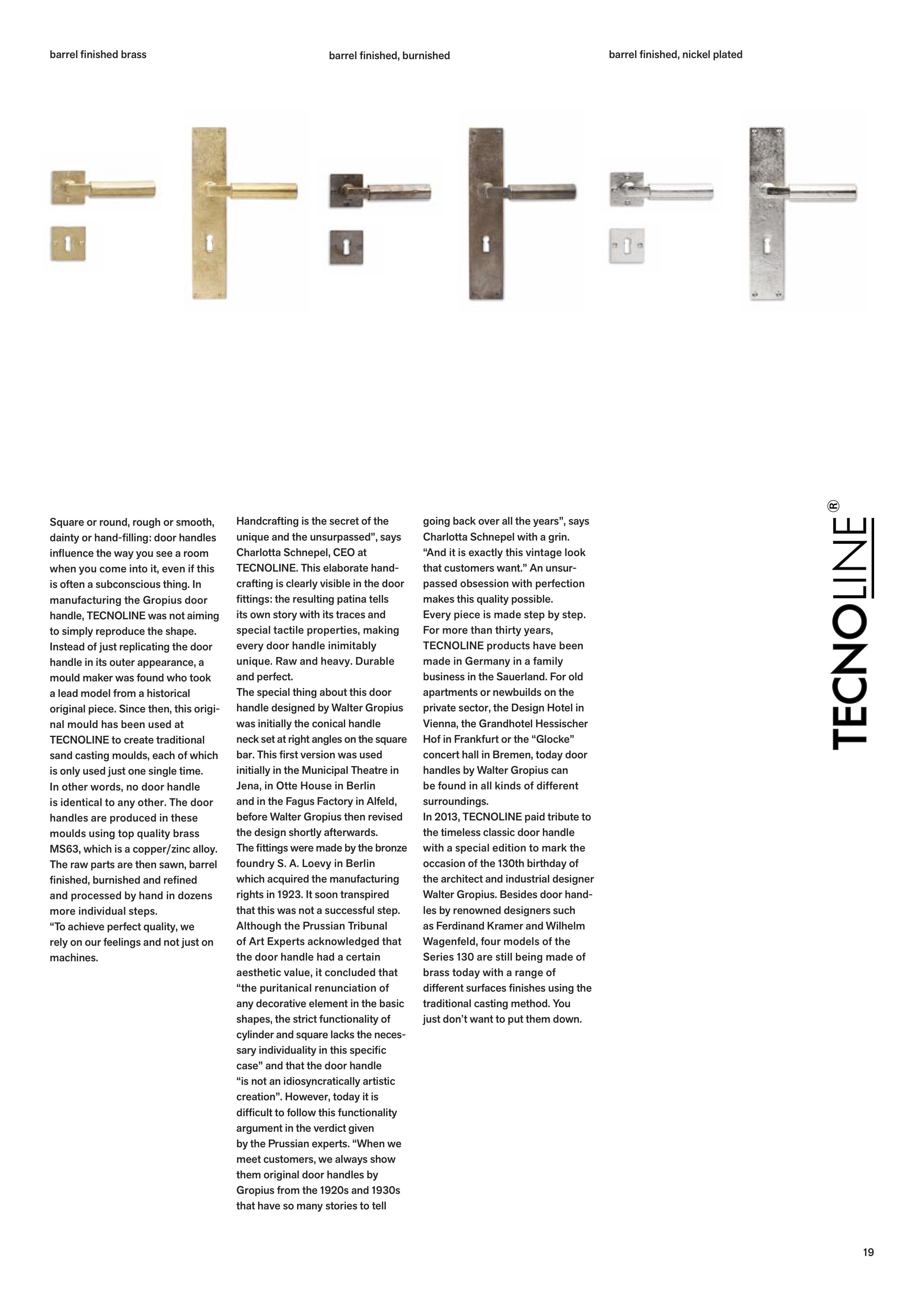
barrel finished brass
barrel finished, burnished
barrel finished, nickel plated