Oliver Niewiadomski: A Portrait
Spheres, cubes, cylinders: for Oliver Niewiadomski, the
basic geometric shapes are the archetypes of design and
characterise his creative work as a designer as well as
his teaching at Bremen University of the Arts. “Shapes like
these are easy to understand because of our established
habits of seeing and perception.” But the designer is concer-
ned about more than just reproducing known shapes. Itˇs
a case of interpreting the theme: turning something familiar
into something surprising, innovative and new.
16
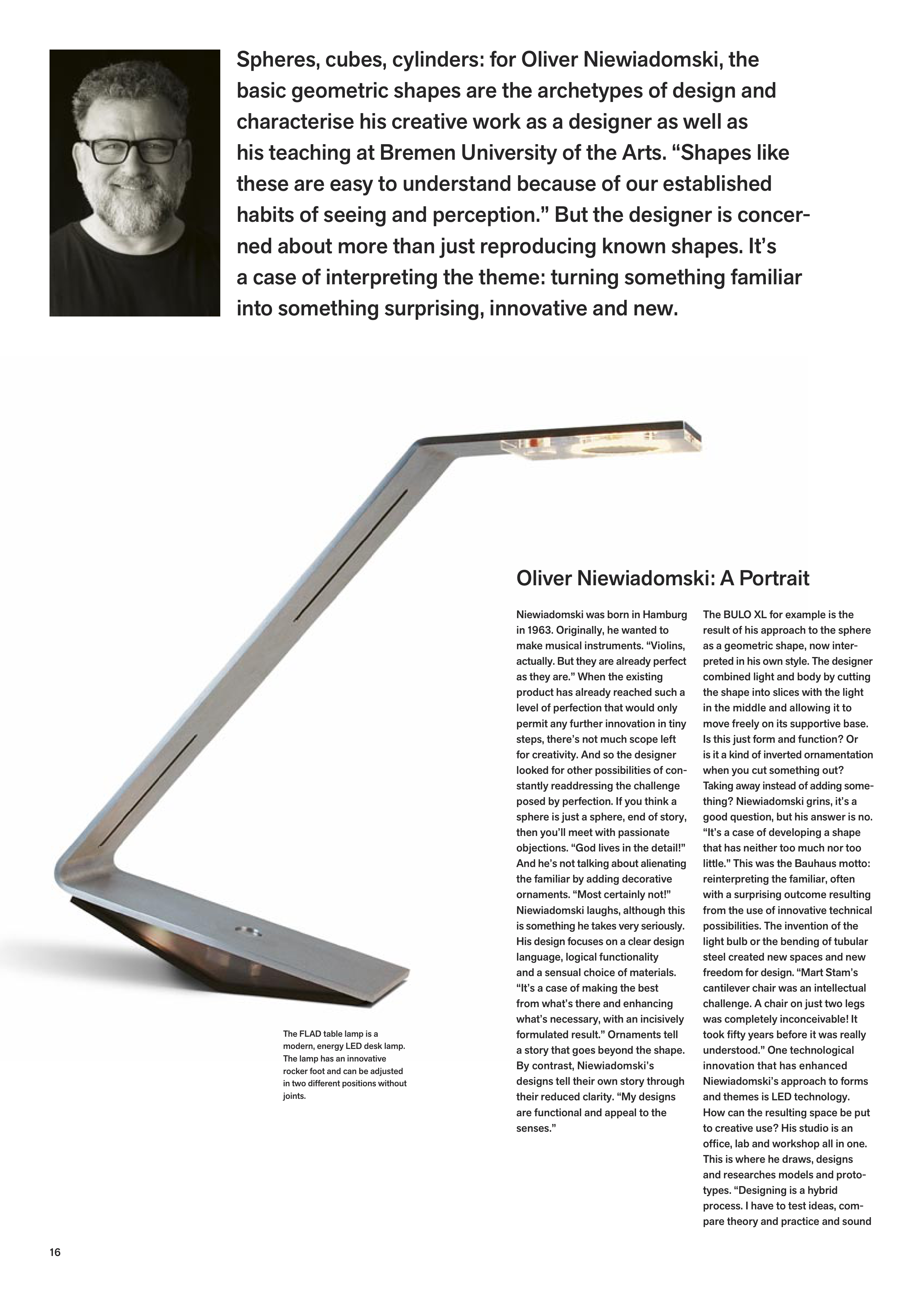
The FLAD table lamp is a
modern, energy LED desk lamp.
The lamp has an innovative
rocker foot and can be adjusted
in two different positions without
joints.
The BULO XL for example is the
result of his approach to the sphere
as a geometric shape, now inter-
preted in his own style. The designer
combined light and body by cutting
the shape into slices with the light
in the middle and allowing it to
move freely on its supportive base.
Is this just form and function? Or
is it a kind of inverted ornamentation
when you cut something out?
Taking away instead of adding some-
thing? Niewiadomski grins, itˇs a
good question, but his answer is no.
“Itˇs a case of developing a shape
that has neither too much nor too
little.” This was the Bauhaus motto:
reinterpreting the familiar, often
with a surprising outcome resulting
from the use of innovative technical
possibilities. The invention of the
light bulb or the bending of tubular
steel created new spaces and new
freedom for design. “Mart Stamˇs
cantilever chair was an intellectual
challenge. A chair on just two legs
was completely inconceivable! It
took fifty years before it was really
understood.” One technological
innovation that has enhanced
Niewiadomskiˇs approach to forms
and themes is LED technology.
How can the resulting space be put
to creative use? His studio is an
office, lab and workshop all in one.
This is where he draws, designs
and researches models and proto-
types. “Designing is a hybrid
process. I have to test ideas, com-
pare theory and practice and sound
Niewiadomski was born in Hamburg
in 1963. Originally, he wanted to
make musical instruments. “Violins,
actually. But they are already perfect
as they are.” When the existing
product has already reached such a
level of perfection that would only
permit any further innovation in tiny
steps, thereˇs not much scope left
for creativity. And so the designer
looked for other possibilities of con-
stantly readdressing the challenge
posed by perfection. If you think a
sphere is just a sphere, end of story,
then youˇll meet with passionate
objections. “God lives in the detail!”
And heˇs not talking about alienating
the familiar by adding decorative
ornaments. “Most certainly not!”
Niewiadomski laughs, although this
is something he takes very seriously.
His design focuses on a clear design
language, logical functionality
and a sensual choice of materials.
“Itˇs a case of making the best
from whatˇs there and enhancing
whatˇs necessary, with an incisively
formulated result.” Ornaments tell
a story that goes beyond the shape.
By contrast, Niewiadomskiˇs
designs tell their own story through
their reduced clarity. “My designs
are functional and appeal to the
senses.”