14
Glasgow and Vienna? In fact, the
Austrian influence extended right
up north. Take Josef Hoffmann,
for example: architect, co-founder
of the Vienna Secession and sub-
sequently founder of the Wiener
Werkstätte, professor at the Vienna
School of Art and Crafts and pro-
ponent of modern, rational design.
His aim was to give people an
aesthetic education through the all-
encompassing design of everyday
objects, in other words by creating
total artwork along the same lines
as the Arts and Crafts Movement in
England.
However, instead or organic
curved lines, he soon turned to geo-
metric design, just like the Scotsman
Charles Rennie Macintosh.
Was that a coincidence? Hardly.
After all, the Netherlands also
witnessed a growing reluctance to
accept industrially optimised
design. De Stijl called itself the
movement of protagonists who
transposed the aesthetic aspect of
geometric style into free art, putting
geometric abstraction into painting.
Theo van Doesburg spoke of the
“desire for style”, the ultimate style
of modernism and comprehen-
sive design in all areas, as already
advocated by Mackintosh and
Hoffmann. “Rooms as accessible
works of art”.
Glasgow, Vienna, the Netherlands:
wherever you looked, the new
industrial possibilities were giving
rise to discussion and debate about
the historical and the natural
connection between production
and design. What about Germany?
Well, Germany also had its answer
to modernism. In 1906, the third
German Arts and Crafts Exhibition
in Dresden sought to find a place
for art in the new system of industri-
alisation and its associated capita-
lism, seeing a chance in efficient
production methods. The intention
was for the “mass-produced
furniture programme” to combine
artistic design and high quality
standards with machine production
on the basis of an objective design
language, with applied art playing a
central role. Furniture started to
be made in mass production at low
cost in “noble simplicity” for the
newly emerging educated middle
classes of the consumer society.
Easily combined, with first-rate
quality and recognisable corporate
identity design, rather than the
individual one-off approach. Two of
the most successful proponents
were Richard Riemerschmid, co-
founder of the German Association
of Craftsmen, and Bruno Paul,
with their mass-produced furniture
according to the type furniture
programme.
The German Association of Crafts-
men founded in 1907 by twelve
artists and architects saw itself as a
platform for promoting cooperation
between designers and industry,
including: AEG and Kaffee Hag. The
aim was to achieve a systematic
approach to design in the context
of industrial production. But how?
By restricting artistic freedom?
Designers as service providers for
industry? The debate culminated
in a dispute at the German Associa-
tion of Craftsmen in 1914. Hermann
Muthesius and his ten theses de-
manded that art and design should
be separated seeking to establish
a German style that would be a com-
mercial success and lead to global
exports, thus establishing a
new understanding of design and
designers. Henry van de Velde
on the other hand believed in the
role of artists working with artistic
freedom and thus independently
from industry.
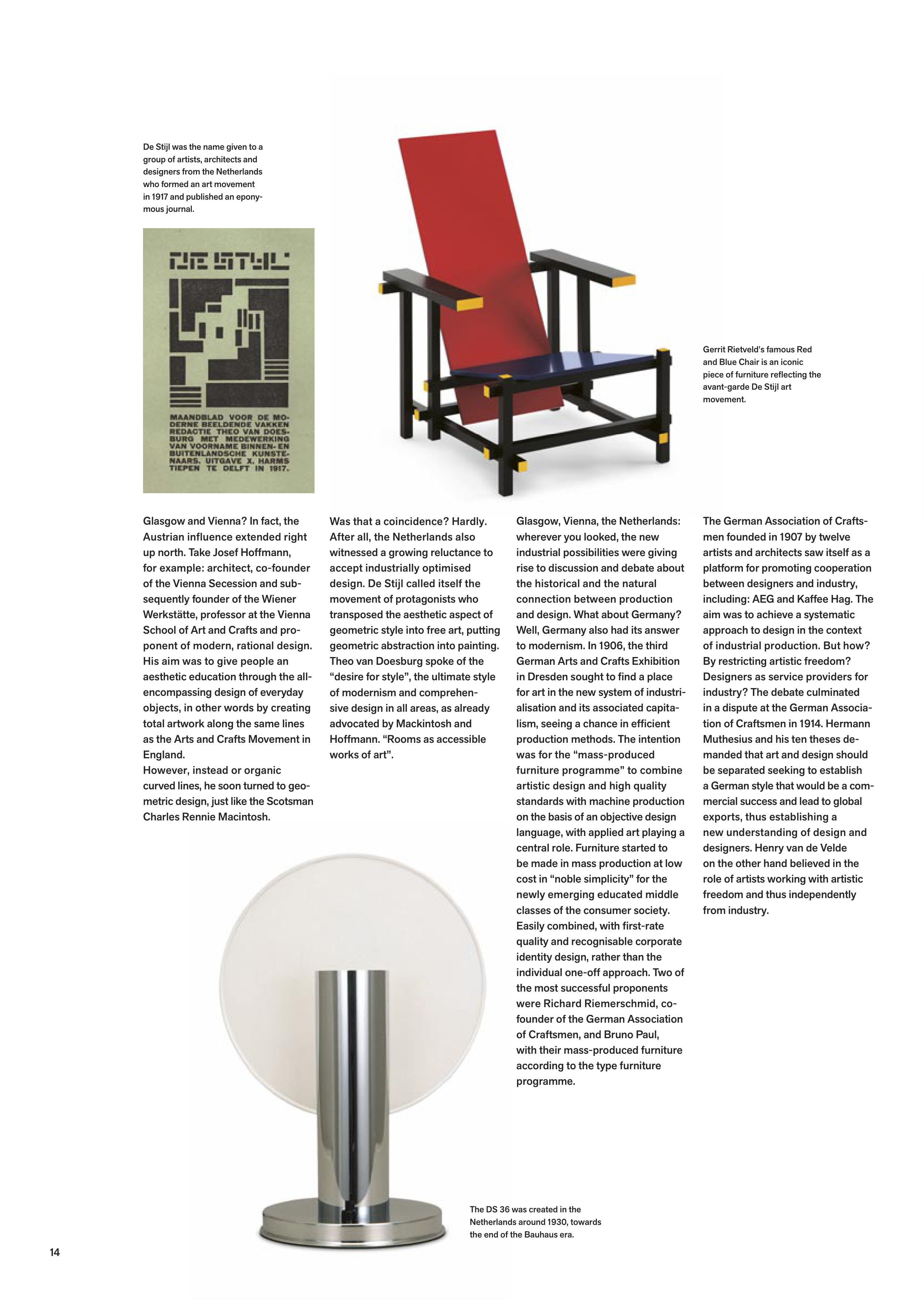
De Stijl was the name given to a
group of artists, architects and
designers from the Netherlands
who formed an art movement
in 1917 and published an epony-
mous journal.
Gerrit Rietveld's famous Red
and Blue Chair is an iconic
piece of furniture reflecting the
avant-garde De Stijl art
movement.
The DS 36 was created in the
Netherlands around 1930, towards
the end of the Bauhaus era.