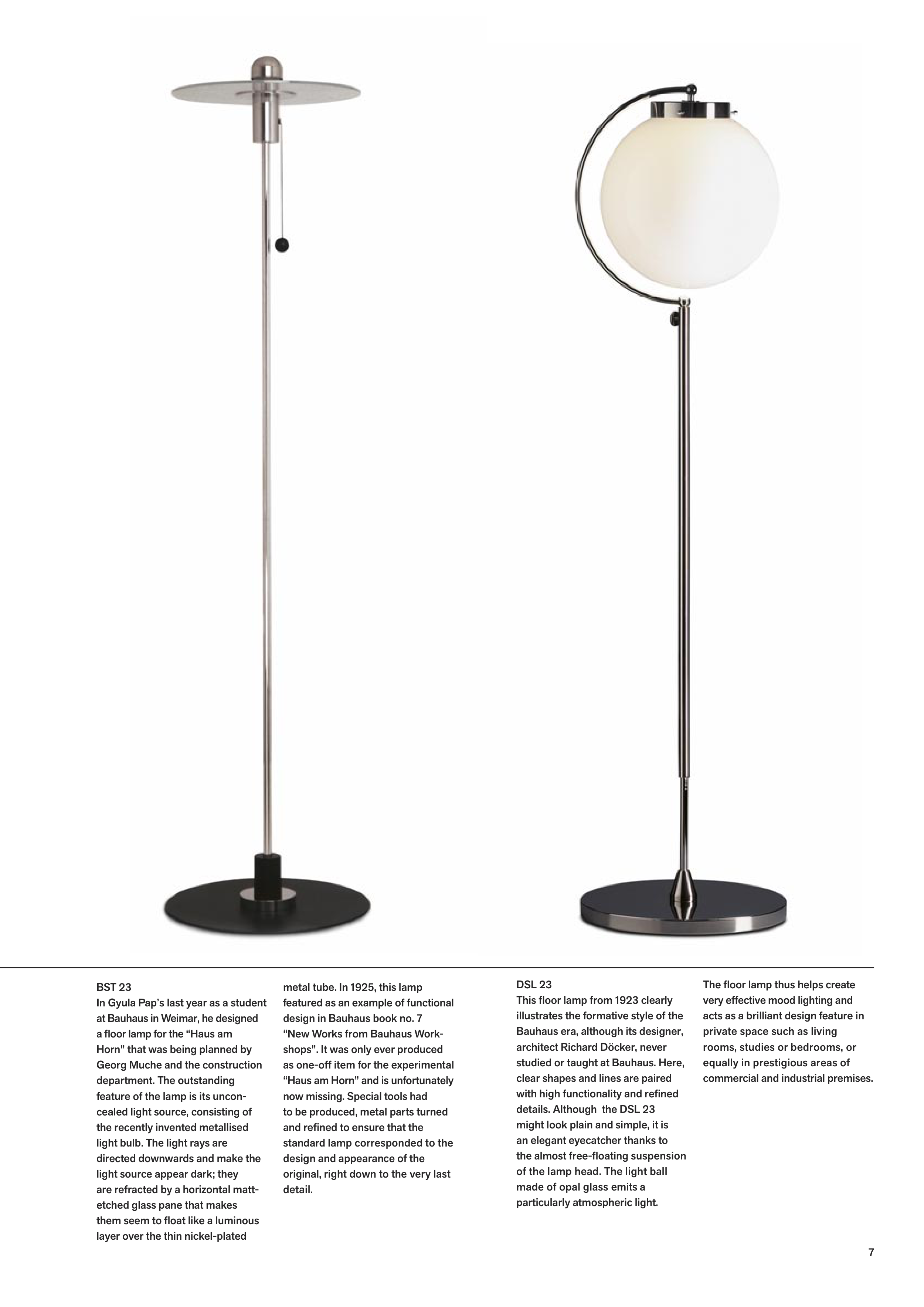
DSL 23
This floor lamp from 1923 clearly
illustrates the formative style of the
Bauhaus era, although its designer,
architect Richard Döcker, never
studied or taught at Bauhaus. Here,
clear shapes and lines are paired
with high functionality and refined
details. Although the DSL 23
might look plain and simple, it is
an elegant eyecatcher thanks to
the almost free-floating suspension
of the lamp head. The light ball
made of opal glass emits a
particularly atmospheric light.
The floor lamp thus helps create
very effective mood lighting and
acts as a brilliant design feature in
private space such as living
rooms, studies or bedrooms, or
equally in prestigious areas of
commercial and industrial premises.
BST 23
In Gyula Papˇs last year as a student
at Bauhaus in Weimar, he designed
a floor lamp for the “Haus am
Horn” that was being planned by
Georg Muche and the construction
department. The outstanding
feature of the lamp is its uncon-
cealed light source, consisting of
the recently invented metallised
light bulb. The light rays are
directed downwards and make the
light source appear dark; they
are refracted by a horizontal matt-
etched glass pane that makes
them seem to float like a luminous
layer over the thin nickel-plated
metal tube. In 1925, this lamp
featured as an example of functional
design in Bauhaus book no. 7
“New Works from Bauhaus Work-
shops”. It was only ever produced
as one-off item for the experimental
“Haus am Horn” and is unfortunately
now missing. Special tools had
to be produced, metal parts turned
and refined to ensure that the
standard lamp corresponded to the
design and appearance of the
original, right down to the very last
detail.
7