15
Like van de Velde, Walter Gropius
didnˇt reject industrial production as
such and similarly also tried to find a
formula for the relationship between
art and technology. In the end, he
established his position by founding
his Bauhaus and with his state-
ment “Art and Technology – a New
Unity”. Admittedly, this connection
was not really ‘newˇ. Initially, the
proponents of the newly founded
school did not set great score by
industrial manufacturing. The move
to take emotion out of the equation
and to combine geometry and
machine aesthetics had nothing to
do with actual industrial mass
production. Instead, Bauhaus and
its protagonists strived to eliminate
the distinction between art and
craft: this was a goal they shared
with the Arts and Craft Movement.
“When we design a bottle, we should
ask whether it will work, whether it
will meet all the demands made of a
bottle, whether it could work even
better and, finally (...) whether it is
nice to look at.” In the end, moder-
nism also had its impact on Bauhaus.
Hannes Meyer, one of the best
known functionalist architects of the
1920s and Bauhaus director from
1928, brought industrialisation and
mass production with him, thus
also making industry a partner of
Bauhaus. This consistent colla-
boration with industrial production,
and with the manufacturing process
which was thus transformed accor-
dingly, changed the approach to the
design process itself. A new profes-
sion emerged that bridged the
gap between history and modernism,
between art and craft. Bauhaus
became the “School of Design”,
offering designers the necessary
training.
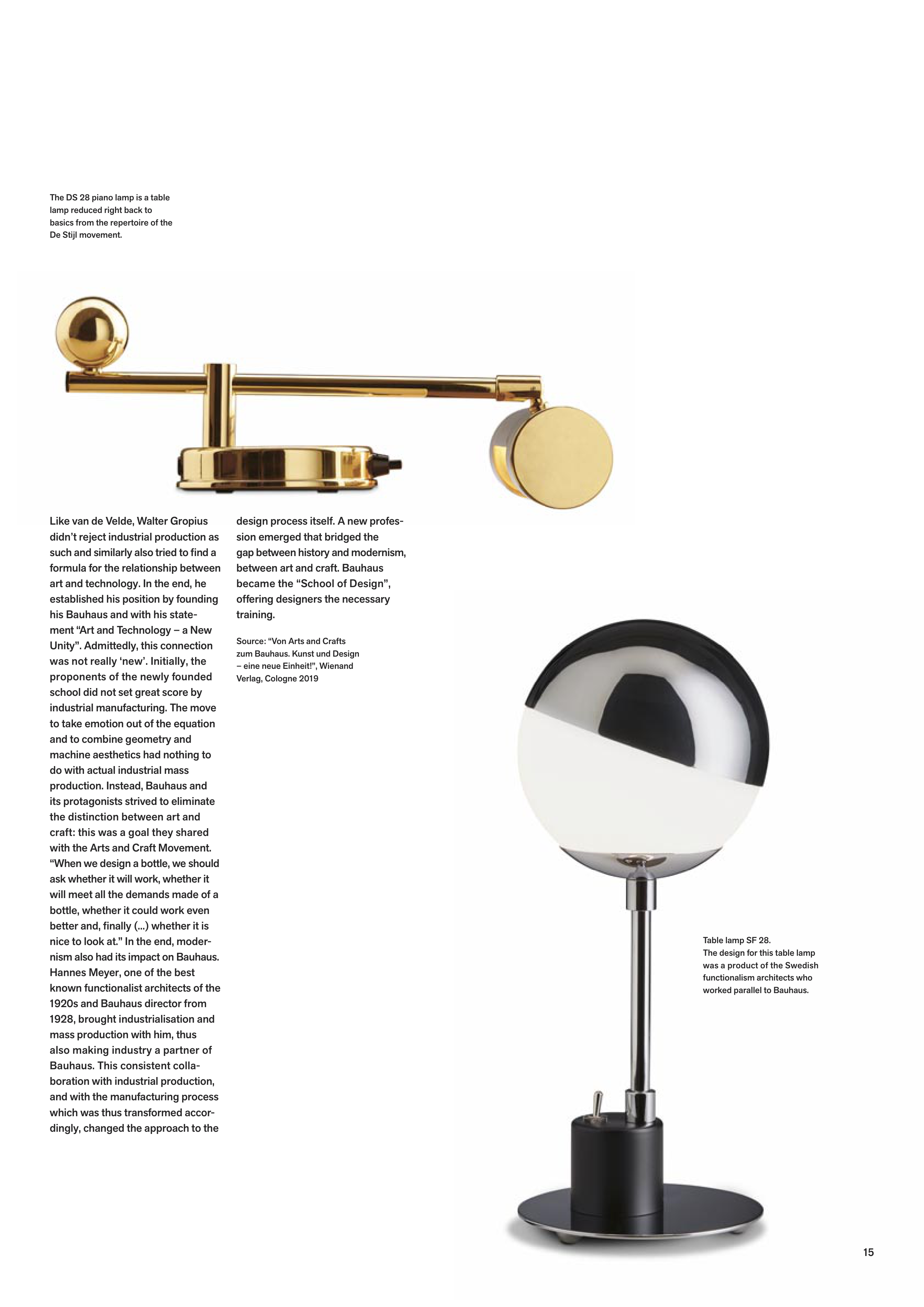
The DS 28 piano lamp is a table
lamp reduced right back to
basics from the repertoire of the
De Stijl movement.
Table lamp SF 28.
The design for this table lamp
was a product of the Swedish
functionalism architects who
worked parallel to Bauhaus.
Source: “Von Arts and Crafts
zum Bauhaus. Kunst und Design
– eine neue Einheit!”, Wienand
Verlag, Cologne 2019