13
So how did it all begin? The early
history of Bauhaus takes us back
two centuries. Back to the 1870s, to
be precise. In terms of social
development, it was a time of epic
upheaval. But not everyone thought
the industrial revolution was a
good thing. While some saw the
transformation from agricultural
to industrial production as a new era
for mankind with inestimable
opportunities for society and the
economy, others warned of cultural
losses and dangers. Art historians
such as John Ruskin and Gottfried
Semper examined the rapid changes
of their time, representing the
views of many in defence of innova-
tion and progress or conservative-
romantic preservation of value;
Karl Marx and Friedrich Engels saw
the impoverishment of the pro-
letariat rather than technological
and economic progress. Despite
being surrounded in controversy,
in 1851 the Great Exhibition opened
its doors in London. More than
100,000 exhibits were on display.
They presented the status of
development of the whole of man-
kind, illustrating both the diversity
of industrial design and the latest
production methods. Exhibits
including Joseph Paxtonˇs Crystal
Palace made it an unforgettable
experience for around six million
visitors. Semper compared the
abundant diversity of industrial pro-
duces presented at the exhibition
with the Tower of Babel. Despite all
scepticism and hostility, European
designers found new inspiration in
the exhibits from all over the
world. Edward William Godwin from
Great Britain was one of the
most exciting designers of the day,
with modern designs made time-
less by managing without historical
features. Japonism was one of the
prime influences, with its reduced
simplicity being a perfect match
for the emerging possibilities for
machine production. Generally
speaking, the new production forms
changed the design of many every-
day objects. Industrialisation made
it easy to have access to things
that used to be unique, turning
them into mass products with
the possibility of unlimited repro-
duction putting them on the
shelves of middle-class households.
But the use of machinery in the
production process increasingly
became separated from any kind
of craftsmanship and inevitably led
to a longing for originality. Instead
of plain unadorned items for
industrial production, it was in fact
by focusing on natural, honest
materials and processing them with
honest, simple craftsmanship
that the Arts and Crafts Movement
made a name for itself in England
and beyond, with an ever increasing
number of followers. This anti-
industrial movement aimed to
eliminate the distinction between
free and applied art, finding in-
spiration in the shapes and colours
of nature, in Mediaeval Europe –
and in Japanese art.
It didnˇt take long for similar develop-
ments to emerge. In Scotland, it
was the city of Glasgow that became
a leading centre for architecture
and design, with the regionˇs ship-
building industry promoting the
demand for craftsmanship and
design. Frances Newbery founded
the Glasgow School of Art with a
focus on traditional techniques and
craftsmanship. One of the best
known representatives of the Glas-
gow Style is Charles Rennie
Macintosh. He worked with James
Herbert McNair and the sisters
Margaret and Francis MacDonald
as The Four to propagate the link
between architecture and furnishing
as implemented in the “Tea Rooms”.
They were clearly influenced by the
Arts and Crafts Movement with its
concept of “total artwork” allowing
them to transcend structural hierar-
chies as artists, architects and
designers. Taking a genuine Scottish
approach combined with the
Japanese influence on design lan-
guage, the symbolism of the
MacDonald sisters and Art Nouveau
influences from Vienna, he characte-
rised all that was new in the Glasgow
Style.
Top picture:
The Crystal Palace by Joseph
Paxton was the landmark of the
Great Exhibition in London in
1851. The Crystal Palace burnt
down in 1936.
Bottom picture:
The famous woodblock print
“The Great Wave off Kanagawa”
by Katsushika Hokusai also
influenced the development of
design in Europe.
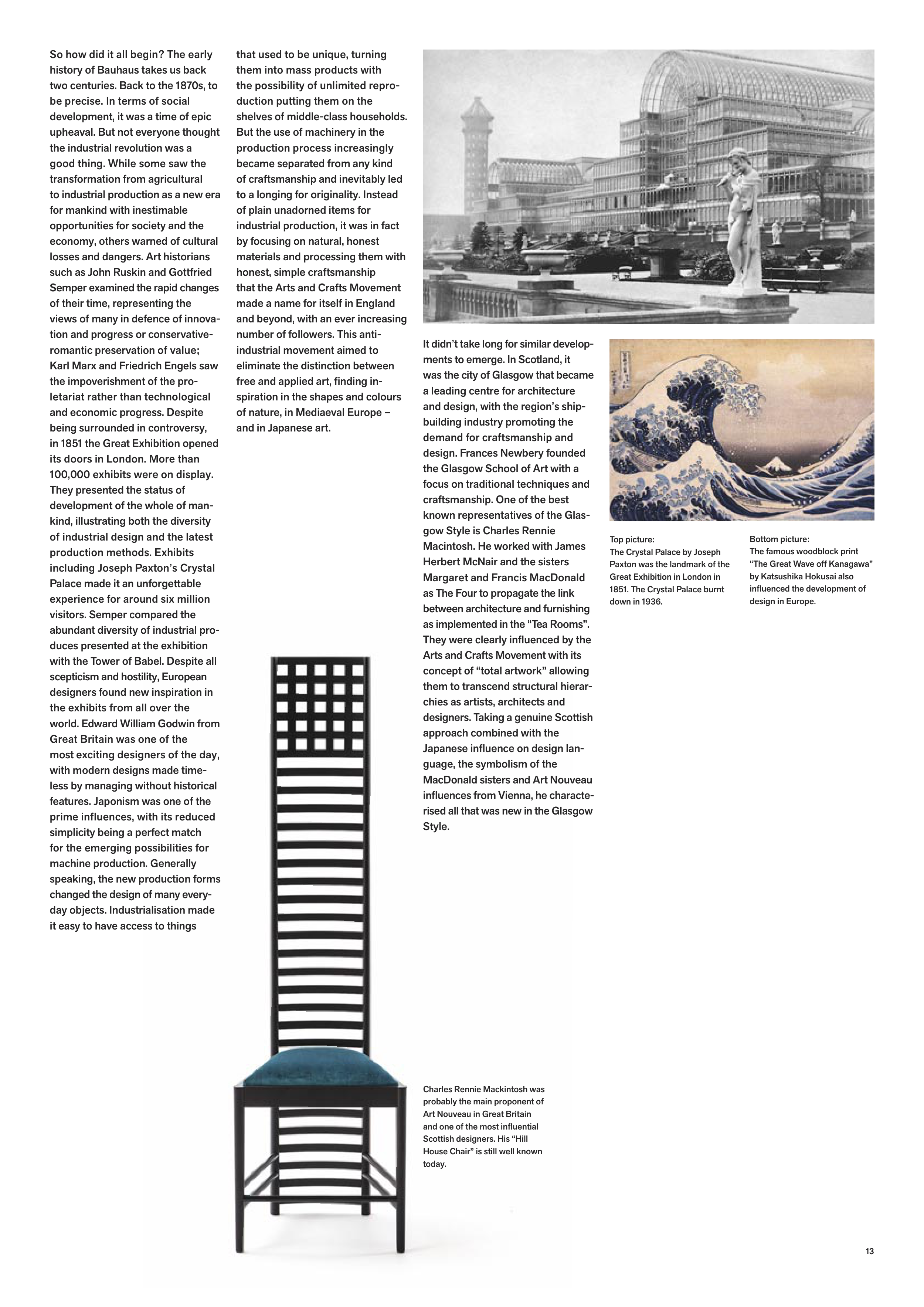
Charles Rennie Mackintosh was
probably the main proponent of
Art Nouveau in Great Britain
and one of the most influential
Scottish designers. His “Hill
House Chair” is still well known
today.