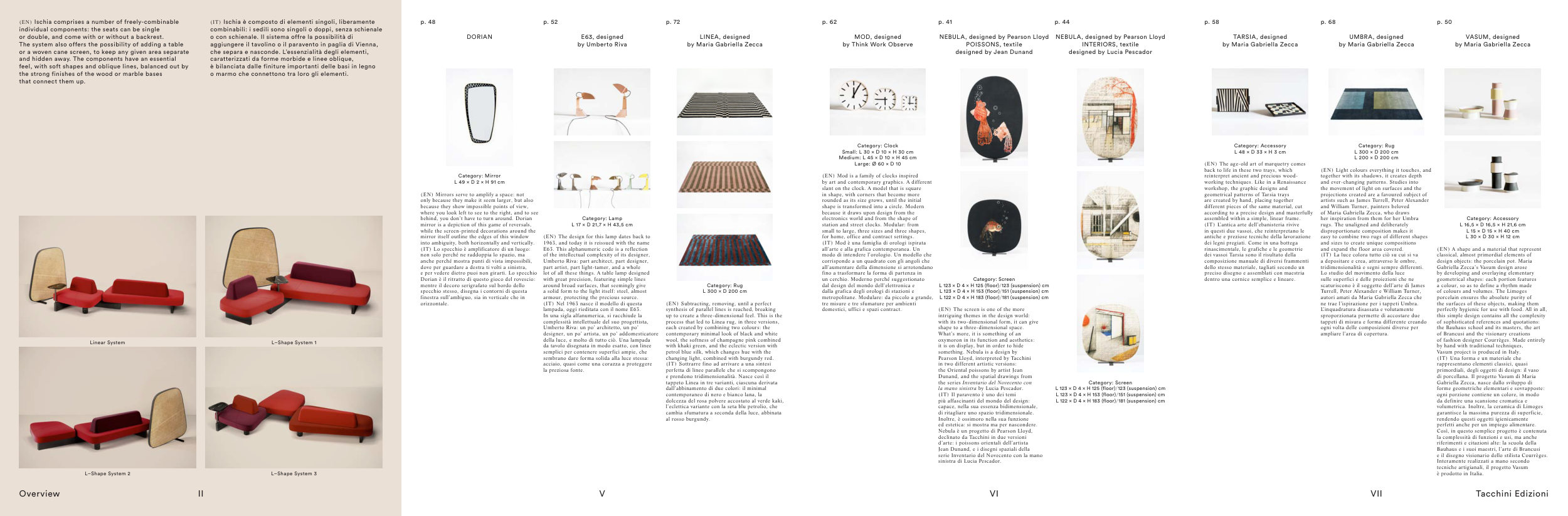
L–Shape System 3
L–Shape System 2
Overview
II
L–Shape System 1
Linear System
(EN) Ischia comprises a number of freely-combinable
individual components: the seats can be single
or double, and come with or without a backrest.
The system also offers the possibility of adding a table
or a woven cane screen, to keep any given area separate
and hidden away. The components have an essential
feel, with soft shapes and oblique lines, balanced out by
the strong finishes of the wood or marble bases
that connect them up.
(IT) Ischia è composto di elementi singoli, liberamente
combinabili: i sedili sono singoli o doppi, senza schienale
o con schienale. Il sistema offre la possibilità di
aggiungere il tavolino o il paravento in paglia di Vienna,
che separa e nasconde. L’essenzialità degli elementi,
caratterizzati da forme morbide e linee oblique,
è bilanciata dalle finiture importanti delle basi in legno
o marmo che connettono tra loro gli elementi.
p. 48
DORIAN
Category: Mirror
L 49 × D 2 × H 91 cm
(EN) Mirrors serve to amplify a space: not
only because they make it seem larger, but also
because they show impossible points of view,
where you look left to see to the right, and to see
behind, you don’t have to turn around. Dorian
mirror is a depiction of this game of reversals,
while the screen-printed decorations around the
mirror itself outline the edges of this window
into ambiguity, both horizontally and vertically.
(IT) Lo specchio è amplificatore di un luogo:
non solo perché ne raddoppia lo spazio, ma
anche perché mostra punti di vista impossibili,
dove per guardare a destra ti volti a sinistra,
e per vedere dietro puoi non girarti. Lo specchio
Dorian è il ritratto di questo gioco del rovescio:
mentre il decoro serigrafato sul bordo dello
specchio stesso, disegna i contorni di questa
finestra sull’ambiguo, sia in verticale che in
orizzontale.
p. 52
E63, designed
by Umberto Riva
Category: Lamp
L 17 × D 21,7 × H 43,5 cm
(EN) The design for this lamp dates back to
1963, and today it is reissued with the name
E63. This alphanumeric code is a reflection
of the intellectual complexity of its designer,
Umberto Riva: part architect, part designer,
part artist, part light-tamer, and a whole
lot of all these things. A table lamp designed
with great precision, featuring simple lines
around broad surfaces, that seemingly give
a solid form to the light itself: steel, almost
armour, protecting the precious source.
(IT) Nel 1963 nasce il modello di questa
lampada, oggi rieditata con il nome E63.
In una sigla alfanumerica, si racchiude la
complessità intellettuale del suo progettista,
Umberto Riva: un po’ architetto, un po’
designer, un po’ artista, un po’ addomesticatore
della luce, e molto di tutto ciò. Una lampada
da tavolo disegnata in modo esatto, con linee
semplici per contenere superfici ampie, che
sembrano dare forma solida alla luce stessa:
acciaio, quasi come una corazza a proteggere
la preziosa fonte.
p. 72
LINEA, designed
by Maria Gabriella Zecca
Category: Rug
L 300 × D 200 cm
(EN) Subtracting, removing, until a perfect
synthesis of parallel lines is reached, breaking
up to create a three-dimensional feel. This is the
process that led to Linea rug, in three versions,
each created by combining two colours: the
contemporary minimal look of black and white
wool, the softness of champagne pink combined
with khaki green, and the eclectic version with
petrol blue silk, which changes hue with the
changing light, combined with burgundy red.
(IT) Sottrarre fino ad arrivare a una sintesi
perfetta di linee parallele che si scompongono
e prendono tridimensionalità. Nasce così il
tappeto Linea in tre varianti, ciascuna derivata
dall’abbinamento di due colori: il minimal
contemporaneo di nero e bianco lana, la
dolcezza del rosa polvere accostato al verde kaki,
l’eclettica variante con la seta blu petrolio, che
cambia sfumatura a seconda della luce, abbinata
al rosso burgundy.
p. 62
MOD, designed
by Think Work Observe
Category: Clock
Small: L 30 × D 10 × H 30 cm
Medium: L 45 × D 10 × H 45 cm
Large: Ø 60 × D 10
(EN) Mod is a family of clocks inspired
by art and contemporary graphics. A different
slant on the clock. A model that is square
in shape, with corners that become more
rounded as its size grows, until the initial
shape is transformed into a circle. Modern
because it draws upon design from the
electronics world and from the shape of
station and street clocks. Modular: from
small to large, three sizes and three shapes,
for home, office and contract settings.
(IT) Mod è una famiglia di orologi ispirata
all’arte e alla grafica contemporanea. Un
modo di intendere l’orologio. Un modello che
corrisponde a un quadrato con gli angoli che
all’aumentare della dimensione si arrotondano
fino a trasformare la forma di partenza in
un cerchio. Moderno perché suggestionato
dal design del mondo dell’elettronica e
dalla grafica degli orologi di stazioni e
metropolitane. Modulare: da piccolo a grande,
tre misure e tre sfumature per ambienti
domestici, uffici e spazi contract.
p. 41
NEBULA, designed by Pearson Lloyd
POISSONS, textile
designed by Jean Dunand
Category: Screen
L 123 × D 4 × H 125 (floor)/123 (suspension) cm
L 123 × D 4 × H 153 (floor)/151 (suspension) cm
L 122 × D 4 × H 183 (floor)/181 (suspension) cm
(EN) The screen is one of the more
intriguing themes in the design world:
with its two-dimensional form, it can give
shape to a three-dimensional space.
What’s more, it is something of an
oxymoron in its function and aesthetics:
it is on display, but in order to hide
something. Nebula is a design by
Pearson Lloyd, interpreted by Tacchini
in two different artistic versions:
the Oriental poissons by artist Jean
Dunand, and the spatial drawings from
the series Inventario del Novecento con
la mano sinistra by Lucia Pescador.
(IT) Il paravento è uno dei temi
più affascinanti del mondo del design:
capace, nella sua essenza bidimensionale,
di ritagliare uno spazio tridimensionale.
Inoltre, è ossimoro nella sua funzione
ed estetica: si mostra ma per nascondere.
Nebula è un progetto di Pearson Lloyd,
declinato da Tacchini in due versioni
d’arte: i poissons orientali dell’artista
Jean Dunand, e i disegni spaziali della
serie Inventario del Novecento con la mano
sinistra di Lucia Pescador.
p. 44
NEBULA, designed by Pearson Lloyd
INTERIORS, textile
designed by Lucia Pescador
Category: Screen
L 123 × D 4 × H 125 (floor)/123 (suspension) cm
L 123 × D 4 × H 153 (floor)/151 (suspension) cm
L 122 × D 4 × H 183 (floor)/181 (suspension) cm
p. 58
TARSIA, designed
by Maria Gabriella Zecca
Category: Accessory
L 48 × D 33 × H 3 cm
(EN) The age-old art of marquetry comes
back to life in these two trays, which
reinterpret ancient and precious wood-
working techniques. Like in a Renaissance
workshop, the graphic designs and
geometrical patterns of Tarsia trays
are created by hand, placing together
different pieces of the same material, cut
according to a precise design and masterfully
assembled within a simple, linear frame.
(IT) L’antica arte dell’ebanisteria rivive
in questi due vassoi, che reinterpretano le
antiche e preziose tecniche della lavorazione
dei legni pregiati. Come in una bottega
rinascimentale, le grafiche e le geometrie
dei vassoi Tarsia sono il risultato della
composizione manuale di diversi frammenti
dello stesso materiale, tagliati secondo un
preciso disegno e assemblati con maestria
dentro una cornice semplice e lineare.
p. 68
UMBRA, designed
by Maria Gabriella Zecca
Category: Rug
L 300 × D 200 cm
L 200 × D 200 cm
(EN) Light colours everything it touches, and
together with its shadows, it creates depth
and ever-changing patterns. Studies into
the movement of light on surfaces and the
projections created are a favoured subject of
artists such as James Turrell, Peter Alexander
and William Turner, painters beloved
of Maria Gabriella Zecca, who draws
her inspiration from them for her Umbra
rugs. The unaligned and deliberately
disproportionate composition makes it
easy to combine two rugs of different shapes
and sizes to create unique compositions
and expand the floor area covered.
(IT) La luce colora tutto ciò su cui si va
a depositare e crea, attraverso le ombre,
tridimensionalità e segni sempre differenti.
Lo studio del movimento della luce
sulle superfici e delle proiezioni che ne
scaturiscono è il soggetto dell’arte di James
Turrell, Peter Alexander e William Turner,
autori amati da Maria Gabriella Zecca che
ne trae l’ispirazione per i tappeti Umbra.
L’inquadratura disassata e volutamente
sproporzionata permette di accostare due
tappeti di misura e forma differente creando
ogni volta delle composizioni diverse per
ampliare l’area di copertura.
p. 50
VASUM, designed
by Maria Gabriella Zecca
Category: Accessory
L 16,5 × D 16,5 × H 21,6 cm
L 15 × D 15 × H 40 cm
L 30 × D 30 × H 12 cm
(EN) A shape and a material that represent
classical, almost primordial elements of
design objects: the porcelain pot. Maria
Gabriella Zecca’s Vasum design arose
by developing and overlaying elementary
geometrical shapes: each portion features
a colour, so as to define a rhythm made
of colours and volumes. The Limoges
porcelain ensures the absolute purity of
the surfaces of these objects, making them
perfectly hygienic for use with food. All in all,
this simple design contains all the complexity
of sophisticated references and quotations:
the Bauhaus school and its masters, the art
of Brancusi and the visionary creations
of fashion designer Courrèges. Made entirely
by hand with traditional techniques,
Vasum project is produced in Italy.
(IT) Una forma e un materiale che
rappresentano elementi classici, quasi
primordiali, degli oggetti di design: il vaso
di porcellana. Il progetto Vasum di Maria
Gabriella Zecca, nasce dallo sviluppo di
forme geometriche elementari e sovrapposte:
ogni porzione contiene un colore, in modo
da definire una scansione cromatica e
volumetrica. Inoltre, la ceramica di Limoges
garantisce la massima purezza di superficie,
rendendo questi oggetti igienicamente
perfetti anche per un impiego alimentare.
Così, in questo semplice progetto è contenuta
la complessità di funzioni e usi, ma anche
riferimenti e citazioni alte: la scuola della
Bauhaus e i suoi maestri, l’arte di Brancusi
e il disegno visionario dello stilista Courrèges.
Interamente realizzati a mano secondo
tecniche artigianali, il progetto Vasum
è prodotto in Italia.
V
VI
VII
Tacchini Edizioni