Tacchini Italia Forniture Srl
19, via Domodossola
20822 Baruccana di Seveso
(Monza Brianza) Italy
T: +39 0362 504182
F: +39 0362 552402
E–mail: info@tacchini.it
www.tacchini.it
T’Journal N°6
Sixth Year
News Magazine
Milan International
Furniture Fair
Photography:
Andrea Ferrari
Photographic
concept and styling:
Gabriella Zecca
Digital retouching:
Erica Fadini
Text editing:
Rujana Rebernjak
Graphic design:
Think Work Observe
Printing:
Grafiche Filacorda
Italy, April 2015
© Tacchini Italia
Forniture Srl
Tacchini T’Journal, News Magazine, N°6 — Sixth Year. Discover T’15 Tacchini New Collection: Dot, Nebula, Sesann, Pisa, Kelly C⁄H⁄W. Featuring seven designers:
Claesson Koivisto Rune, Gianfranco Frattini, Patrick Norguet, Pearson Lloyd. 32 pages, format 28 × 42 cm and Design Classics: ‘The Italian Line: the collective spirit
between past and present’ a four pages supplement with Italian and English texts. Photographed by Andrea Ferrari, printed for Milan International Furniture Fair,
April 14th — 19th, 2015. Limited Edition by Tacchini. For more visit our website: www.tacchini.it
31
Colophon
T’Journal
Technical Overview
FOREWORD
DOT
The ideal home, between
reality and imagination
The dream of an ideal home
has penetrated the collective
imagination for centuries, constantly
changing between a symbolic idea
and the material reality of every day.
Every project of design we handle,
is created from the abstract image
of an ideal home, based not only on
the architecture of this imaginary
home, but above all on the objects,
you can find in it and which represent
its spirit and its real nature. How
to transform this utopian ideal into
a three-dimensional reality is an
alchemical process that requires
an audacious way of thinking and an
extraordinary ability in doing.
NEBULA
From the idea of the space
to the space of ideas
Among a multitude of possible
interpretations, what is the most
suitable definition related to the
concept of “space”? Referring to
traditional explanations, we can
describe the space as a no defined
and no limited place, where the
material things are contained.
However, this pragmatic definition
does not include one of the most
exciting features that describe
the idea of space: its vague and
uncontrollable immateriality. This
can lead to many interpretations and
it is vain every attempt to control or
dominate it. Therefore the space is,
first, a place of ideas – concepts and
processing – that forms a scenery of
references, inspirations and abstract
models.
SESANN
The design of the synthesis
and the synthesis of design
From home to work — from
armchairs, desks, lamps and tables,
down to the smallest daily utensils
— every object we get in touch with
is, itself, a system of ideas. From
the words of Baudrillard, the great
French Philosopher, the house and
the things, which we live with, reflect
both in their form and through their
communicative power, our culture
and our society. Looking at the work
of Gianfranco Frattini, the great
master of modern Italian design,
we find that this metaphysical spirit
shines through every rounded shape,
every detail and combinations
of materials that characterize
his projects. Frattini’s products
summarize, in their particular formal
configuration, thoughts, dreams
and concerns of modern design:
the utopian vision and confidence
in a better future, the daily quality
of life and the satisfaction that can
be drawn from the smallest familiar
action.
PISA
Gestural expression as an
instrument, method and source
of inspiration
In 1958 Bruno Munari examined
the way of talking without using
words in his famous “Supplemento
al dizionario italiano” (“Addition to
Italian dictionary”): Munari’s aim
was to catalogue hand gestures,
facial expressions and attitudes of a
person as a whole, in order to give a
real instrument of communication.
Fifty years after the first publication
of Munari’s ironic and funny primer,
Claesson, Koivisto Rune studio
proposes a project that was born
from a careful analysis of body
gestures. They also translate them
into an iconic and suggestive shape,
but at the same time geometric and
essential one.
KELLY
The metamorphosis
of the contemporary design
More than great revolutions,
contemporary design is made of
small changes and slow patient
mutations of visual language, which
changes even the most mundane
things in extraordinary objects.
The unique character of design
objects results from these silent
revolutions that transform familiar
usual and recognizable forms into
iconic projects that capture the
spirit of their time. For Claesson,
Koivisto and Rune the spirit of the
modern age is right to be found in
the relationship with the past and
in the slow metamorphosis of its
distinctive formal language.
30
Tacchini — T’Journal 6
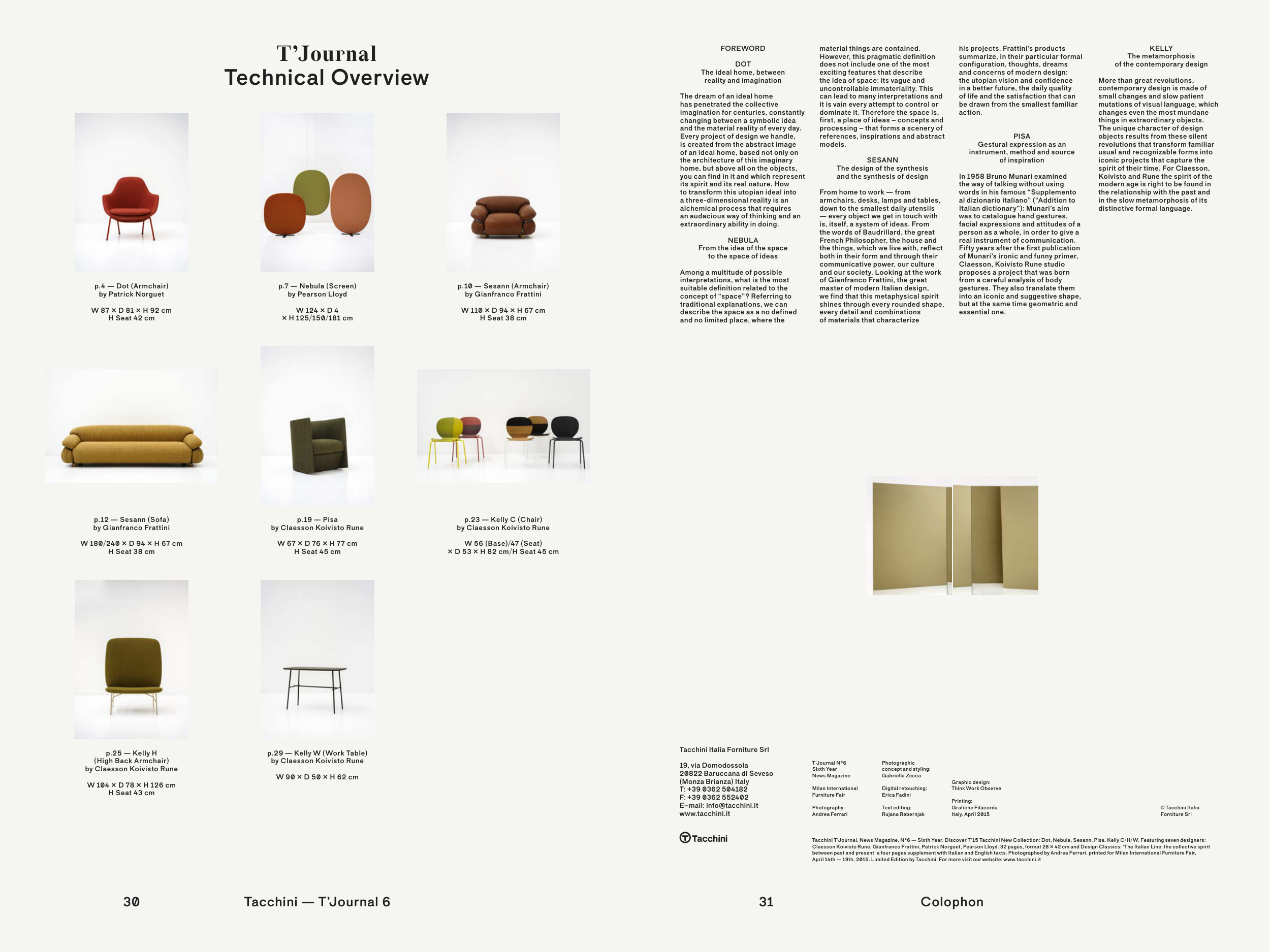
p.25 — Kelly H
(High Back Armchair)
by Claesson Koivisto Rune
W 104 × D 78 × H 126 cm
H Seat 43 cm
p.4 — Dot (Armchair)
by Patrick Norguet
W 87 × D 81 × H 92 cm
H Seat 42 cm
p.7 — Nebula (Screen)
by Pearson Lloyd
W 124 × D 4
× H 125⁄150⁄181 cm
p.10 — Sesann (Armchair)
by Gianfranco Frattini
W 110 × D 94 × H 67 cm
H Seat 38 cm
p.12 — Sesann (Sofa)
by Gianfranco Frattini
W 180⁄240 × D 94 × H 67 cm
H Seat 38 cm
p.19 — Pisa
by Claesson Koivisto Rune
W 67 × D 76 × H 77 cm
H Seat 45 cm
p.23 — Kelly C (Chair)
by Claesson Koivisto Rune
W 56 (Base)⁄47 (Seat)
× D 53 × H 82 cm⁄H Seat 45 cm
p.29 — Kelly W (Work Table)
by Claesson Koivisto Rune
W 90 × D 50 × H 62 cm