TH E M AS TE RS
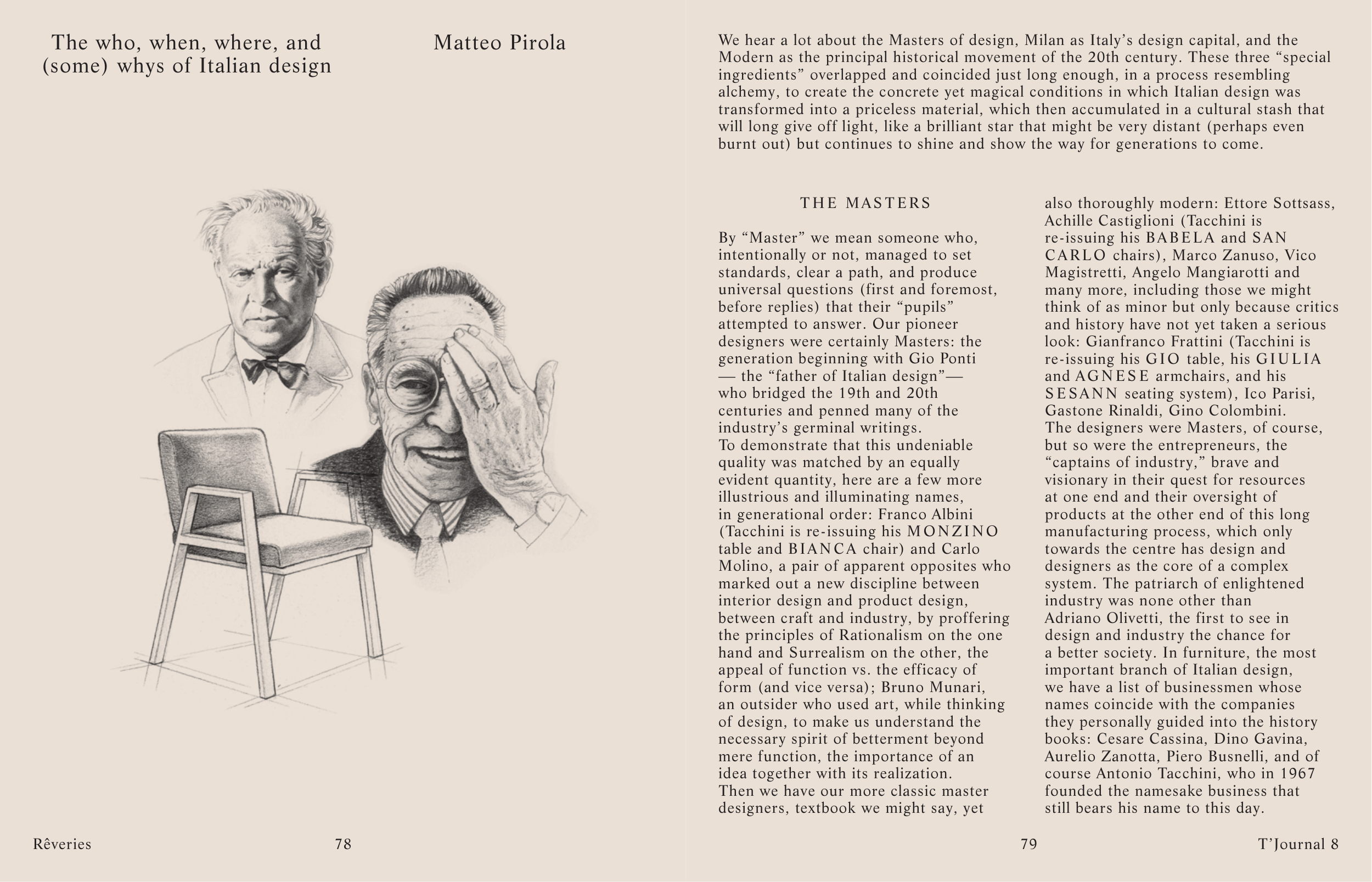
By “Master” we mean someone who,
intentionally or not, managed to set
standards, clear a path, and produce
universal questions (first and foremost,
before replies) that their “pupils”
attempted to answer. Our pioneer
designers were certainly Masters: the
generation beginning with Gio Ponti
— the “father of Italian design”—
who bridged the 19th and 20th
centuries and penned many of the
industry’s germinal writings.
To demonstrate that this undeniable
quality was matched by an equally
evident quantity, here are a few more
illustrious and illuminating names,
in generational order: Franco Albini
(Tacchini is re-issuing his M O NZI NO
table and B I A NC A chair) and Carlo
Molino, a pair of apparent opposites who
marked out a new discipline between
interior design and product design,
between craft and industry, by proffering
the principles of Rationalism on the one
hand and Surrealism on the other, the
appeal of function vs. the efficacy of
form (and vice versa); Bruno Munari,
an outsider who used art, while thinking
of design, to make us understand the
necessary spirit of betterment beyond
mere function, the importance of an
idea together with its realization.
Then we have our more classic master
designers, textbook we might say, yet
also thoroughly modern: Ettore Sottsass,
Achille Castiglioni (Tacchini is
re-issuing his B A B E LA and SAN
C A RL O chairs), Marco Zanuso, Vico
Magistretti, Angelo Mangiarotti and
many more, including those we might
think of as minor but only because critics
and history have not yet taken a serious
look: Gianfranco Frattini (Tacchini is
re-issuing his GI O table, his GIULIA
and AGNE S E armchairs, and his
S E SA NN seating system), Ico Parisi,
Gastone Rinaldi, Gino Colombini.
The designers were Masters, of course,
but so were the entrepreneurs, the
“captains of industry,” brave and
visionary in their quest for resources
at one end and their oversight of
products at the other end of this long
manufacturing process, which only
towards the centre has design and
designers as the core of a complex
system. The patriarch of enlightened
industry was none other than
Adriano Olivetti, the first to see in
design and industry the chance for
a better society. In furniture, the most
important branch of Italian design,
we have a list of businessmen whose
names coincide with the companies
they personally guided into the history
books: Cesare Cassina, Dino Gavina,
Aurelio Zanotta, Piero Busnelli, and of
course Antonio Tacchini, who in 1967
founded the namesake business that
still bears his name to this day.
79
T’Journal 8
We hear a lot about the Masters of design, Milan as Italy’s design capital, and the
Modern as the principal historical movement of the 20th century. These three “special
ingredients” overlapped and coincided just long enough, in a process resembling
alchemy, to create the concrete yet magical conditions in which Italian design was
transformed into a priceless material, which then accumulated in a cultural stash that
will long give off light, like a brilliant star that might be very distant (perhaps even
burnt out) but continues to shine and show the way for generations to come.
The who, when, where, and
(some) whys of Italian design
Matteo Pirola
Rêveries
78