the detailed technical drawings needed to construct his
bookshelf. Together, they formed a winning team.
String wins the contest
In the autumn 1949, Nisse and Kajsa’s String shelf won first
place in Bonniers’ bookcase competition. Made of blue wall
panels and pine shelves, their design beat 194 entries from
around Europe, the US and even as far away as Australia.
Commercial production began soon afterwards, with only
one small modification. The dimensions were adjusted to
ensure that the wall panels and shelves could be packaged
and sold in the same box.
An ingenious construction turns into success
The construction of the very first shelf was based on three
simple elements; the shelf, the wall panel and the metal fit-
ting. The dimensions of the shelves and wall panels were 78
cm wide, 75 cm high and 20 cm deep – exactly the same
as they are today. Meaning you can connect a String from
1949 with another from 2024. After a few short months,
String became known all over Sweden, and in less than a
year over 40,000 systems had been sold.
International success
In the years that followed, the String shelf began to appear
in interior design magazines, at trade fairs and other im-
portant exhibitions. Its popularity spread to the rest of
Europe, the United States and South America. String shelves
were used in the offices of the UN Headquarters in New
York, and in 1954, String was awarded a gold medal at the
Milan Trienniale. In the summer of 1955, an Art Industry
Exhibition known as the H55, was held in Sweden, with nine
nations participating: Denmark, Finland, France, Japan,
Norway, Sweden, Switzerland, United Kingdom, and West
Germany. The Strinnings took the opportunity to present
several additions to their range as part of the ‘Home and
Interior Design of the Future’ exhibition.
The legacy lives on
Today, String comprises of an entire system and can be
combined in an infinite number of configurations. New
colours, materials, and accessories have been added over
time. Some of them blueprint ideas from Nisse’s archives;
others created by contemporary Swedish designers.
Although the system is endlessly being reinvented as it passes
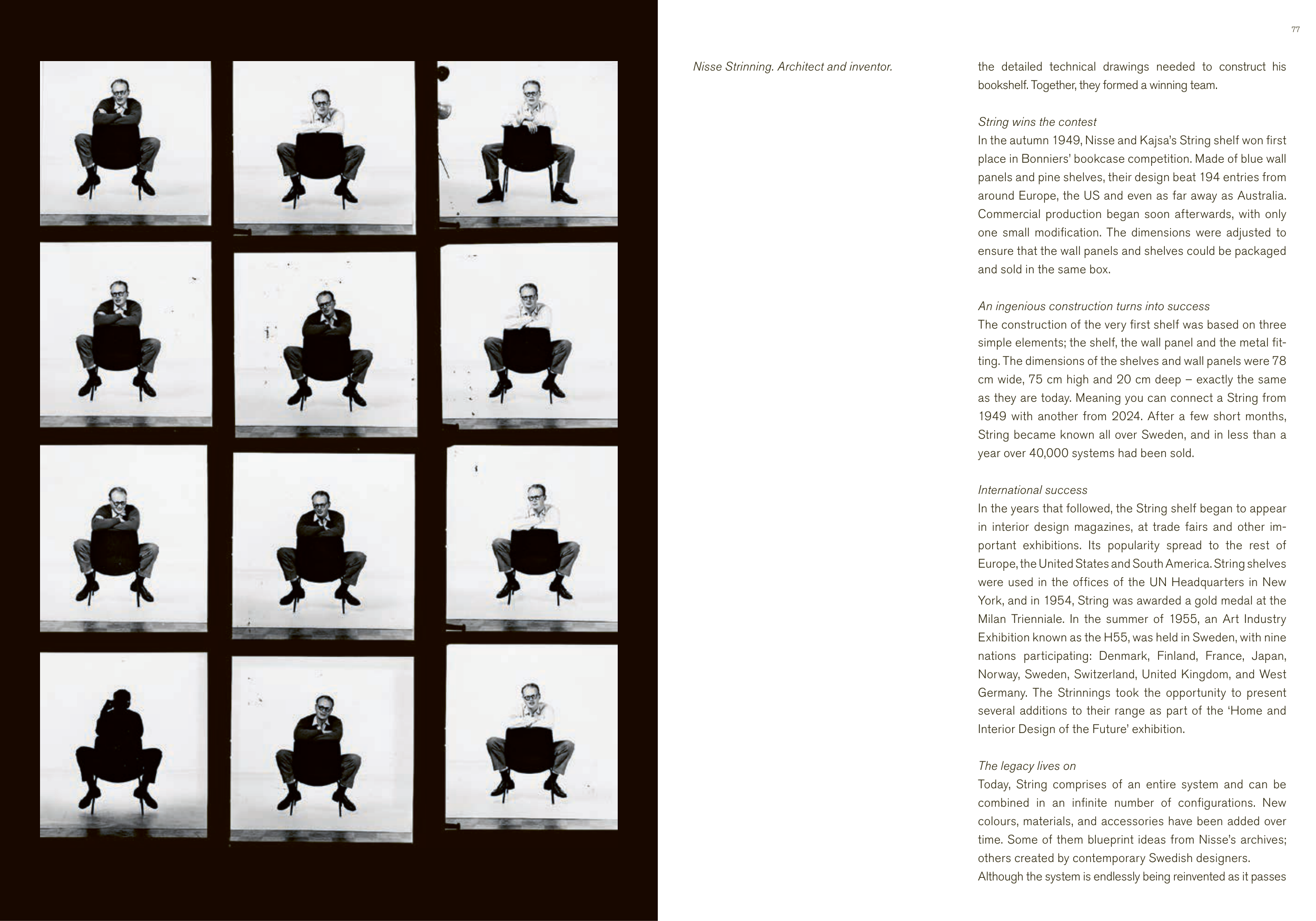
Nisse Strinning. Architect and inventor.
77