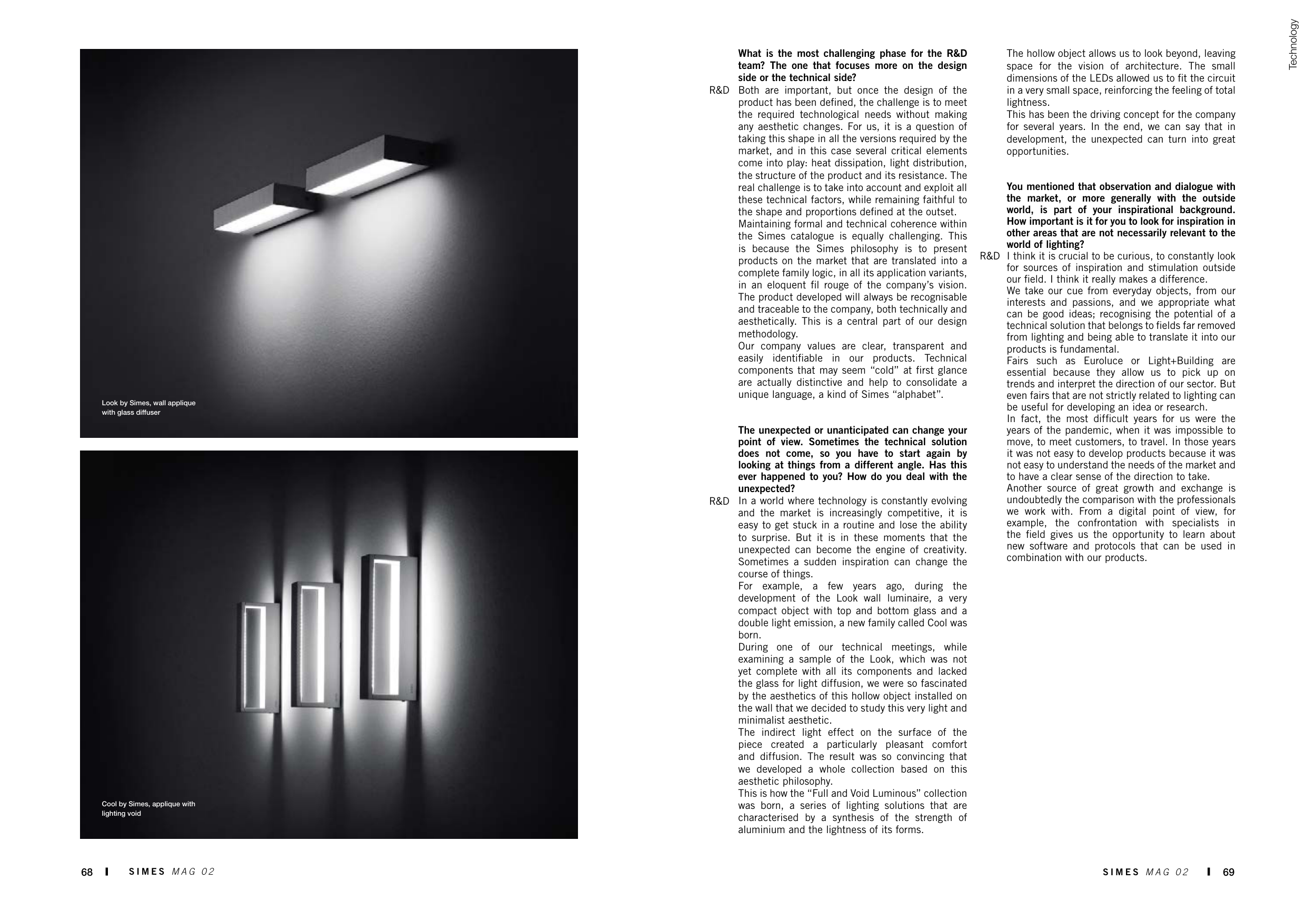
Look by Simes, wall applique
with glass diffuser
Cool by Simes, applique with
lighting void
What is the most challenging phase for the R&D
team? The one that focuses more on the design
side or the technical side?
Both are important, but once the design of the
product has been defined, the challenge is to meet
the required technological needs without making
any aesthetic changes. For us, it is a question of
taking this shape in all the versions required by the
market, and in this case several critical elements
come into play: heat dissipation, light distribution,
the structure of the product and its resistance. The
real challenge is to take into account and exploit all
these technical factors, while remaining faithful to
the shape and proportions defined at the outset.
Maintaining formal and technical coherence within
the Simes catalogue is equally challenging. This
is because the Simes philosophy is to present
products on the market that are translated into a
complete family logic, in all its application variants,
in an eloquent fil rouge of the company’s vision.
The product developed will always be recognisable
and traceable to the company, both technically and
aesthetically. This is a central part of our design
methodology.
Our company values are clear, transparent and
easily identifiable in our products. Technical
components that may seem “cold” at first glance
are actually distinctive and help to consolidate a
unique language, a kind of Simes “alphabet”.
The unexpected or unanticipated can change your
point of view. Sometimes the technical solution
does not come, so you have to start again by
looking at things from a different angle. Has this
ever happened to you? How do you deal with the
unexpected?
In a world where technology is constantly evolving
and the market is increasingly competitive, it is
easy to get stuck in a routine and lose the ability
to surprise. But it is in these moments that the
unexpected can become the engine of creativity.
Sometimes a sudden inspiration can change the
course of things.
For example, a few years ago, during the
development of the Look wall luminaire, a very
compact object with top and bottom glass and a
double light emission, a new family called Cool was
born.
During one of our technical meetings, while
examining a sample of the Look, which was not
yet complete with all its components and lacked
the glass for light diffusion, we were so fascinated
by the aesthetics of this hollow object installed on
the wall that we decided to study this very light and
minimalist aesthetic.
The indirect light effect on the surface of the
piece created a particularly pleasant comfort
and diffusion. The result was so convincing that
we developed a whole collection based on this
aesthetic philosophy.
This is how the “Full and Void Luminous” collection
was born, a series of lighting solutions that are
characterised by a synthesis of the strength of
aluminium and the lightness of its forms.
The hollow object allows us to look beyond, leaving
space for the vision of architecture. The small
dimensions of the LEDs allowed us to fit the circuit
in a very small space, reinforcing the feeling of total
lightness.
This has been the driving concept for the company
for several years. In the end, we can say that in
development, the unexpected can turn into great
opportunities.
You mentioned that observation and dialogue with
the market, or more generally with the outside
world, is part of your inspirational background.
How important is it for you to look for inspiration in
other areas that are not necessarily relevant to the
world of lighting?
I think it is crucial to be curious, to constantly look
for sources of inspiration and stimulation outside
our field. I think it really makes a difference.
We take our cue from everyday objects, from our
interests and passions, and we appropriate what
can be good ideas; recognising the potential of a
technical solution that belongs to fields far removed
from lighting and being able to translate it into our
products is fundamental.
Fairs such as Euroluce or Light+Building are
essential because they allow us to pick up on
trends and interpret the direction of our sector. But
even fairs that are not strictly related to lighting can
be useful for developing an idea or research.
In fact, the most difficult years for us were the
years of the pandemic, when it was impossible to
move, to meet customers, to travel. In those years
it was not easy to develop products because it was
not easy to understand the needs of the market and
to have a clear sense of the direction to take.
Another source of great growth and exchange is
undoubtedly the comparison with the professionals
we work with. From a digital point of view, for
example, the confrontation with specialists in
the field gives us the opportunity to learn about
new software and protocols that can be used in
combination with our products.
R&D
R&D
R&D
Technology
68
69
S I M E S M A G 0 2
S I M E S M A G 0 2