G.T.
G.T.
G.T.
which is what we are aiming for in all our buildings,
it is necessary to know all the potentials of the
site, energy potentials that are given not only by
the sun, which I have already mentioned, but also
by the geothermal potential of the ground, by the
winds and by the trees that provide shade: so the
context means, as it used to mean out of necessity,
being able to optimise the energy performance of a
building in relation to the potential of the site. So
yes, I believe that context has a double value: an
energetic one and a qualitative one, which is also
linked to the well-being of the occupants.
What are the design challenges of integrating
natural light with its artificial component, and how
well is today’s technology able to merge the two?
The challenges lie precisely in the word integration,
i.e. trying to make artificial light more and more like
natural light, so that it can gradually replace it in
terms of both intensity and quality, so that it can
be as warm as the sun or as cold as the sky, and
so that it can change. I think this is a very topical
issue. All the new solid-state technologies, more
commonly known as LEDs, combined with the
ever-increasing proliferation of control systems,
expressed through the programmability of light and
the use of sensors, allow light to become a positive
light for people again. Artificial light, as revolutionary
as it has been in prolonging human life in the dark,
has in turn conditioned its quality because it has
been static light, often glaring, with a constant
colour temperature. I think first of tungsten, then
fluorescent, then discharge, and so on. The LEDs,
on the other hand, by its very nature, is an electronic
component, so it is easily modifiable, and I think
it is precisely in this modifiability that it can play
its strength, and in many of our projects we have
experimented with precisely this possibility of using
the LEDs as a continuous integration as an emulation
of natural light. It can work for emulation in closed
office spaces and it can also work for integration in
strongly naturally lit daylight spaces.
On the subject of raising awareness of spaces
where light plays an increasingly important role
in people’s well-being, what role can brands play
on of this aspect, which is very often neglected by
designers?
What I hope is that lighting brands will be able to
embrace this change and the need for a change
of perspective, from light measured in Lumens to
light measured in quality. It is no longer so much
a question of being able to make the most efficient
lamp possible, as the best engineers would do
with monochromatic light in the greatest quantity,
but of being able to give priority to well-being, to
modulation, also because in reality we all work more
and more in front of a screen in situations where we
already have the light, it is already inside the device
we are working with.
From micro to macro, from residential to
commercial, the scalability of a process is essential.
How does the design methodology change, if at all,
depending on these aspects?
No, I don’t think it changes, and the beauty of our
work is that it’s multi-scale, where micro and macro
constantly mix at different levels and scales, but the
method is always the same. Designing a small space
or a large space always follows the same rules of
analysis and synthesis that are part of the design
process, so the attention and priorities are always
the same, so yes, only the scale changes.
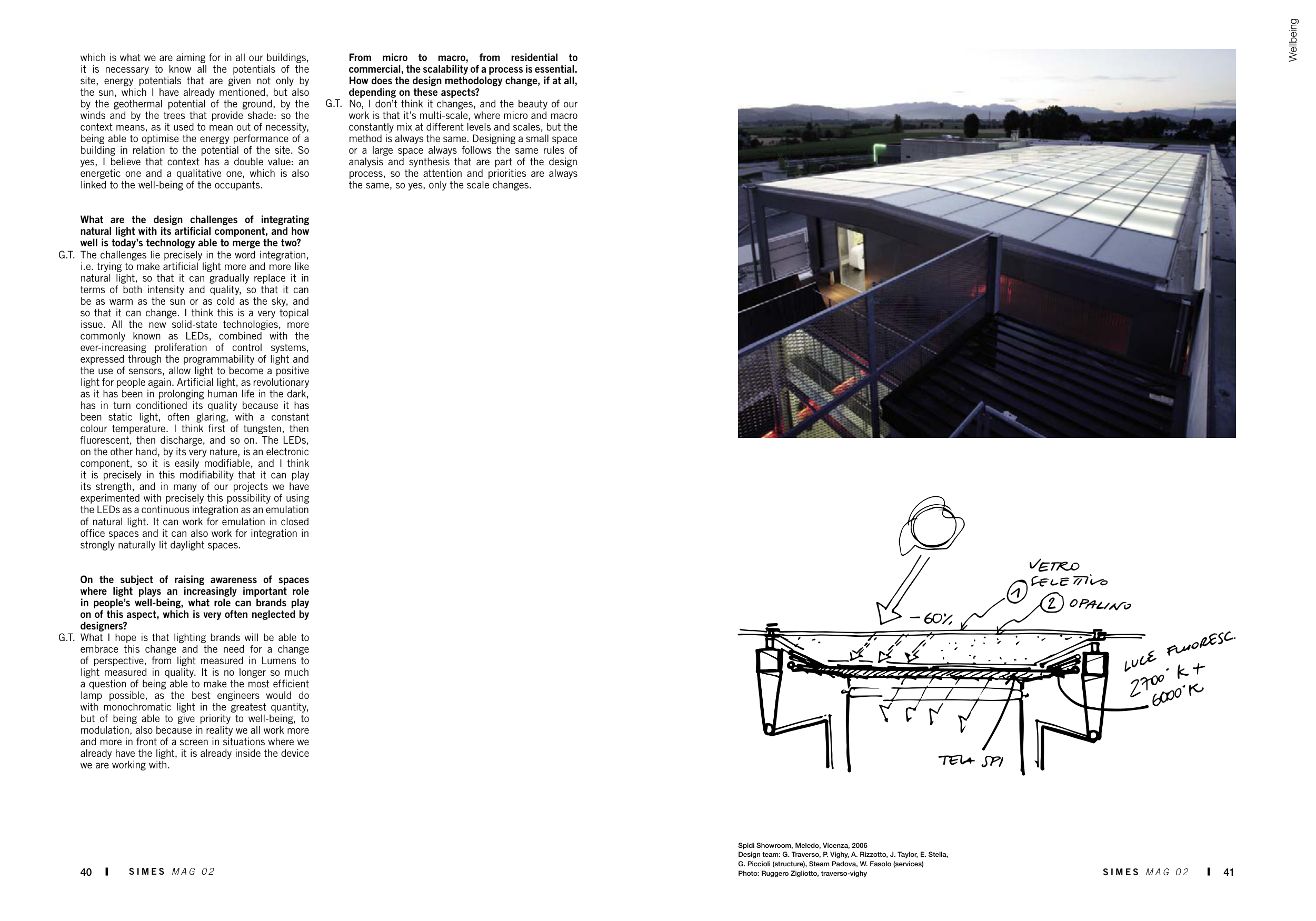
Spidi Showroom, Meledo, Vicenza, 2006
Design team: G. Traverso, P. Vighy, A. Rizzotto, J. Taylor, E. Stella,
G. Piccioli (structure), Steam Padova, W. Fasolo (services)
Photo: Ruggero Zigliotto, traverso-vighy
Wellbeing
40
41
S I M E S M A G 0 2
S I M E S M A G 0 2