K.A.
K.A.
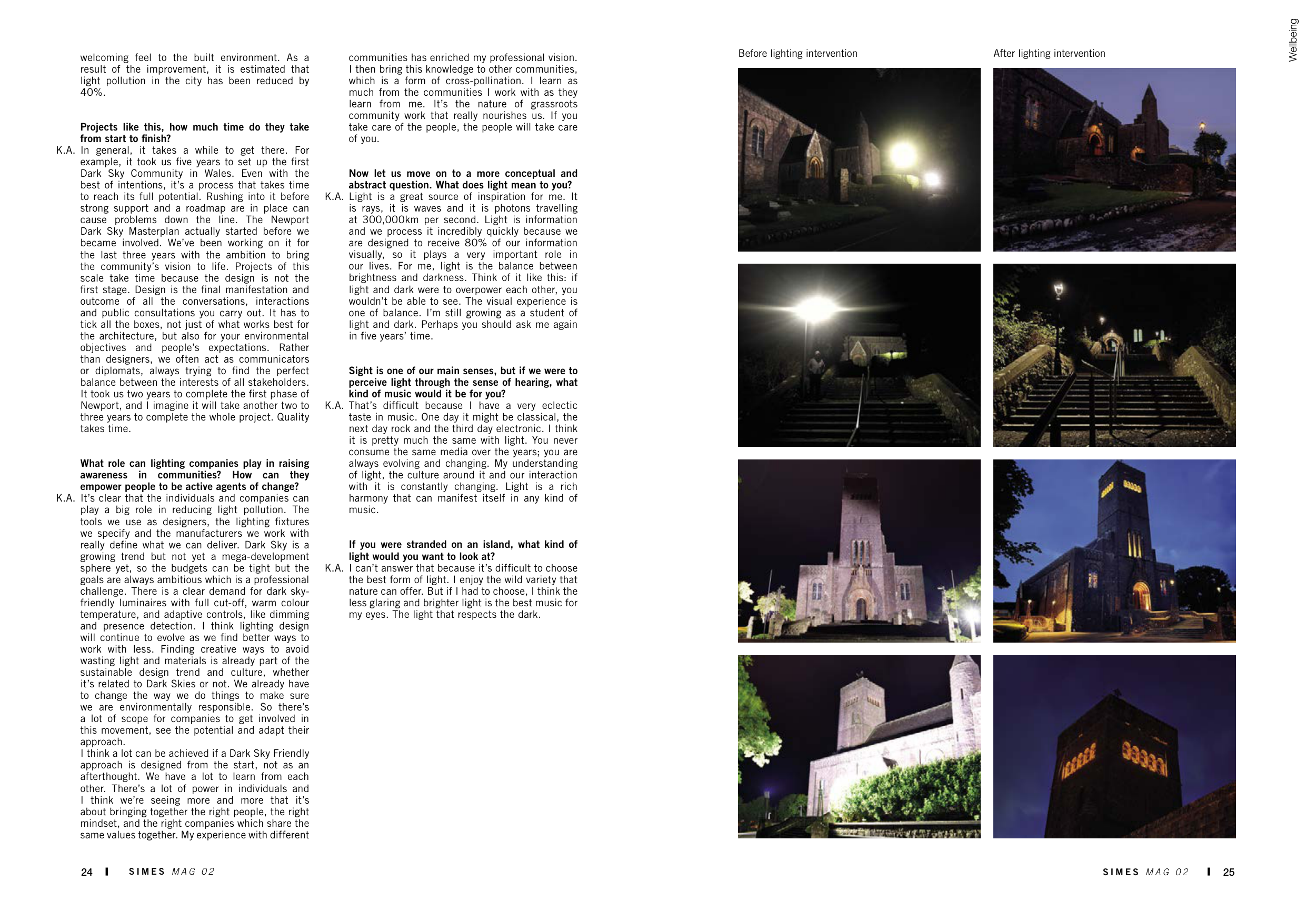
welcoming feel to the built environment. As a
result of the improvement, it is estimated that
light pollution in the city has been reduced by
40%.
Projects like this, how much time do they take
from start to finish?
In general, it takes a while to get there. For
example, it took us five years to set up the first
Dark Sky Community in Wales. Even with the
best of intentions, it’s a process that takes time
to reach its full potential. Rushing into it before
strong support and a roadmap are in place can
cause problems down the line. The Newport
Dark Sky Masterplan actually started before we
became involved. We’ve been working on it for
the last three years with the ambition to bring
the community’s vision to life. Projects of this
scale take time because the design is not the
first stage. Design is the final manifestation and
outcome of all the conversations, interactions
and public consultations you carry out. It has to
tick all the boxes, not just of what works best for
the architecture, but also for your environmental
objectives and people’s expectations. Rather
than designers, we often act as communicators
or diplomats, always trying to find the perfect
balance between the interests of all stakeholders.
It took us two years to complete the first phase of
Newport, and I imagine it will take another two to
three years to complete the whole project. Quality
takes time.
What role can lighting companies play in raising
awareness in communities? How can they
empower people to be active agents of change?
It’s clear that the individuals and companies can
play a big role in reducing light pollution. The
tools we use as designers, the lighting fixtures
we specify and the manufacturers we work with
really define what we can deliver. Dark Sky is a
growing trend but not yet a mega-development
sphere yet, so the budgets can be tight but the
goals are always ambitious which is a professional
challenge. There is a clear demand for dark sky-
friendly luminaires with full cut-off, warm colour
temperature, and adaptive controls, like dimming
and presence detection. I think lighting design
will continue to evolve as we find better ways to
work with less. Finding creative ways to avoid
wasting light and materials is already part of the
sustainable design trend and culture, whether
it’s related to Dark Skies or not. We already have
to change the way we do things to make sure
we are environmentally responsible. So there’s
a lot of scope for companies to get involved in
this movement, see the potential and adapt their
approach.
I think a lot can be achieved if a Dark Sky Friendly
approach is designed from the start, not as an
afterthought. We have a lot to learn from each
other. There’s a lot of power in individuals and
I think we’re seeing more and more that it’s
about bringing together the right people, the right
mindset, and the right companies which share the
same values together. My experience with different
K.A.
communities has enriched my professional vision.
I then bring this knowledge to other communities,
which is a form of cross-pollination. I learn as
much from the communities I work with as they
learn from me. It’s the nature of grassroots
community work that really nourishes us. If you
take care of the people, the people will take care
of you.
Now let us move on to a more conceptual and
abstract question. What does light mean to you?
Light is a great source of inspiration for me. It
is rays, it is waves and it is photons travelling
at 300,000km per second. Light is information
and we process it incredibly quickly because we
are designed to receive 80% of our information
visually, so it plays a very important role in
our lives. For me, light is the balance between
brightness and darkness. Think of it like this: if
light and dark were to overpower each other, you
wouldn’t be able to see. The visual experience is
one of balance. I’m still growing as a student of
light and dark. Perhaps you should ask me again
in five years’ time.
Sight is one of our main senses, but if we were to
perceive light through the sense of hearing, what
kind of music would it be for you?
That’s difficult because I have a very eclectic
taste in music. One day it might be classical, the
next day rock and the third day electronic. I think
it is pretty much the same with light. You never
consume the same media over the years; you are
always evolving and changing. My understanding
of light, the culture around it and our interaction
with it is constantly changing. Light is a rich
harmony that can manifest itself in any kind of
music.
If you were stranded on an island, what kind of
light would you want to look at?
I can’t answer that because it’s difficult to choose
the best form of light. I enjoy the wild variety that
nature can offer. But if I had to choose, I think the
less glaring and brighter light is the best music for
my eyes. The light that respects the dark.
K.A.
K.A.
Before lighting intervention
After lighting intervention
Wellbeing
24
25
S I M E S M A G 0 2
S I M E S M A G 0 2