CRI 80
CRI 70
CRI 90
6000K
3000K
4000K
2000K
6500K
5000K
4000K
3500K
3000K
2700K
2400K
4
Visual comfort
LEDs are light sources with extremely small
dimensions and high luminance. If not
properly managed, they cause an annoying
glare. Though the use of lenses, reflectors
and anti glare cowels, the lm/W ratio is
marginally sacrified but light is emitted
where it is needed and how it is needed,
greatly improving visual comfort and cutting
the unwanted portion of light.
Zip comes today with a renewed look
thanks to the introduction of the COMFORT
OPTIC: a sophisticated optical systems
able to considerably reduce glare thanks
to the retracted position of the LED.
The adjustable optic can direct the light
in the required direction modulating the
desired luminous effect. The maximum
inclination angle is:
+/- 15° in narrow and wide beam versions
+/- 5° in asymmetrical beam versions
Visual comfort and
adjustable optic
Color Rendering Index (CRI)
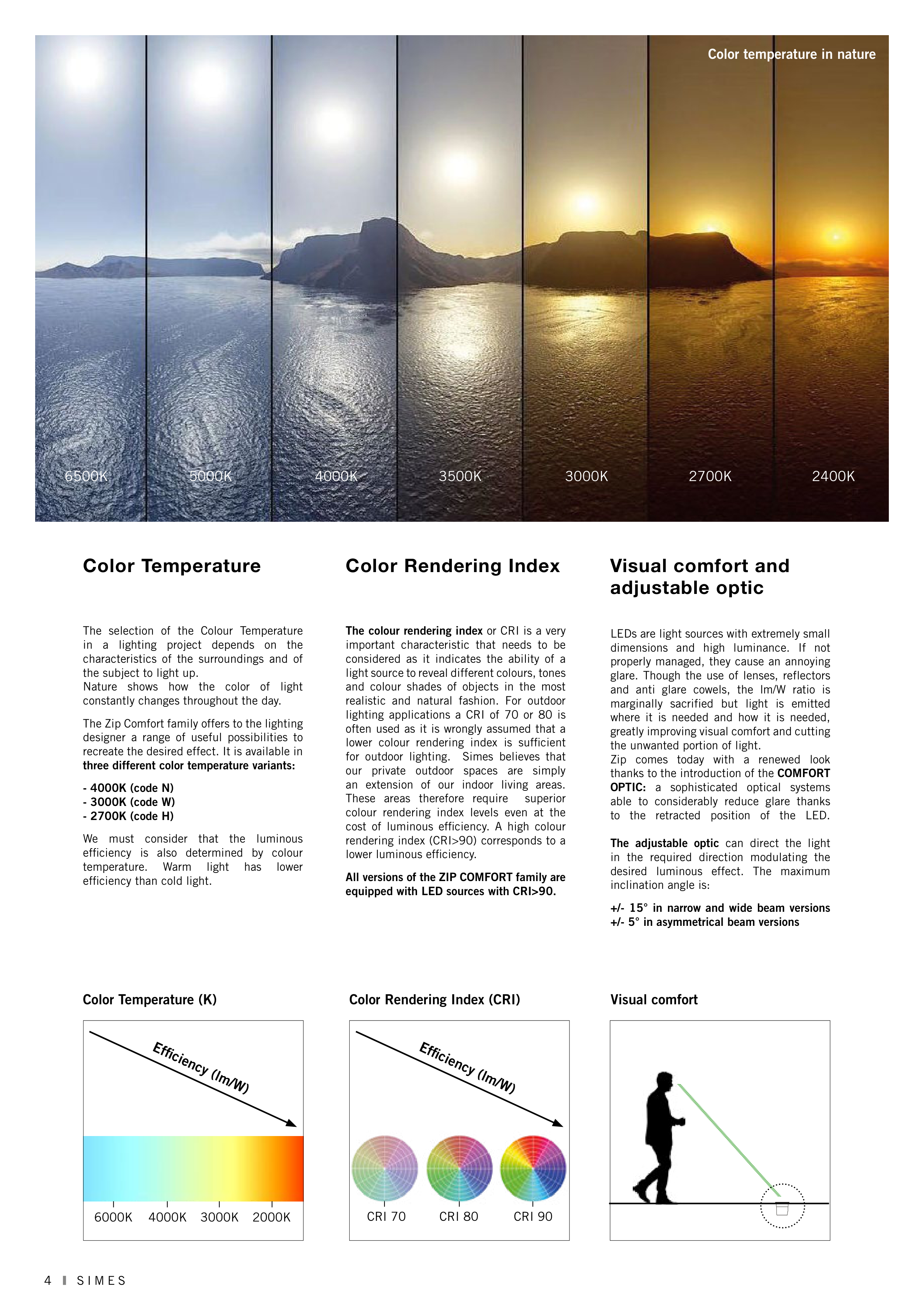
Color temperature in nature
The colour rendering index or CRI is a very
important characteristic that needs to be
considered as it indicates the ability of a
light source to reveal different colours, tones
and colour shades of objects in the most
realistic and natural fashion. For outdoor
lighting applications a CRI of 70 or 80 is
often used as it is wrongly assumed that a
lower colour rendering index is sufficient
for outdoor lighting. Simes believes that
our private outdoor spaces are simply
an extension of our indoor living areas.
These areas therefore require superior
colour rendering index levels even at the
cost of luminous efficiency. A high colour
rendering index (CRI>90) corresponds to a
lower luminous efficiency.
All versions of the ZIP COMFORT family are
equipped with LED sources with CRI>90.
Color Rendering Index
Color Temperature
The selection of the Colour Temperature
in a lighting project depends on the
characteristics of the surroundings and of
the subject to light up.
Nature shows how the color of light
constantly changes throughout the day.
The Zip Comfort family offers to the lighting
designer a range of useful possibilities to
recreate the desired effect. It is available in
three different color temperature variants:
- 4000K (code N)
- 3000K (code W)
- 2700K (code H)
We must consider that the luminous
efficiency is also determined by colour
temperature.
Warm
light
has
lower
efficiency than cold light.
Color Temperature (K)
Efficiency (lm/W)
Efficiency (lm/W)