Editorial
In his 1971 text “Designing for the Real World”, the designer Viktor Papanek calls for
inclusiveness, social justice and sustainability, issues that have become indispensable to
planning in the fields of design, architecture and urbanism.
Design is not only a mean to shape something, but a tool for transformation, for investigation
that must take into account and respect social, ethical and ecological points of view. The role
of the designer is therefore also a social one, a mediator capable of guiding choices towards
sensitive and responsible design, in order to influence his interlocutors or possible decision-
makers to initiate changes towards virtuous paths.
Designing for and with light does not shy away from this responsibility, and today, more than
ever, the approach of eco-centric and eco-systemic design has become central to meeting the
challenges that await us in rebalancing a planet sorely tested by the impact of human activity.
In a short space of time, humans have come to inhabit a tiny part of the earth, the cities. We
now know that they have a major role to play in shaping the future of our planet, as they are
responsible for 75% of CO2 emissions and are now home to more than 54% of the world’s
population. An urban dimension that has lost contact with the countryside, which over time
has accumulated excesses and bad habits, and which continues to disrupt, if not destroy, the
balance that nature has always maintained in all its expressions.
A multidisciplinary approach, collaboration and synergy between companies, designers,
researchers and universities at an international level are therefore becoming central. Sharing
and participatory design now make it possible to imagine and realise visions that were
previously considered impossible. What Bruno Munari simply defined as “everything that was
not there before”, we could define as “dreams”. Actions that are no longer singular but plural,
capable of looking at development models in order to innovate according to the canons of
global sustainability.
Light is a vital trigger, well-being, an indispensable element of our lives, as well as a
fundamental component for the entire ecosystem of the planet. We are reminded of this in
these pages by Kerem Asfuroglu, lighting designer, who tells us how designing light for dark
skies is now a priority for large and small communities, in order to restore the balance between
our increasingly densely populated urban areas and the environment.
Circadian rhythms have always shaped the evolution of life on our planet. Thinking of
architecture as a symbiotic element in the relationship between man and nature is the key to
making our “living space” sustainable. The architect Giovanni Traverso, co-founder of Traverso-
Vighy, shows us how it is possible to design reversible architecture, based on natural light in
dialogue with artificial light, to create well-being and balance in living spaces.
In today’s scenario, where it is necessary to define design methods capable of guiding us
towards long-term strategies, the field of research and development becomes a fundamental
pillar for a company like SIMES, which has always made the “dream of light” its guiding
principle. The words of the R&D team illustrate how hardware and software technology are
revolutionising the way we design light, and how multidisciplinarity is an essential value for
new challenges and the fulfilment of a dream.
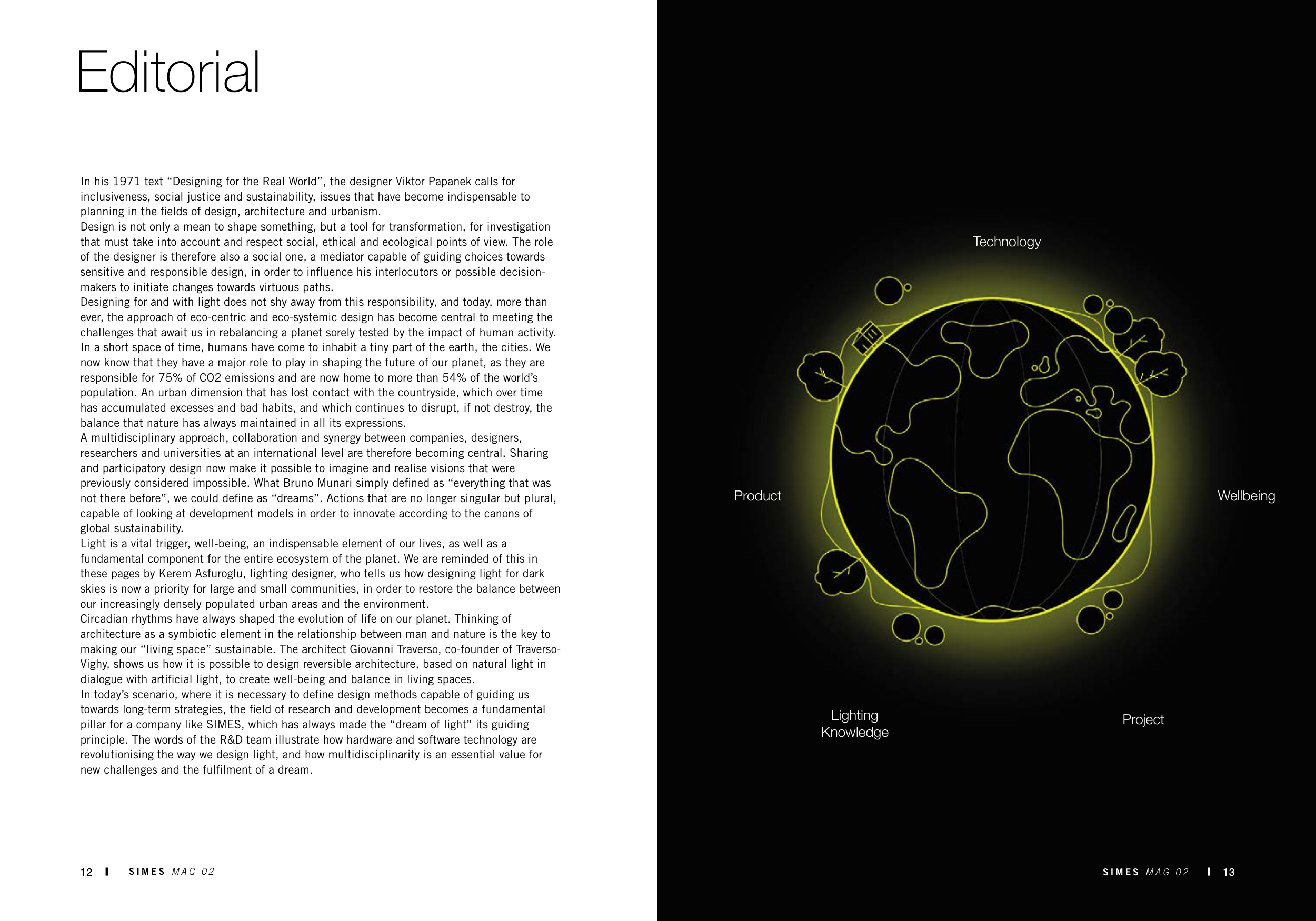
Technology
Product
Lighting
Knowledge
Project
Wellbeing
13
S I M E S M A G 0 2
12
S I M E S M A G 0 2