How do you manage the research and development
of new technologies in your company? How long
does this work take?
Our company is dedicated to providing integrated
and specialised solutions in the field of electronic
components for lighting products.
Our approach is based on a method that involves,
first of all, analysing the manufacturing company
and its products. To do this, we have to talk to
the customer, travel and conduct audits at the
company’s premises, and get to know and validate
the production processes involved. Our work
aims at constant product improvement through
continuous testing and evaluation of results.
We identify the solutions that perform best, the
repeatability of failure and other functional and
strategic parameters. This process takes up a large
part of our time and we are investing more and
more in this area because we have realised that
this is the right way to stay ahead of the times and
sometimes even manage to anticipate trends. We
like to define ourselves as value-added partners,
i.e. developers of innovative solutions for lighting
companies.
How did the collaboration with Simes begin and
how do you work together on a product digitisation
project?
Our collaboration with Simes, which started several
years ago, has been very stimulating because
it has opened us up to the unexpected and to
seemingly impossible challenges. It is one of the
most innovative companies in the lighting sector
and has helped us to overcome the technological
limits of the market. Simes had the brilliant
intuition to bring into the outdoors, products that
until then had only been conceived for indoor use.
This idea was a game changer: we collaborated
with Simes to develop a lighting system that
simultaneously worked as an energy propagator.
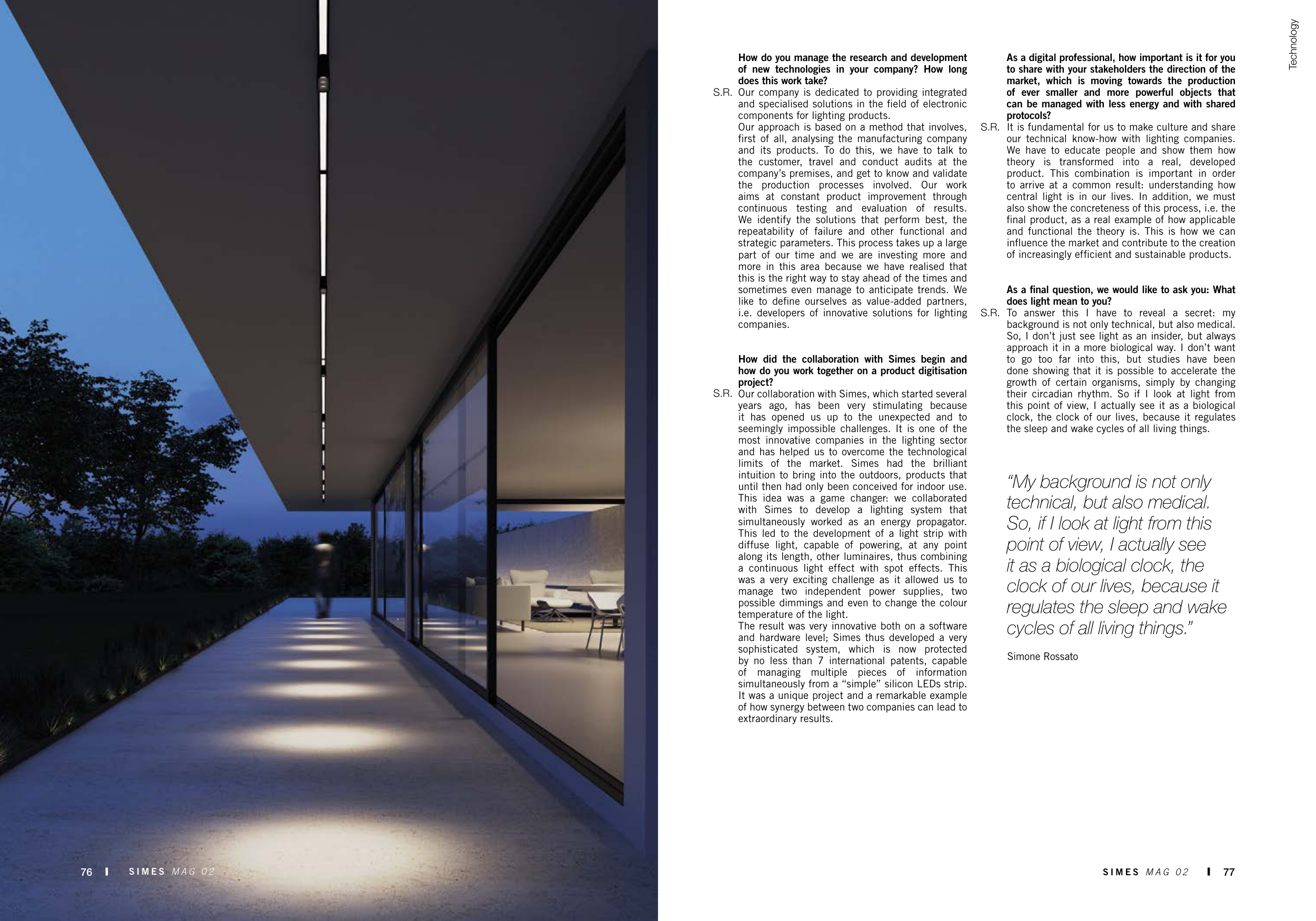
This led to the development of a light strip with
diffuse light, capable of powering, at any point
along its length, other luminaires, thus combining
a continuous light effect with spot effects. This
was a very exciting challenge as it allowed us to
manage two independent power supplies, two
possible dimmings and even to change the colour
temperature of the light.
The result was very innovative both on a software
and hardware level; Simes thus developed a very
sophisticated system, which is now protected
by no less than 7 international patents, capable
of managing multiple pieces of information
simultaneously from a “simple” silicon LEDs strip.
It was a unique project and a remarkable example
of how synergy between two companies can lead to
extraordinary results.
As a digital professional, how important is it for you
to share with your stakeholders the direction of the
market, which is moving towards the production
of ever smaller and more powerful objects that
can be managed with less energy and with shared
protocols?
It is fundamental for us to make culture and share
our technical know-how with lighting companies.
We have to educate people and show them how
theory is transformed into a real, developed
product. This combination is important in order
to arrive at a common result: understanding how
central light is in our lives. In addition, we must
also show the concreteness of this process, i.e. the
final product, as a real example of how applicable
and functional the theory is. This is how we can
influence the market and contribute to the creation
of increasingly efficient and sustainable products.
As a final question, we would like to ask you: What
does light mean to you?
To answer this I have to reveal a secret: my
background is not only technical, but also medical.
So, I don’t just see light as an insider, but always
approach it in a more biological way. I don’t want
to go too far into this, but studies have been
done showing that it is possible to accelerate the
growth of certain organisms, simply by changing
their circadian rhythm. So if I look at light from
this point of view, I actually see it as a biological
clock, the clock of our lives, because it regulates
the sleep and wake cycles of all living things.
“My background is not only
technical, but also medical.
So, if I look at light from this
point of view, I actually see
it as a biological clock, the
clock of our lives, because it
regulates the sleep and wake
cycles of all living things.”
Simone Rossato
S.R.
S.R.
S.R.
S.R.
Technology
77
S I M E S M A G 0 2
76
S I M E S M A G 0 2