T1
T2
VIRTUAL MIDNIGHT
Sunrise
Sunset
100% of the flux
Dimming % Reduction of flux
Back to 100%
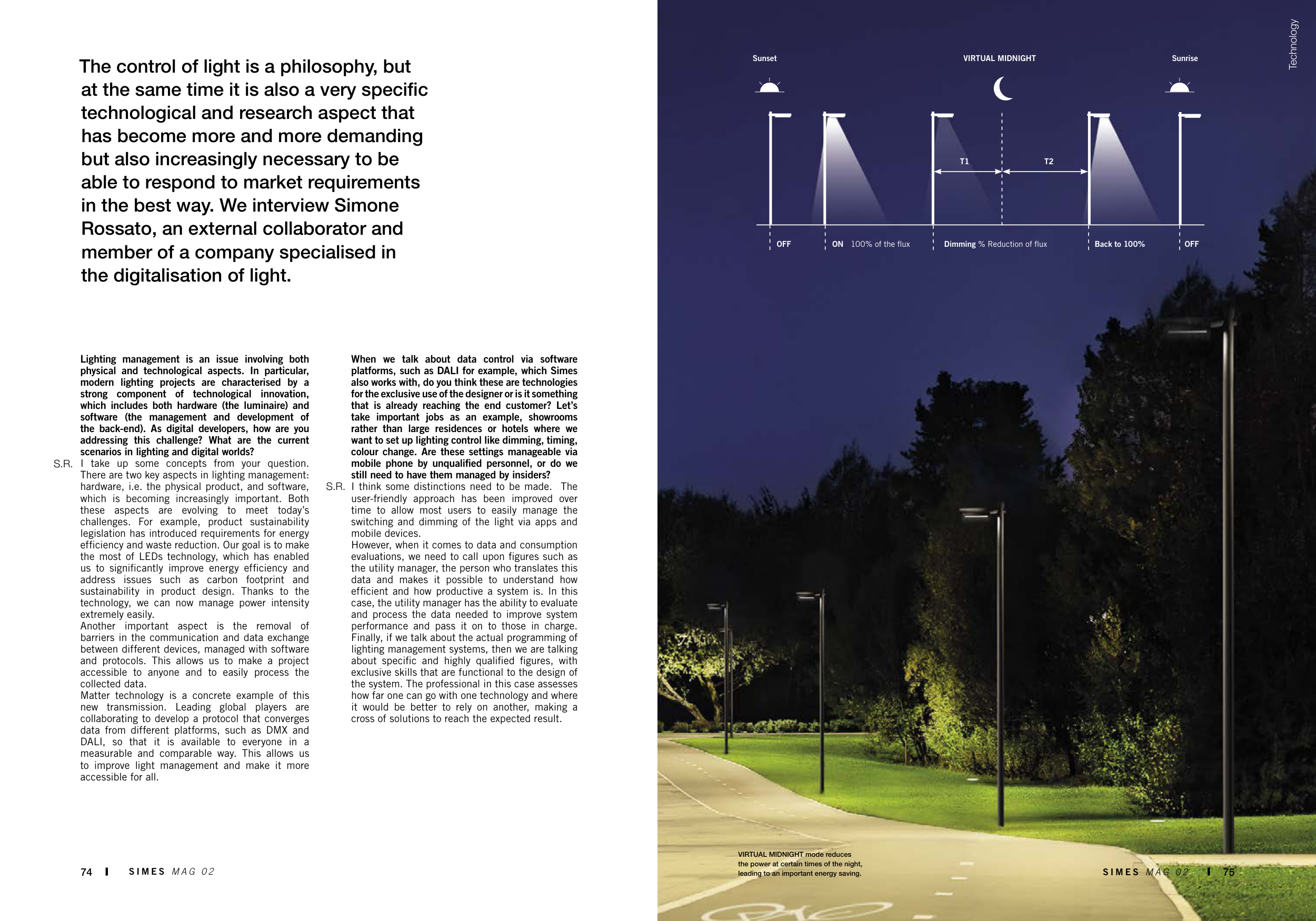
VIRTUAL MIDNIGHT mode reduces
the power at certain times of the night,
leading to an important energy saving.
Lighting management is an issue involving both
physical and technological aspects. In particular,
modern lighting projects are characterised by a
strong component of technological innovation,
which includes both hardware (the luminaire) and
software (the management and development of
the back-end). As digital developers, how are you
addressing this challenge? What are the current
scenarios in lighting and digital worlds?
I take up some concepts from your question.
There are two key aspects in lighting management:
hardware, i.e. the physical product, and software,
which is becoming increasingly important. Both
these aspects are evolving to meet today’s
challenges. For example, product sustainability
legislation has introduced requirements for energy
efficiency and waste reduction. Our goal is to make
the most of LEDs technology, which has enabled
us to significantly improve energy efficiency and
address issues such as carbon footprint and
sustainability in product design. Thanks to the
technology, we can now manage power intensity
extremely easily.
Another important aspect is the removal of
barriers in the communication and data exchange
between different devices, managed with software
and protocols. This allows us to make a project
accessible to anyone and to easily process the
collected data.
Matter technology is a concrete example of this
new transmission. Leading global players are
collaborating to develop a protocol that converges
data from different platforms, such as DMX and
DALI, so that it is available to everyone in a
measurable and comparable way. This allows us
to improve light management and make it more
accessible for all.
The control of light is a philosophy, but
at the same time it is also a very specific
technological and research aspect that
has become more and more demanding
but also increasingly necessary to be
able to respond to market requirements
in the best way. We interview Simone
Rossato, an external collaborator and
member of a company specialised in
the digitalisation of light.
When we talk about data control via software
platforms, such as DALI for example, which Simes
also works with, do you think these are technologies
for the exclusive use of the designer or is it something
that is already reaching the end customer? Let’s
take important jobs as an example, showrooms
rather than large residences or hotels where we
want to set up lighting control like dimming, timing,
colour change. Are these settings manageable via
mobile phone by unqualified personnel, or do we
still need to have them managed by insiders?
I think some distinctions need to be made. The
user-friendly approach has been improved over
time to allow most users to easily manage the
switching and dimming of the light via apps and
mobile devices.
However, when it comes to data and consumption
evaluations, we need to call upon figures such as
the utility manager, the person who translates this
data and makes it possible to understand how
efficient and how productive a system is. In this
case, the utility manager has the ability to evaluate
and process the data needed to improve system
performance and pass it on to those in charge.
Finally, if we talk about the actual programming of
lighting management systems, then we are talking
about specific and highly qualified figures, with
exclusive skills that are functional to the design of
the system. The professional in this case assesses
how far one can go with one technology and where
it would be better to rely on another, making a
cross of solutions to reach the expected result.
S.R.
S.R.
Technology
OFF
OFF
ON
74
75
S I M E S M A G 0 2
S I M E S M A G 0 2