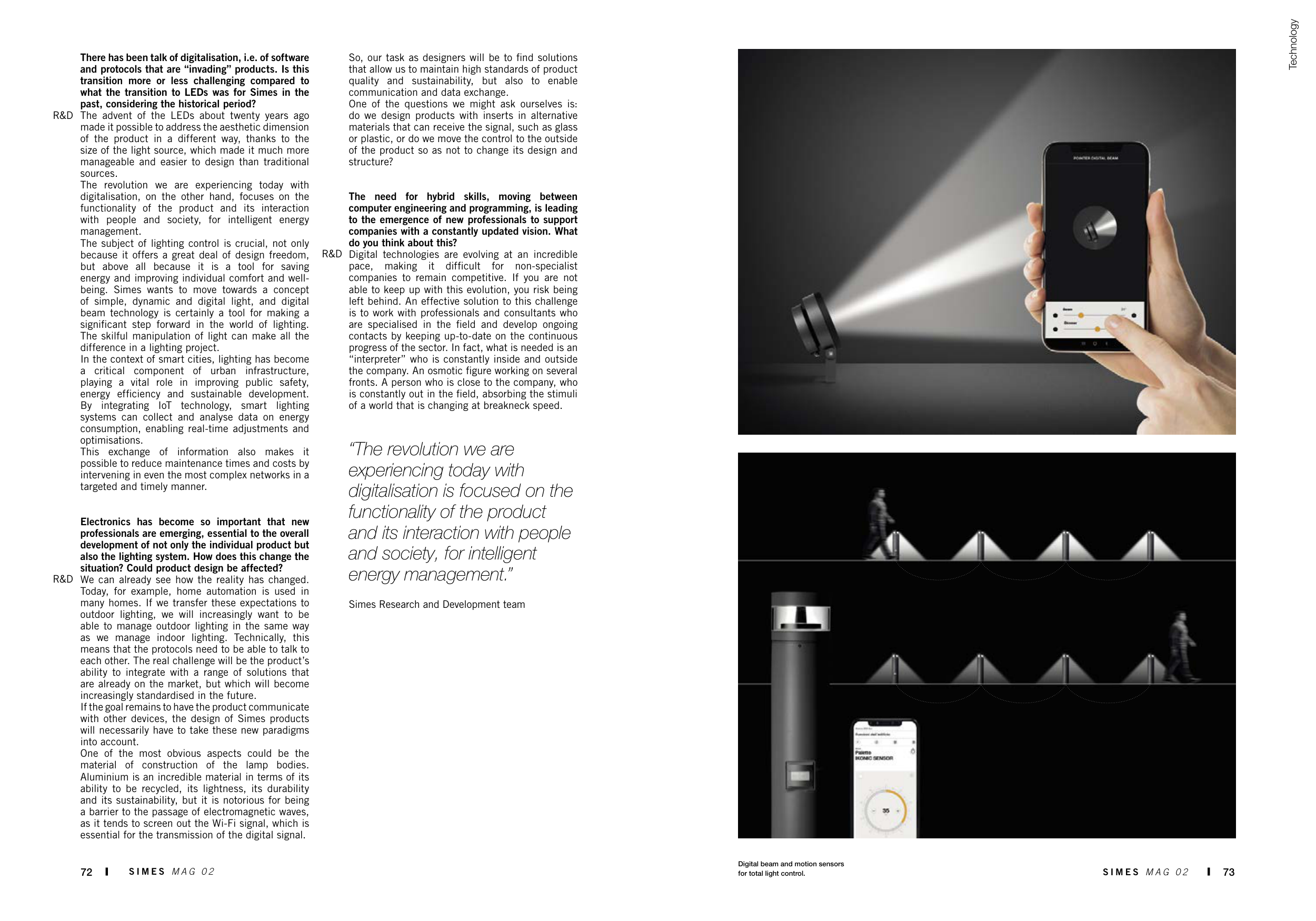
Digital beam and motion sensors
for total light control.
“The revolution we are
experiencing today with
digitalisation is focused on the
functionality of the product
and its interaction with people
and society, for intelligent
energy management.”
Simes Research and Development team
R&D
R&D
R&D
There has been talk of digitalisation, i.e. of software
and protocols that are “invading” products. Is this
transition more or less challenging compared to
what the transition to LEDs was for Simes in the
past, considering the historical period?
The advent of the LEDs about twenty years ago
made it possible to address the aesthetic dimension
of the product in a different way, thanks to the
size of the light source, which made it much more
manageable and easier to design than traditional
sources.
The revolution we are experiencing today with
digitalisation, on the other hand, focuses on the
functionality of the product and its interaction
with people and society, for intelligent energy
management.
The subject of lighting control is crucial, not only
because it offers a great deal of design freedom,
but above all because it is a tool for saving
energy and improving individual comfort and well-
being. Simes wants to move towards a concept
of simple, dynamic and digital light, and digital
beam technology is certainly a tool for making a
significant step forward in the world of lighting.
The skilful manipulation of light can make all the
difference in a lighting project.
In the context of smart cities, lighting has become
a critical component of urban infrastructure,
playing a vital role in improving public safety,
energy efficiency and sustainable development.
By integrating IoT technology, smart lighting
systems can collect and analyse data on energy
consumption, enabling real-time adjustments and
optimisations.
This exchange of information also makes it
possible to reduce maintenance times and costs by
intervening in even the most complex networks in a
targeted and timely manner.
Electronics has become so important that new
professionals are emerging, essential to the overall
development of not only the individual product but
also the lighting system. How does this change the
situation? Could product design be affected?
We can already see how the reality has changed.
Today, for example, home automation is used in
many homes. If we transfer these expectations to
outdoor lighting, we will increasingly want to be
able to manage outdoor lighting in the same way
as we manage indoor lighting. Technically, this
means that the protocols need to be able to talk to
each other. The real challenge will be the product’s
ability to integrate with a range of solutions that
are already on the market, but which will become
increasingly standardised in the future.
If the goal remains to have the product communicate
with other devices, the design of Simes products
will necessarily have to take these new paradigms
into account.
One of the most obvious aspects could be the
material of construction of the lamp bodies.
Aluminium is an incredible material in terms of its
ability to be recycled, its lightness, its durability
and its sustainability, but it is notorious for being
a barrier to the passage of electromagnetic waves,
as it tends to screen out the Wi-Fi signal, which is
essential for the transmission of the digital signal.
So, our task as designers will be to find solutions
that allow us to maintain high standards of product
quality and sustainability, but also to enable
communication and data exchange.
One of the questions we might ask ourselves is:
do we design products with inserts in alternative
materials that can receive the signal, such as glass
or plastic, or do we move the control to the outside
of the product so as not to change its design and
structure?
The need for hybrid skills, moving between
computer engineering and programming, is leading
to the emergence of new professionals to support
companies with a constantly updated vision. What
do you think about this?
Digital technologies are evolving at an incredible
pace, making it difficult for non-specialist
companies to remain competitive. If you are not
able to keep up with this evolution, you risk being
left behind. An effective solution to this challenge
is to work with professionals and consultants who
are specialised in the field and develop ongoing
contacts by keeping up-to-date on the continuous
progress of the sector. In fact, what is needed is an
“interpreter” who is constantly inside and outside
the company. An osmotic figure working on several
fronts. A person who is close to the company, who
is constantly out in the field, absorbing the stimuli
of a world that is changing at breakneck speed.
Technology
72
73
S I M E S M A G 0 2
S I M E S M A G 0 2