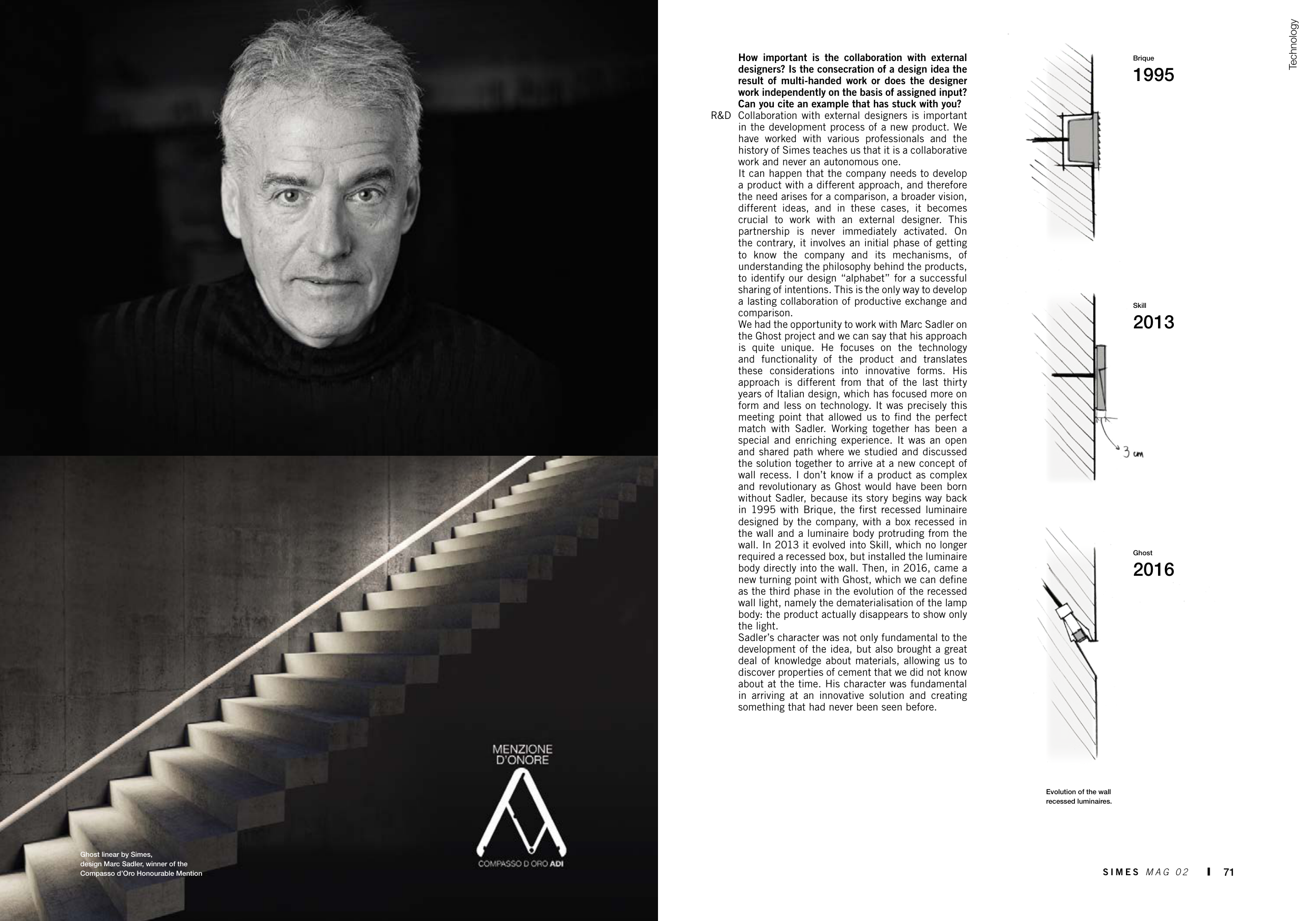
Brique
1995
Skill
2013
Ghost
2016
Ghost linear by Simes,
design Marc Sadler, winner of the
Compasso d’Oro Honourable Mention
Evolution of the wall
recessed luminaires.
How important is the collaboration with external
designers? Is the consecration of a design idea the
result of multi-handed work or does the designer
work independently on the basis of assigned input?
Can you cite an example that has stuck with you?
Collaboration with external designers is important
in the development process of a new product. We
have worked with various professionals and the
history of Simes teaches us that it is a collaborative
work and never an autonomous one.
It can happen that the company needs to develop
a product with a different approach, and therefore
the need arises for a comparison, a broader vision,
different ideas, and in these cases, it becomes
crucial to work with an external designer. This
partnership is never immediately activated. On
the contrary, it involves an initial phase of getting
to know the company and its mechanisms, of
understanding the philosophy behind the products,
to identify our design “alphabet” for a successful
sharing of intentions. This is the only way to develop
a lasting collaboration of productive exchange and
comparison.
We had the opportunity to work with Marc Sadler on
the Ghost project and we can say that his approach
is quite unique. He focuses on the technology
and functionality of the product and translates
these considerations into innovative forms. His
approach is different from that of the last thirty
years of Italian design, which has focused more on
form and less on technology. It was precisely this
meeting point that allowed us to find the perfect
match with Sadler. Working together has been a
special and enriching experience. It was an open
and shared path where we studied and discussed
the solution together to arrive at a new concept of
wall recess. I don’t know if a product as complex
and revolutionary as Ghost would have been born
without Sadler, because its story begins way back
in 1995 with Brique, the first recessed luminaire
designed by the company, with a box recessed in
the wall and a luminaire body protruding from the
wall. In 2013 it evolved into Skill, which no longer
required a recessed box, but installed the luminaire
body directly into the wall. Then, in 2016, came a
new turning point with Ghost, which we can define
as the third phase in the evolution of the recessed
wall light, namely the dematerialisation of the lamp
body: the product actually disappears to show only
the light.
Sadler’s character was not only fundamental to the
development of the idea, but also brought a great
deal of knowledge about materials, allowing us to
discover properties of cement that we did not know
about at the time. His character was fundamental
in arriving at an innovative solution and creating
something that had never been seen before.
R&D
Technology
71
S I M E S M A G 0 2