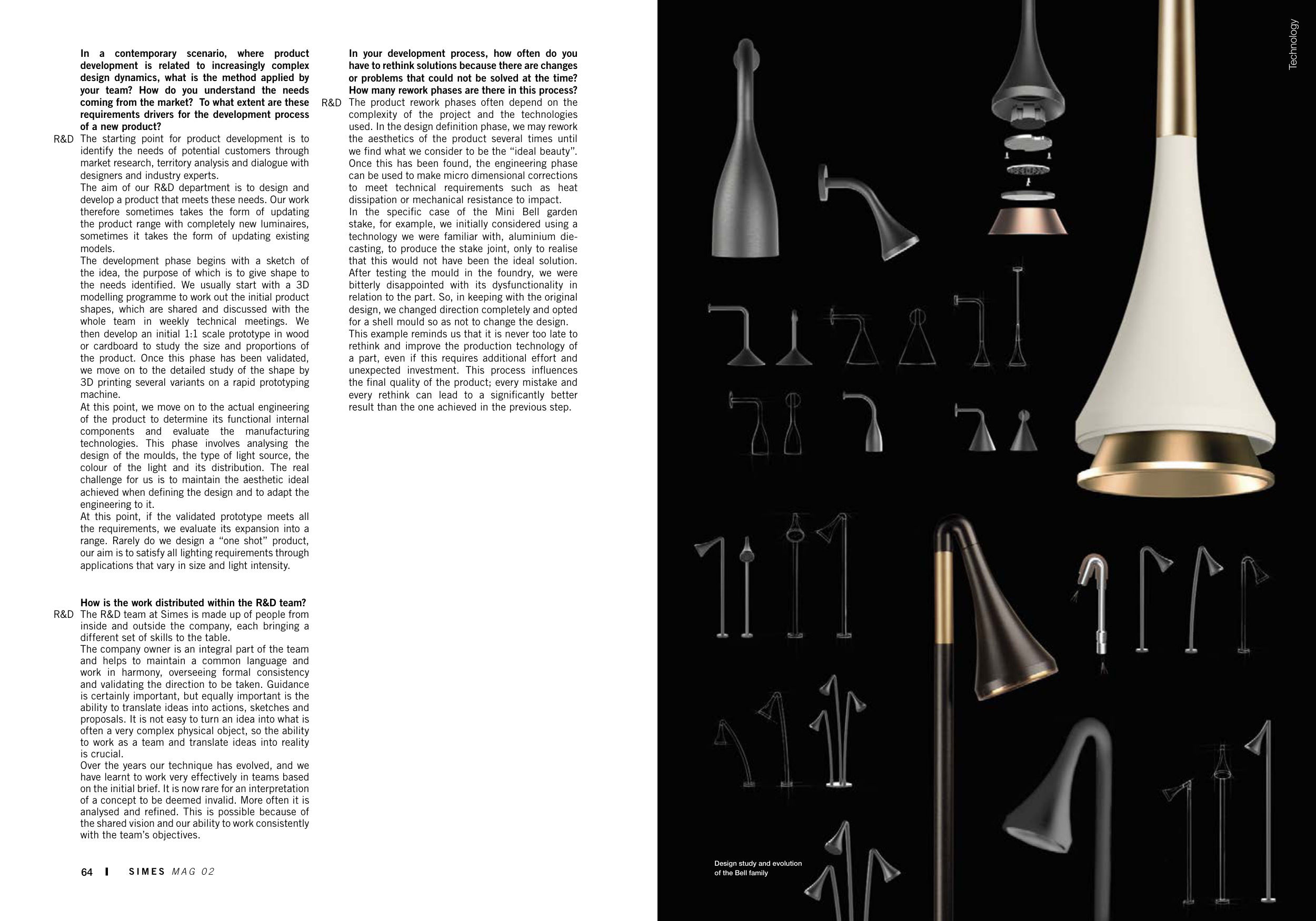
Design study and evolution
of the Bell family
In a contemporary scenario, where product
development is related to increasingly complex
design dynamics, what is the method applied by
your team? How do you understand the needs
coming from the market? To what extent are these
requirements drivers for the development process
of a new product?
The starting point for product development is to
identify the needs of potential customers through
market research, territory analysis and dialogue with
designers and industry experts.
The aim of our R&D department is to design and
develop a product that meets these needs. Our work
therefore sometimes takes the form of updating
the product range with completely new luminaires,
sometimes it takes the form of updating existing
models.
The development phase begins with a sketch of
the idea, the purpose of which is to give shape to
the needs identified. We usually start with a 3D
modelling programme to work out the initial product
shapes, which are shared and discussed with the
whole team in weekly technical meetings. We
then develop an initial 1:1 scale prototype in wood
or cardboard to study the size and proportions of
the product. Once this phase has been validated,
we move on to the detailed study of the shape by
3D printing several variants on a rapid prototyping
machine.
At this point, we move on to the actual engineering
of the product to determine its functional internal
components and evaluate the manufacturing
technologies. This phase involves analysing the
design of the moulds, the type of light source, the
colour of the light and its distribution. The real
challenge for us is to maintain the aesthetic ideal
achieved when defining the design and to adapt the
engineering to it.
At this point, if the validated prototype meets all
the requirements, we evaluate its expansion into a
range. Rarely do we design a “one shot” product,
our aim is to satisfy all lighting requirements through
applications that vary in size and light intensity.
How is the work distributed within the R&D team?
The R&D team at Simes is made up of people from
inside and outside the company, each bringing a
different set of skills to the table.
The company owner is an integral part of the team
and helps to maintain a common language and
work in harmony, overseeing formal consistency
and validating the direction to be taken. Guidance
is certainly important, but equally important is the
ability to translate ideas into actions, sketches and
proposals. It is not easy to turn an idea into what is
often a very complex physical object, so the ability
to work as a team and translate ideas into reality
is crucial.
Over the years our technique has evolved, and we
have learnt to work very effectively in teams based
on the initial brief. It is now rare for an interpretation
of a concept to be deemed invalid. More often it is
analysed and refined. This is possible because of
the shared vision and our ability to work consistently
with the team’s objectives.
In your development process, how often do you
have to rethink solutions because there are changes
or problems that could not be solved at the time?
How many rework phases are there in this process?
The product rework phases often depend on the
complexity of the project and the technologies
used. In the design definition phase, we may rework
the aesthetics of the product several times until
we find what we consider to be the “ideal beauty”.
Once this has been found, the engineering phase
can be used to make micro dimensional corrections
to meet technical requirements such as heat
dissipation or mechanical resistance to impact.
In the specific case of the Mini Bell garden
stake, for example, we initially considered using a
technology we were familiar with, aluminium die-
casting, to produce the stake joint, only to realise
that this would not have been the ideal solution.
After testing the mould in the foundry, we were
bitterly disappointed with its dysfunctionality in
relation to the part. So, in keeping with the original
design, we changed direction completely and opted
for a shell mould so as not to change the design.
This example reminds us that it is never too late to
rethink and improve the production technology of
a part, even if this requires additional effort and
unexpected investment. This process influences
the final quality of the product; every mistake and
every rethink can lead to a significantly better
result than the one achieved in the previous step.
R&D
R&D
R&D
Technology
64
S I M E S M A G 0 2