Designing light for a demanding client who pays
attention to the smallest details. A stimulus or a
brake?
The aim of all the members and sponsors of
the Swiss Bike Park was to have lighting that
matched the quality of the product on display and
the architectural project. With this in mind, we
conceived the lighting project as an integral part
of a broad and shared process aimed at ensuring
visual well-being. An accessible and safe place
where careful lighting design has helped to make the
spaces inside and outside the building even more
attractive and comfortable. We gained the client’s
trust with an initial proposal based on the pre-
existing historic building. We designed it with some
up and down light effects positioned on the façade
and combined with linear elements. The idea was so
convincing that it gave us carte blanche for the next
steps. We kept to the line of targeted and punctual
light. The decisions were discussed and validated
with the architect from time to time and it was very
stimulating work.
The Swiss Bike Park is a complex project in terms
of its spatial configuration, consisting of different
buildings, historical origins and uses: transit and
logistical hubs alternating with relaxation and rest
areas. How did the lighting design evolve?
First of all, we have to contextualise the project.
The Swiss Bikepark is located in a large valley, in a
natural and agricultural context, far from industrial
areas or urban centres, so it is very dark at night.
For the lighting project, we wanted to respect the
environment by using luminaires that would not
disturb the darkness.
Simes products were ideal for this project because
they direct the light exactly where it is needed
and the intensity can be adjusted at any time. The
technical flexibility provided by the DALI protocol
was essential, as it allowed us to control each
individual group of products by setting the required
light level and minimising spillage. The assumption
that we would be able to control and adjust the light
according to our needs was the driving force behind
the development of the entire project. In the outdoor
exhibition area dedicated to bicycles, we favoured
scenic and point lighting rather than street lighting
The Swiss Bike Park is the result of a broad
and collaborative project in which light has
played a very important role, both in the
natural context in which the park is located
and in the functions it has to perform.
In the story of the lighting project we find
out in detail about the challenges and
choices made.
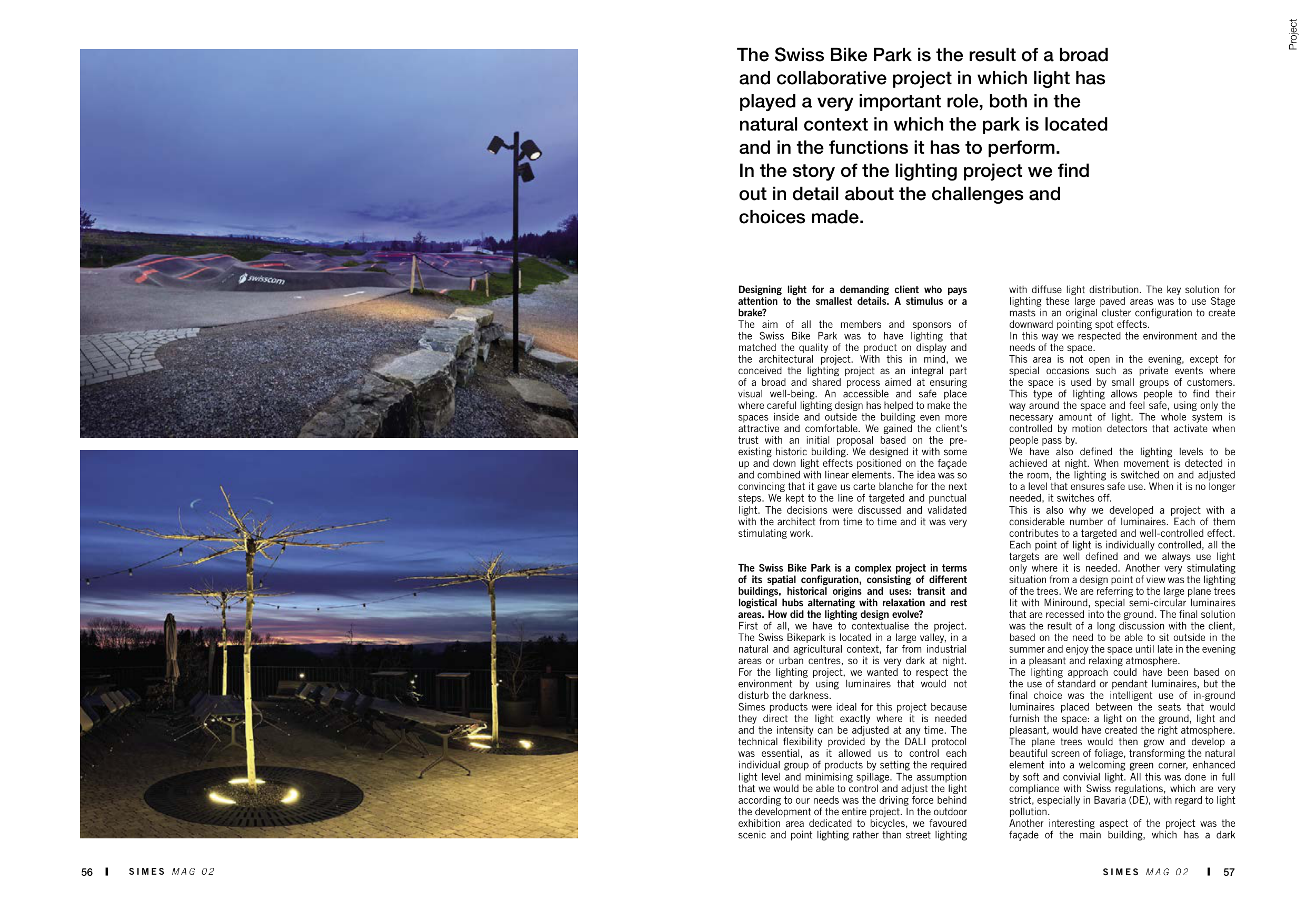
with diffuse light distribution. The key solution for
lighting these large paved areas was to use Stage
masts in an original cluster configuration to create
downward pointing spot effects.
In this way we respected the environment and the
needs of the space.
This area is not open in the evening, except for
special occasions such as private events where
the space is used by small groups of customers.
This type of lighting allows people to find their
way around the space and feel safe, using only the
necessary amount of light. The whole system is
controlled by motion detectors that activate when
people pass by.
We have also defined the lighting levels to be
achieved at night. When movement is detected in
the room, the lighting is switched on and adjusted
to a level that ensures safe use. When it is no longer
needed, it switches off.
This is also why we developed a project with a
considerable number of luminaires. Each of them
contributes to a targeted and well-controlled effect.
Each point of light is individually controlled, all the
targets are well defined and we always use light
only where it is needed. Another very stimulating
situation from a design point of view was the lighting
of the trees. We are referring to the large plane trees
lit with Miniround, special semi-circular luminaires
that are recessed into the ground. The final solution
was the result of a long discussion with the client,
based on the need to be able to sit outside in the
summer and enjoy the space until late in the evening
in a pleasant and relaxing atmosphere.
The lighting approach could have been based on
the use of standard or pendant luminaires, but the
final choice was the intelligent use of in-ground
luminaires placed between the seats that would
furnish the space: a light on the ground, light and
pleasant, would have created the right atmosphere.
The plane trees would then grow and develop a
beautiful screen of foliage, transforming the natural
element into a welcoming green corner, enhanced
by soft and convivial light. All this was done in full
compliance with Swiss regulations, which are very
strict, especially in Bavaria (DE), with regard to light
pollution.
Another interesting aspect of the project was the
façade of the main building, which has a dark
Project
56
57
S I M E S M A G 0 2
S I M E S M A G 0 2