We are often used to thinking of architecture
as something sculptural, linked to our historical
heritage, a form that is almost immutable in time.
In your projects (Studio Traverso-Vighy), on the
other hand, an approach emerges that you define as
“reversibility” applied to architecture, almost as if it
were a living organism.
Could you describe how this circular vision of yours
has developed?
I believe this vision has matured over time, starting
from our formative years and then perfected in our
more recent works, which are also the most radical
in this sense. I think it all started with the generation
to which I belong. Born in ‘69 and graduated in ‘94,
I grew up in a world that had mainly developed in the
twenty to thirty years following an explosive building
boom. Indeed, about 80% of italian construction
can be attributed to the period after the Second
World War.
Perhaps it derives from an “allergy” to this
cementification
and,
conversely,
a
sensitive
appreciation for the landscape of my territory. I
come from a small city, Vicenza, where there are
open spaces, mountains, hills, intact environments
that have often been contaminated by this trend.
Probably unconsciously, even in our studies, we have
always sought an antidote to this cementification.
Both Paola Vighy and I (ed. Traverso-Vighy studio)
graduated in architecture at the Iuav University
of Venice and later studied in London at Bartlett
University where we learned an architecture thought
more for “craft pieces” and components typical of
the entire strand of English architecture of those
years and where we followed a master’s course in
Light & Lighting. Returning to Italy, we opened our
studio in a very fertile situation characterized by a
very flexible economy made up of small enterprises
where it was possible to produce any piece with high
technology at relatively low costs. We experimented
with the first non-traditional buildings. To construct
our first architectures, bricks, mortar, or plasterboard
were not needed, but a dry assembly of predefined
components.
Then, over the years, the use of computers has
become increasingly predominant in the studio,
and this architecture has become digital, making it
possible to control the single piece, build it three-
dimensionally, and arrive, as it has been precisely
in the latest projects of the studio, to produce
everything with a perfectly digital method. We
applied this process to traditional materials because
traditional architecture, which by definition is made
of local materials available within a small radius
from the construction site, relies on materials like
larch wood from the mountains, steel from local
carpentries, glass, and stone from the territory.
All materials workable with CNC numerical control
or laser cutting. We are talking, therefore, about
automatic processes on traditional materials, of
which we have tried to resume the use and the
knowledge of processing and finishing. For example,
wood that dries when it rains to avoid treatments
or varnishes also for the love of what John Ruskin
called “patina”, i.e., that thing that attacks the
materials and makes them able to merge with the
environment.
Thus, the first buildings were of this type, and then
little by little, we developed our path, our current in
G.T.
a perspective of recycling materials from buildings
at the end of life. I think about glass, aluminium, or
steel, or materials that can also be directly reused,
such as wooden beams and planks. So yes, perhaps
our buildings are somewhat of an organism.
I believe this is a way of proceeding in continuity
with the environment. It is a way that joins a word
very much in vogue today, which is circularity. I
hope that this method of work can be as ethical as
possible and become an example to share with the
people we collaborate with.
Also, our working system is crucial: we design
everything in the design phase. No choice is made on
the construction site because everything is already
predetermined in the project phase, in which all our
internal and external collaborators at the studio,
including engineers, structuralists, mechanics,
electricians, geologists, or surveyors, participate.
Very often, in this phase, we consult craftsmen who
make prototypes, we fine-tune them, and then in the
executive design, the finished product appears. This
very detailed design also allows cost control, i.e.,
offers as a whole “bypassing” as much as possible
the traditional accounting of a construction site and
the arising of economies. This has led to progressive
growth for clients and the studio with increasingly
ambitious commissions.
“There’s no place like another”, to borrow from
Dorothy’s famous line in “The Wizard of Oz”, to
what extent does context influence design choices
to create buildings designed for human wellbeing?
The context totally influences the design choices.
Naturally, the ideal situation would be to have a
house on top of a hill, surrounded by nature 360°,
like in the Renaissance. In our time, however, we
have to somehow carve out the context, because in
architectural terms, context means views and points
to look at. Context is also exposure and orientation
to the sun, because passive buildings, like the ones
we design, have to make the best use of the sun
throughout the seasons, to warm in winter and stay
cool in summer. For this reason they need a sensible
exposure to the sun. The design of the building
envelope in relation to the context is important
because it determines the relationship between
the occupant and the external environment. We
strongly believe in the concept of circadianity, i.e.
the fact that people live and work in an “external”
environment even though they are inside a case.
It is well known that in modern civilisation one of the
stress problems for many people is precisely the fact
that we are more and more in enclosed spaces, in
means of transport, in the presence of artificial light,
losing contact with the seasons, with meteorology,
with the variations and modulations of light, which
are instead extremely positive in regulating our
biorhythms for our well-being. This is therefore an
aspect common to all our buildings, where we always
try to have or recreate a contact with the outside,
which can be horizontal towards the garden, towards
a valley, but also, as in some projects such as the
“Spidi Sport Showroom”, open upwards towards the
sky, just by capturing the modulations of light.
The context can also have another level of reasoning,
which in our case started from the project of our
studio in 2011. For a building to be zero energy,
G.T.
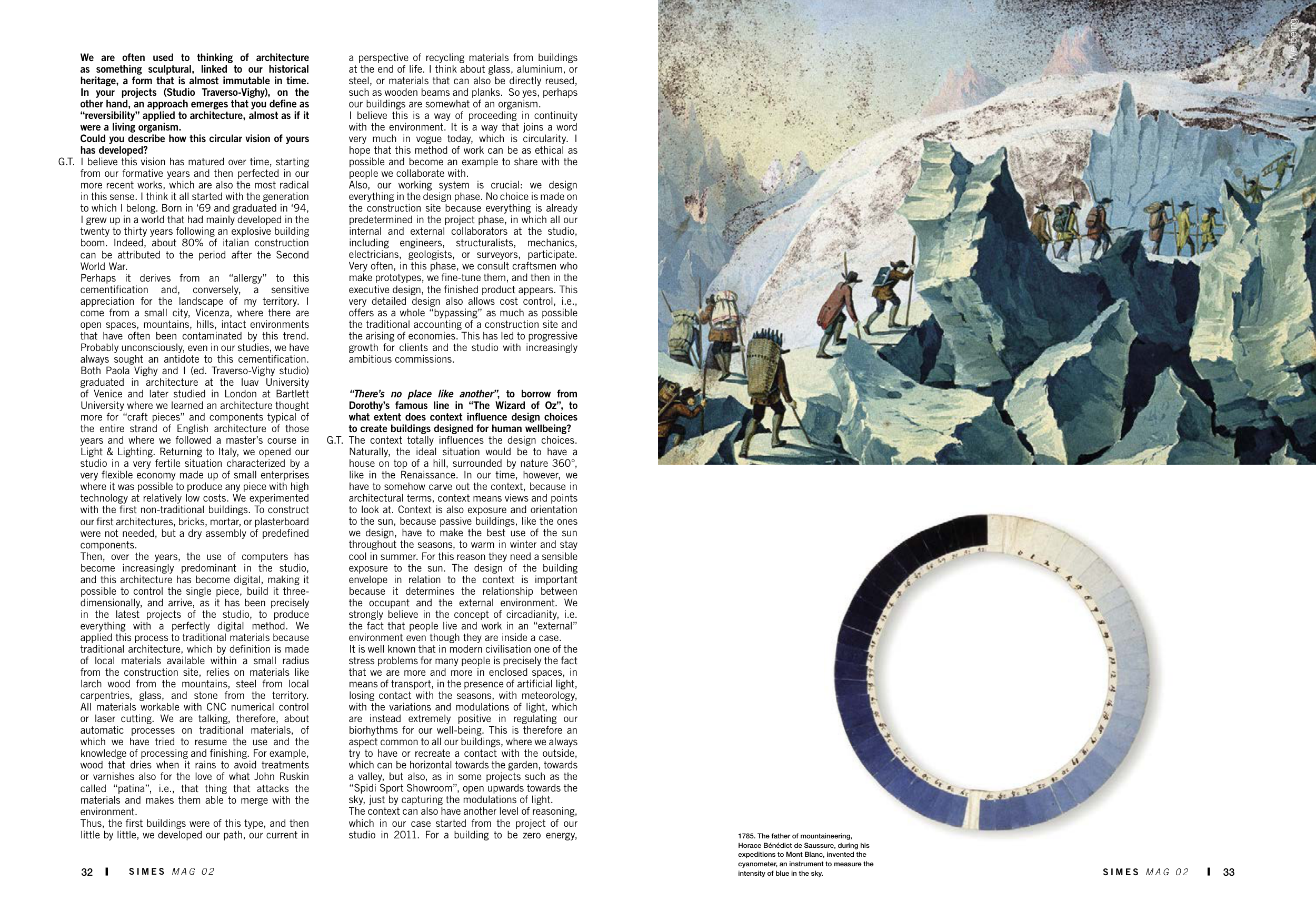
1785. The father of mountaineering,
Horace Bénédict de Saussure, during his
expeditions to Mont Blanc, invented the
cyanometer, an instrument to measure the
intensity of blue in the sky.
Wellbeing
32
33
S I M E S M A G 0 2
S I M E S M A G 0 2