1909
1910
1911
1911
1911
1911
1911
12
13
COSTUMI E COREOGRAFIE
COSTUMES AND CHOREOGRAPHIES
INTRODUZIONE
Dopo ormai più di un secolo, i leggendari spettacoli dei Ballet russes
rappresentano ancora un punto di riferimento importante in tutto il mondo.
Fu proprio Léon Bakst che, nel suo ruolo di direttore artistico fino all’abbandono
della compagnia nel 1914, contribuì al loro enorme successo, lasciando ai
posteri la possibilità di ammirare alcuni dei bozzetti da lui realizzati.
Le intense armonie cromatiche, l’interesse per il movimento e i motivi
orientali, la passione e l’erotismo raffinato furono i principali elementi
che caratterizzarono i Ballet russes. Ambientazioni e costumi che trassero
ispirazione dai viaggi che Bakst fece nel corso della sua vita.
Léon Bakst realizzò i primi bozzetti di scene e costumi per il teatro dell’Ermitage
e per il Teatro Marijinskij di San Pietroburgo, tra il 1902 e il 1904.
Il successo arrivò proprio in quegli anni, quando la sua collaborazione con
la compagnia di Djagilev si fece più intensa. Fu celebre la sua scenografia per
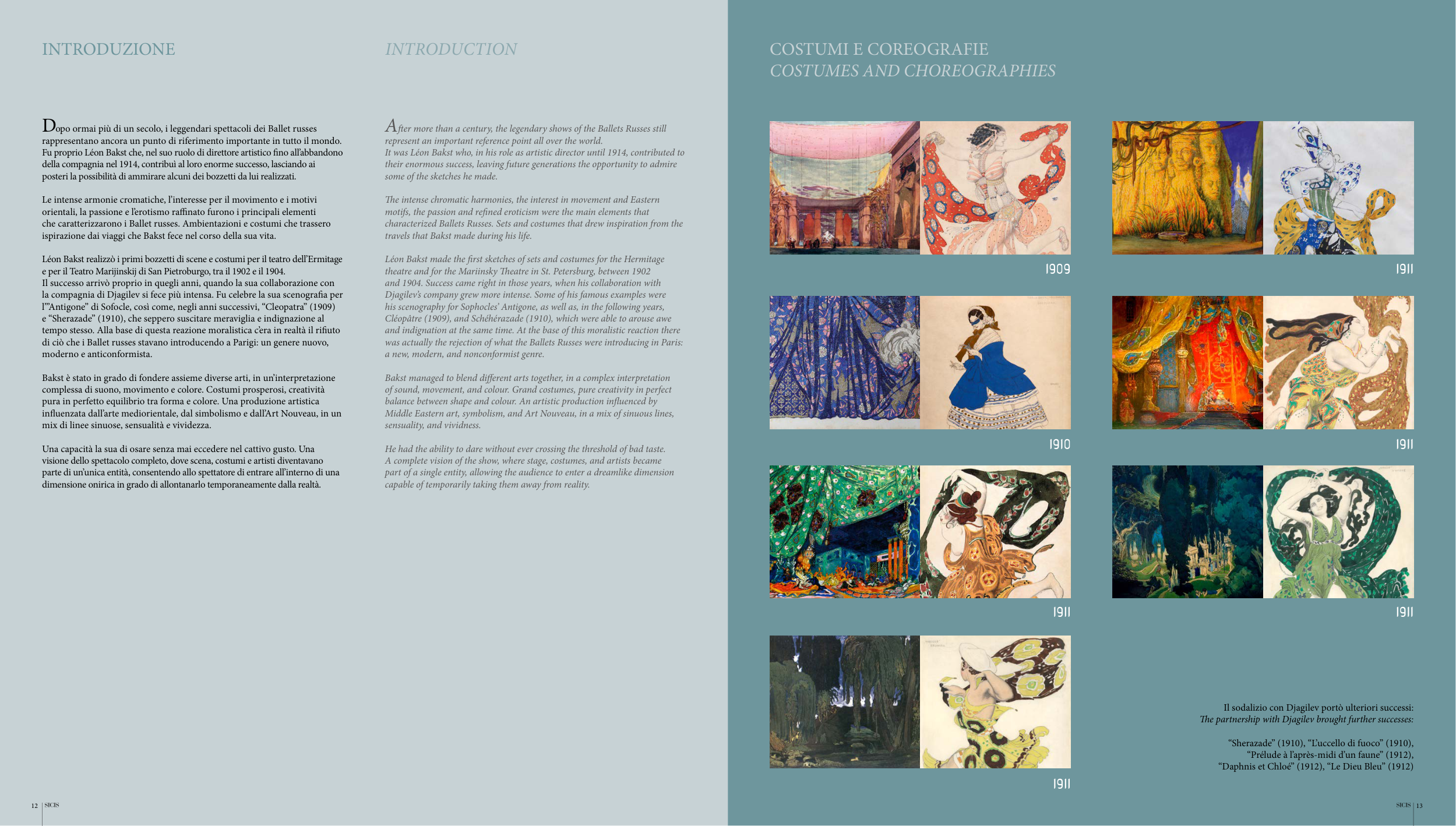
l’”Antigone” di Sofocle, così come, negli anni successivi, “Cleopatra” (1909)
e “Sherazade” (1910), che seppero suscitare meraviglia e indignazione al
tempo stesso. Alla base di questa reazione moralistica c’era in realtà il rifiuto
di ciò che i Ballet russes stavano introducendo a Parigi: un genere nuovo,
moderno e anticonformista.
Bakst è stato in grado di fondere assieme diverse arti, in un’interpretazione
complessa di suono, movimento e colore. Costumi prosperosi, creatività
pura in perfetto equilibrio tra forma e colore. Una produzione artistica
influenzata dall’arte mediorientale, dal simbolismo e dall’Art Nouveau, in un
mix di linee sinuose, sensualità e vividezza.
Una capacità la sua di osare senza mai eccedere nel cattivo gusto. Una
visione dello spettacolo completo, dove scena, costumi e artisti diventavano
parte di un’unica entità, consentendo allo spettatore di entrare all’interno di una
dimensione onirica in grado di allontanarlo temporaneamente dalla realtà.
Il sodalizio con Djagilev portò ulteriori successi:
The partnership with Djagilev brought further successes:
“Sherazade” (1910), “L’uccello di fuoco” (1910),
“Prélude à l’après-midi d’un faune” (1912),
“Daphnis et Chloé” (1912), “Le Dieu Bleu” (1912)
INTRODUCTION
After more than a century, the legendary shows of the Ballets Russes still
represent an important reference point all over the world.
It was Léon Bakst who, in his role as artistic director until 1914, contributed to
their enormous success, leaving future generations the opportunity to admire
some of the sketches he made.
The intense chromatic harmonies, the interest in movement and Eastern
motifs, the passion and refined eroticism were the main elements that
characterized Ballets Russes. Sets and costumes that drew inspiration from the
travels that Bakst made during his life.
Léon Bakst made the first sketches of sets and costumes for the Hermitage
theatre and for the Mariinsky Theatre in St. Petersburg, between 1902
and 1904. Success came right in those years, when his collaboration with
Djagilev’s company grew more intense. Some of his famous examples were
his scenography for Sophocles’ Antigone, as well as, in the following years,
Cléopâtre (1909), and Schéhérazade (1910), which were able to arouse awe
and indignation at the same time. At the base of this moralistic reaction there
was actually the rejection of what the Ballets Russes were introducing in Paris:
a new, modern, and nonconformist genre.
Bakst managed to blend different arts together, in a complex interpretation
of sound, movement, and colour. Grand costumes, pure creativity in perfect
balance between shape and colour. An artistic production influenced by
Middle Eastern art, symbolism, and Art Nouveau, in a mix of sinuous lines,
sensuality, and vividness.
He had the ability to dare without ever crossing the threshold of bad taste.
A complete vision of the show, where stage, costumes, and artists became
part of a single entity, allowing the audience to enter a dreamlike dimension
capable of temporarily taking them away from reality.