10
11
BIOGRAFIA
Léon Bakst, pseudonimo di Lev Schmule Rozenberg, fu un brillante
pittore, illustratore, scenografo e costumista.
Di origine ebraica, nacque a Grodno, nell’attuale Bielorussia, il 10 maggio
del 1866. Interessato alla pittura sin dall’infanzia, nel 1883 si iscrisse
all’Accademia delle Belle Arti di San Pietroburgo, partecipando alle prime
mostre collettive. Negli anni successivi viaggiò tra Europa e Nordafrica,
arrivando infine a Parigi dove studiò pittura presso l’Académie Julian. Qui
ebbe modo di approfondire la conoscenza dell’arte francese e accostarsi al
simbolismo, ma soprattutto strinse un’amicizia, che sarebbe durata fino alla
sua morte, con l’impresario teatrale Sergej Pavlovič Djagilev.
Nel 1898 fondarono la rivista “Il mondo dell’arte”.
Bakst raggiunse la notorietà grazie alle sue doti di illustratore e ritrattista,
e in seguito come disegnatore di scene e bozzetti per il teatro dell’Ermitage.
Nel 1910 si trasferì stabilmente a Parigi, dove si dedicò principalmente
ai disegni per i Ballet Russes, la celebre compagnia fondata da Djagilev.
In questo periodo Bakst lavorò a fianco dei principali artisti dell’epoca,
come il ballerino e coreografo Nižinskij o i compositori Stravinskij, Ravel e
Debussy. I suoi disegni, ricchi di colori saturi e dettagli, segnarono una vera
e propria svolta per l’epoca. Le figure non erano più statiche e inespressive,
ma sinuose e ammiccanti, ricreando i passi di danza. Molti dei costumi da
lui disegnati suscitarono scalpore per la sensualità lussureggiante e la nudità
apparente. Bakst fu tra i primi inoltre ad abbandonare tutù, calzamaglia e
soprattutto le scarpette da punta, lasciando nudi i piedi dei ballerini.
Sull’onda del successo ottenuto grazie ai Ballet Russes, Bakst iniziò a lavorare
anche per altri committenti, non solo in ambito teatrale ma arrivando a
collaborare anche con i principali stilisti francesi e lanciando alcune delle
mode del periodo. Questa sua passione per la moda e questa sua abilità
nel saper intercettare e anticipare i trend lo portò a valutare l’avvio di una
propria casa di moda, dove poter proporre non solo abiti e gioielli, ma anche
arredi e carta da parati.
La morte prematura, nel 1924 a Rueil-Malmaison, infranse però i suoi
progetti.
La sua eredità vive ancora in quella sua capacità di curare ogni minimo
dettaglio e rendere vive le scene, che lo ha fatto diventare uno dei primi
maestri della scenografia moderna.
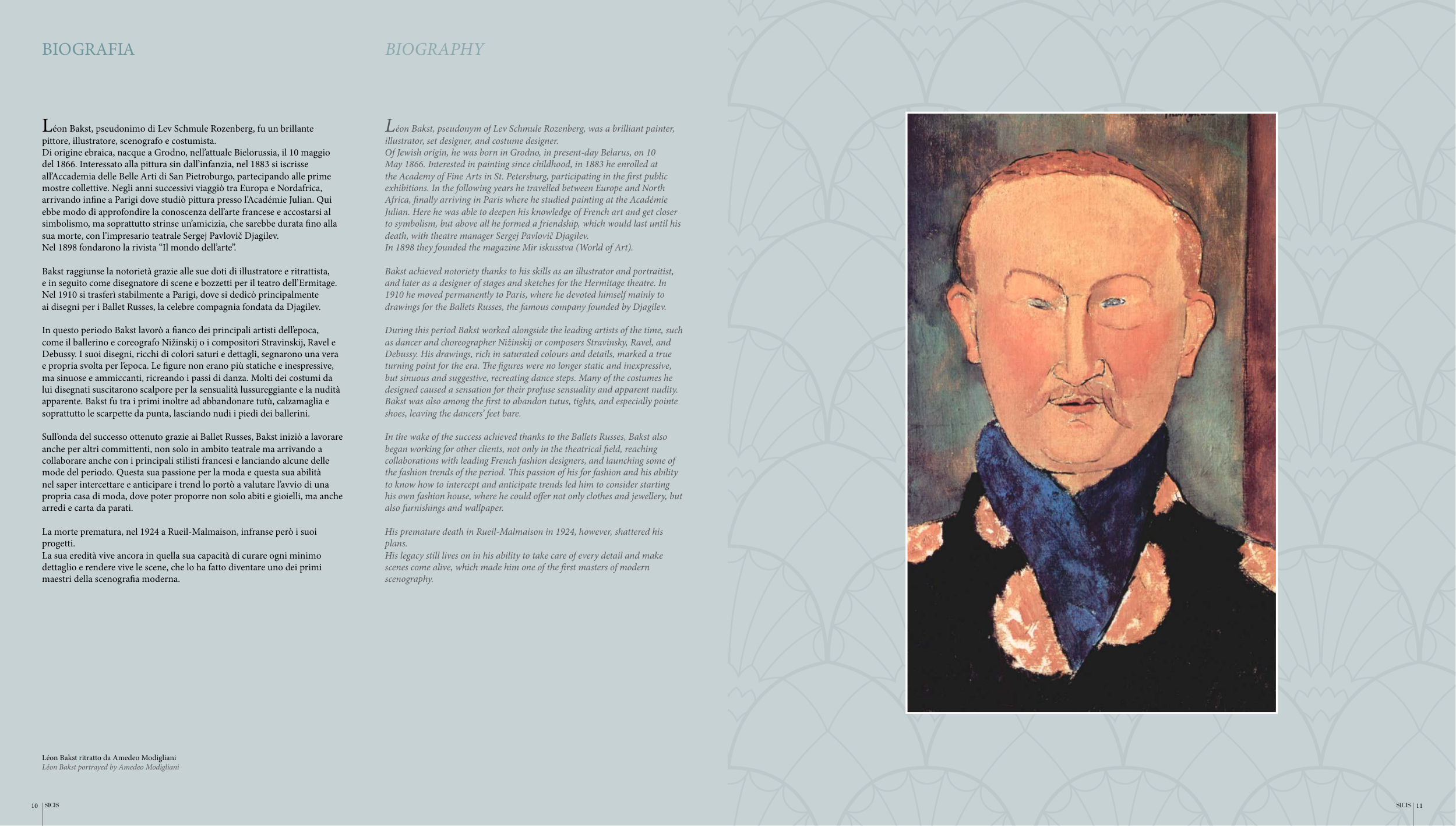
Léon Bakst ritratto da Amedeo Modigliani
Léon Bakst portrayed by Amedeo Modigliani
BIOGRAPHY
Léon Bakst, pseudonym of Lev Schmule Rozenberg, was a brilliant painter,
illustrator, set designer, and costume designer.
Of Jewish origin, he was born in Grodno, in present-day Belarus, on 10
May 1866. Interested in painting since childhood, in 1883 he enrolled at
the Academy of Fine Arts in St. Petersburg, participating in the first public
exhibitions. In the following years he travelled between Europe and North
Africa, finally arriving in Paris where he studied painting at the Académie
Julian. Here he was able to deepen his knowledge of French art and get closer
to symbolism, but above all he formed a friendship, which would last until his
death, with theatre manager Sergej Pavlovič Djagilev.
In 1898 they founded the magazine Mir iskusstva (World of Art).
Bakst achieved notoriety thanks to his skills as an illustrator and portraitist,
and later as a designer of stages and sketches for the Hermitage theatre. In
1910 he moved permanently to Paris, where he devoted himself mainly to
drawings for the Ballets Russes, the famous company founded by Djagilev.
During this period Bakst worked alongside the leading artists of the time, such
as dancer and choreographer Nižinskij or composers Stravinsky, Ravel, and
Debussy. His drawings, rich in saturated colours and details, marked a true
turning point for the era. The figures were no longer static and inexpressive,
but sinuous and suggestive, recreating dance steps. Many of the costumes he
designed caused a sensation for their profuse sensuality and apparent nudity.
Bakst was also among the first to abandon tutus, tights, and especially pointe
shoes, leaving the dancers’ feet bare.
In the wake of the success achieved thanks to the Ballets Russes, Bakst also
began working for other clients, not only in the theatrical field, reaching
collaborations with leading French fashion designers, and launching some of
the fashion trends of the period. This passion of his for fashion and his ability
to know how to intercept and anticipate trends led him to consider starting
his own fashion house, where he could offer not only clothes and jewellery, but
also furnishings and wallpaper.
His premature death in Rueil-Malmaison in 1924, however, shattered his
plans.
His legacy still lives on in his ability to take care of every detail and make
scenes come alive, which made him one of the first masters of modern
scenography.