6
7
The project, of international significance, brought together 27 contemporary artists
from Italy, Belgium, the Netherlands, England, Spain, Russia, Japan, and many
other countries. It was the first step towards an artistic patronage aimed at offering
an idea of an open-air museum that is close to the everyday life of citizens in order
to bring culture and beauty even during their daily commutes, and not only during
those privileged moments dedicated to museums or cultural visits.
A few years later, SICIS’s interest was directed towards an Italian painter of the
Mannerist period, known for his ‘Teste Composte’ (portrait heads made entirely of
objects): Giuseppe Arcimboldo. The richness of the details, especially of flowers and
fruits, and the eclecticism of the artworks, prompted the Ravenna-based company to
reproduce some of the best-known paintings, reinterpreting them with its own style
and adapting them to the artistic technique. The mastery in the use and cuts of the
tiles and in the choice of colours made it one of the most refined reproduction series
from antiquity while never remaining without innovation, combining impactful
iridescent shades in the modernity of the almost exclusively mirroring backgrounds.
In 2014 a complete change of course. SICIS decided to pay homage to one of the
most significant painters of the late 19th century, Gustav Klimt. The rich golden
backgrounds, whose inspiration for the Austrian painter came from some trips to
Ravenna, which made him discover the Byzantine mosaics, seemed perfect for the
SICIS Gold collection. Some of the artist’s most famous paintings were reproduced,
including “The Kiss”, “Judith”, and portrait of “Adele Bloch Bauer”.
The result is nothing short of stunning.
The following year, thanks to a trip to Japan, the president of SICIS was captivated
by the pictorial art of the Edo period. He thus began a collaboration with the
“Museum of the Imperial Collections’” and various private collections to interpret
some of the finest paintings by Itō Jakuchū, depicting animals and nature in
harmony with Shinto beliefs.
The collection evokes the essence of eastern naturalistic and figurative art, with
mosaics with a strong pictorial effect. The calibrated choice of colours, which reflects
the typical palettes of Japanese paintings, and the refined manufacturing are what
most characterize these panels, tapestries that can adorn the walls of a house with
magnificence and preciousness.
Three years later, in the wake of important results and synergies in every part of the
world, the Chinese Government proposed to SICIS, through “The Forbidden City
Culture”, to interpret some ancient masterpieces kept inside the Forbidden City,
among the most famous in all of Chinese history. Immortal masterpieces illustrating
landscapes, mountains, and animals that would be exhibited in Beijing in a
dedicated exhibition. SICIS enthusiastically accepted, starting an accurate phase
of study and research on the artworks. Months of intense work, choice of shades,
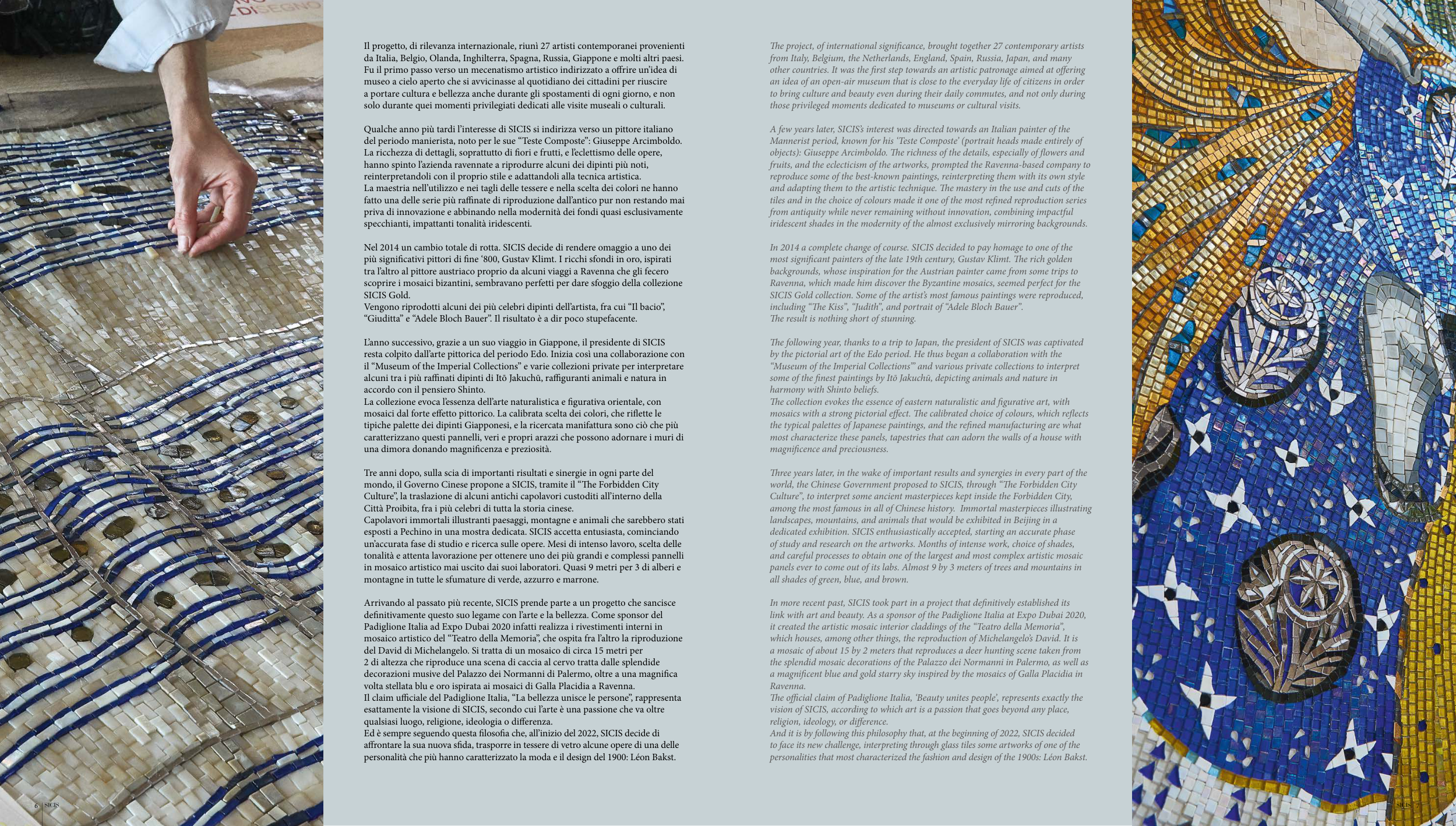
and careful processes to obtain one of the largest and most complex artistic mosaic
panels ever to come out of its labs. Almost 9 by 3 meters of trees and mountains in
all shades of green, blue, and brown.
In more recent past, SICIS took part in a project that definitively established its
link with art and beauty. As a sponsor of the Padiglione Italia at Expo Dubai 2020,
it created the artistic mosaic interior claddings of the “Teatro della Memoria”,
which houses, among other things, the reproduction of Michelangelo’s David. It is
a mosaic of about 15 by 2 meters that reproduces a deer hunting scene taken from
the splendid mosaic decorations of the Palazzo dei Normanni in Palermo, as well as
a magnificent blue and gold starry sky inspired by the mosaics of Galla Placidia in
Ravenna.
The official claim of Padiglione Italia, ‘Beauty unites people’, represents exactly the
vision of SICIS, according to which art is a passion that goes beyond any place,
religion, ideology, or difference.
And it is by following this philosophy that, at the beginning of 2022, SICIS decided
to face its new challenge, interpreting through glass tiles some artworks of one of the
personalities that most characterized the fashion and design of the 1900s: Léon Bakst.
Il progetto, di rilevanza internazionale, riunì 27 artisti contemporanei provenienti
da Italia, Belgio, Olanda, Inghilterra, Spagna, Russia, Giappone e molti altri paesi.
Fu il primo passo verso un mecenatismo artistico indirizzato a offrire un’idea di
museo a cielo aperto che si avvicinasse al quotidiano dei cittadini per riuscire
a portare cultura e bellezza anche durante gli spostamenti di ogni giorno, e non
solo durante quei momenti privilegiati dedicati alle visite museali o culturali.
Qualche anno più tardi l’interesse di SICIS si indirizza verso un pittore italiano
del periodo manierista, noto per le sue “Teste Composte”: Giuseppe Arcimboldo.
La ricchezza di dettagli, soprattutto di fiori e frutti, e l’eclettismo delle opere,
hanno spinto l’azienda ravennate a riprodurre alcuni dei dipinti più noti,
reinterpretandoli con il proprio stile e adattandoli alla tecnica artistica.
La maestria nell’utilizzo e nei tagli delle tessere e nella scelta dei colori ne hanno
fatto una delle serie più raffinate di riproduzione dall’antico pur non restando mai
priva di innovazione e abbinando nella modernità dei fondi quasi esclusivamente
specchianti, impattanti tonalità iridescenti.
Nel 2014 un cambio totale di rotta. SICIS decide di rendere omaggio a uno dei
più significativi pittori di fine ‘800, Gustav Klimt. I ricchi sfondi in oro, ispirati
tra l’altro al pittore austriaco proprio da alcuni viaggi a Ravenna che gli fecero
scoprire i mosaici bizantini, sembravano perfetti per dare sfoggio della collezione
SICIS Gold.
Vengono riprodotti alcuni dei più celebri dipinti dell’artista, fra cui “Il bacio”,
“Giuditta” e “Adele Bloch Bauer”. Il risultato è a dir poco stupefacente.
L’anno successivo, grazie a un suo viaggio in Giappone, il presidente di SICIS
resta colpito dall’arte pittorica del periodo Edo. Inizia così una collaborazione con
il “Museum of the Imperial Collections” e varie collezioni private per interpretare
alcuni tra i più raffinati dipinti di Itō Jakuchū, raffiguranti animali e natura in
accordo con il pensiero Shinto.
La collezione evoca l’essenza dell’arte naturalistica e figurativa orientale, con
mosaici dal forte effetto pittorico. La calibrata scelta dei colori, che riflette le
tipiche palette dei dipinti Giapponesi, e la ricercata manifattura sono ciò che più
caratterizzano questi pannelli, veri e propri arazzi che possono adornare i muri di
una dimora donando magnificenza e preziosità.
Tre anni dopo, sulla scia di importanti risultati e sinergie in ogni parte del
mondo, il Governo Cinese propone a SICIS, tramite il “The Forbidden City
Culture”, la traslazione di alcuni antichi capolavori custoditi all’interno della
Città Proibita, fra i più celebri di tutta la storia cinese.
Capolavori immortali illustranti paesaggi, montagne e animali che sarebbero stati
esposti a Pechino in una mostra dedicata. SICIS accetta entusiasta, cominciando
un’accurata fase di studio e ricerca sulle opere. Mesi di intenso lavoro, scelta delle
tonalità e attenta lavorazione per ottenere uno dei più grandi e complessi pannelli
in mosaico artistico mai uscito dai suoi laboratori. Quasi 9 metri per 3 di alberi e
montagne in tutte le sfumature di verde, azzurro e marrone.
Arrivando al passato più recente, SICIS prende parte a un progetto che sancisce
definitivamente questo suo legame con l’arte e la bellezza. Come sponsor del
Padiglione Italia ad Expo Dubai 2020 infatti realizza i rivestimenti interni in
mosaico artistico del “Teatro della Memoria”, che ospita fra l’altro la riproduzione
del David di Michelangelo. Si tratta di un mosaico di circa 15 metri per
2 di altezza che riproduce una scena di caccia al cervo tratta dalle splendide
decorazioni musive del Palazzo dei Normanni di Palermo, oltre a una magnifica
volta stellata blu e oro ispirata ai mosaici di Galla Placidia a Ravenna.
Il claim ufficiale del Padiglione Italia, “La bellezza unisce le persone”, rappresenta
esattamente la visione di SICIS, secondo cui l’arte è una passione che va oltre
qualsiasi luogo, religione, ideologia o differenza.
Ed è sempre seguendo questa filosofia che, all’inizio del 2022, SICIS decide di
affrontare la sua nuova sfida, trasporre in tessere di vetro alcune opere di una delle
personalità che più hanno caratterizzato la moda e il design del 1900: Léon Bakst.