70
71
Una parte molto complessa e interessante per SICIS è stata
l’interpretazione dei supporti in carta naturale dei disegni prodotti
dall’artista. Carte di fatture e qualità differenti, con macchie, sfumature e
segni del tempo non potevano restare semplicemente un unico colore in
tinta unita.
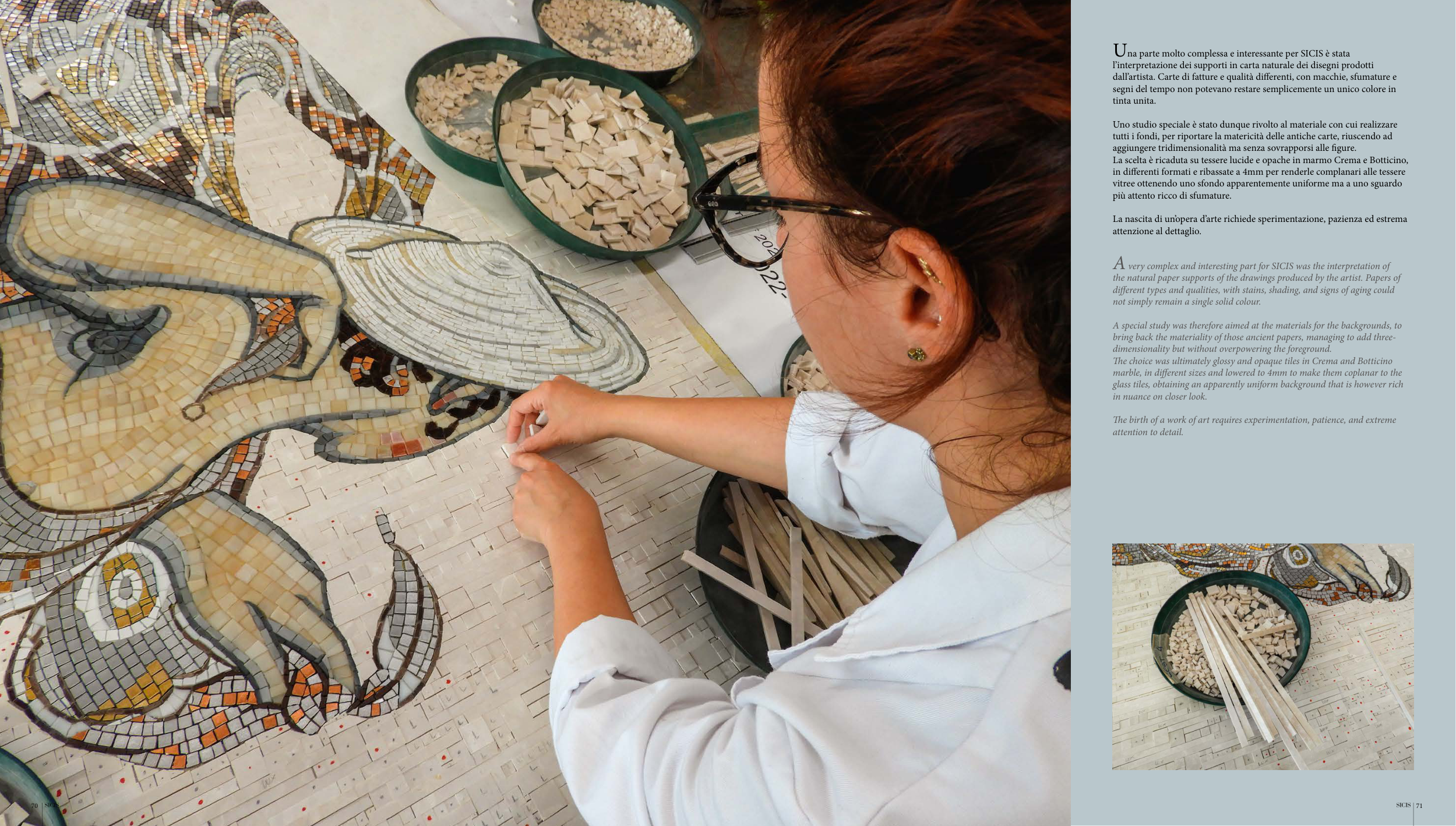
Uno studio speciale è stato dunque rivolto al materiale con cui realizzare
tutti i fondi, per riportare la matericità delle antiche carte, riuscendo ad
aggiungere tridimensionalità ma senza sovrapporsi alle figure.
La scelta è ricaduta su tessere lucide e opache in marmo Crema e Botticino,
in differenti formati e ribassate a 4mm per renderle complanari alle tessere
vitree ottenendo uno sfondo apparentemente uniforme ma a uno sguardo
più attento ricco di sfumature.
La nascita di un’opera d’arte richiede sperimentazione, pazienza ed estrema
attenzione al dettaglio.
A very complex and interesting part for SICIS was the interpretation of
the natural paper supports of the drawings produced by the artist. Papers of
different types and qualities, with stains, shading, and signs of aging could
not simply remain a single solid colour.
A special study was therefore aimed at the materials for the backgrounds, to
bring back the materiality of those ancient papers, managing to add three-
dimensionality but without overpowering the foreground.
The choice was ultimately glossy and opaque tiles in Crema and Botticino
marble, in different sizes and lowered to 4mm to make them coplanar to the
glass tiles, obtaining an apparently uniform background that is however rich
in nuance on closer look.
The birth of a work of art requires experimentation, patience, and extreme
attention to detail.