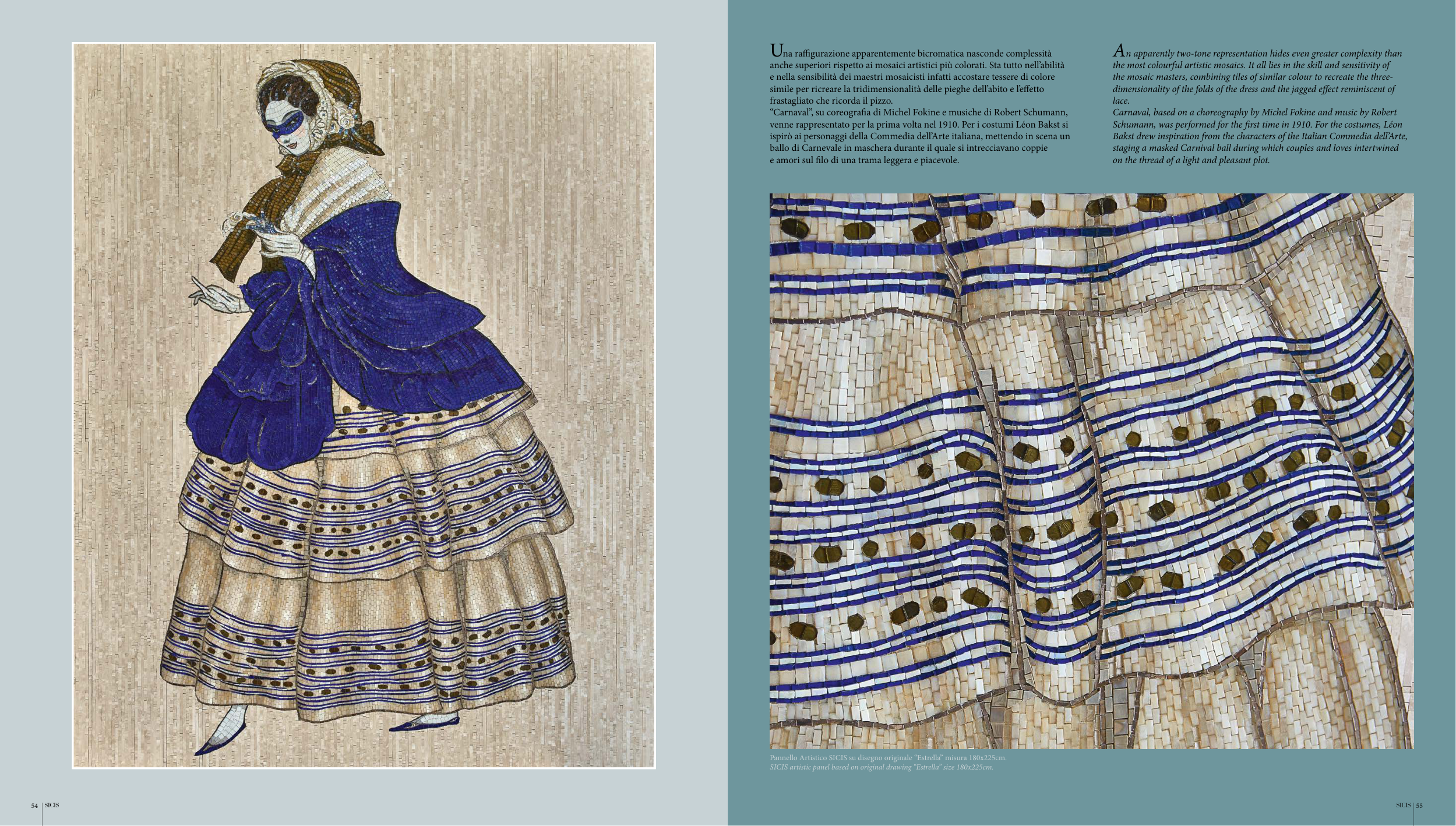
Una raffigurazione apparentemente bicromatica nasconde complessità
anche superiori rispetto ai mosaici artistici più colorati. Sta tutto nell’abilità
e nella sensibilità dei maestri mosaicisti infatti accostare tessere di colore
simile per ricreare la tridimensionalità delle pieghe dell’abito e l’effetto
frastagliato che ricorda il pizzo.
“Carnaval”, su coreografia di Michel Fokine e musiche di Robert Schumann,
venne rappresentato per la prima volta nel 1910. Per i costumi Léon Bakst si
ispirò ai personaggi della Commedia dell’Arte italiana, mettendo in scena un
ballo di Carnevale in maschera durante il quale si intrecciavano coppie
e amori sul filo di una trama leggera e piacevole.
An apparently two-tone representation hides even greater complexity than
the most colourful artistic mosaics. It all lies in the skill and sensitivity of
the mosaic masters, combining tiles of similar colour to recreate the three-
dimensionality of the folds of the dress and the jagged effect reminiscent of
lace.
Carnaval, based on a choreography by Michel Fokine and music by Robert
Schumann, was performed for the first time in 1910. For the costumes, Léon
Bakst drew inspiration from the characters of the Italian Commedia dell’Arte,
staging a masked Carnival ball during which couples and loves intertwined
on the thread of a light and pleasant plot.
54
55
Pannello Artistico SICIS su disegno originale “Estrella” misura 180x225cm.
SICIS artistic panel based on original drawing “Estrella” size 180x225cm.