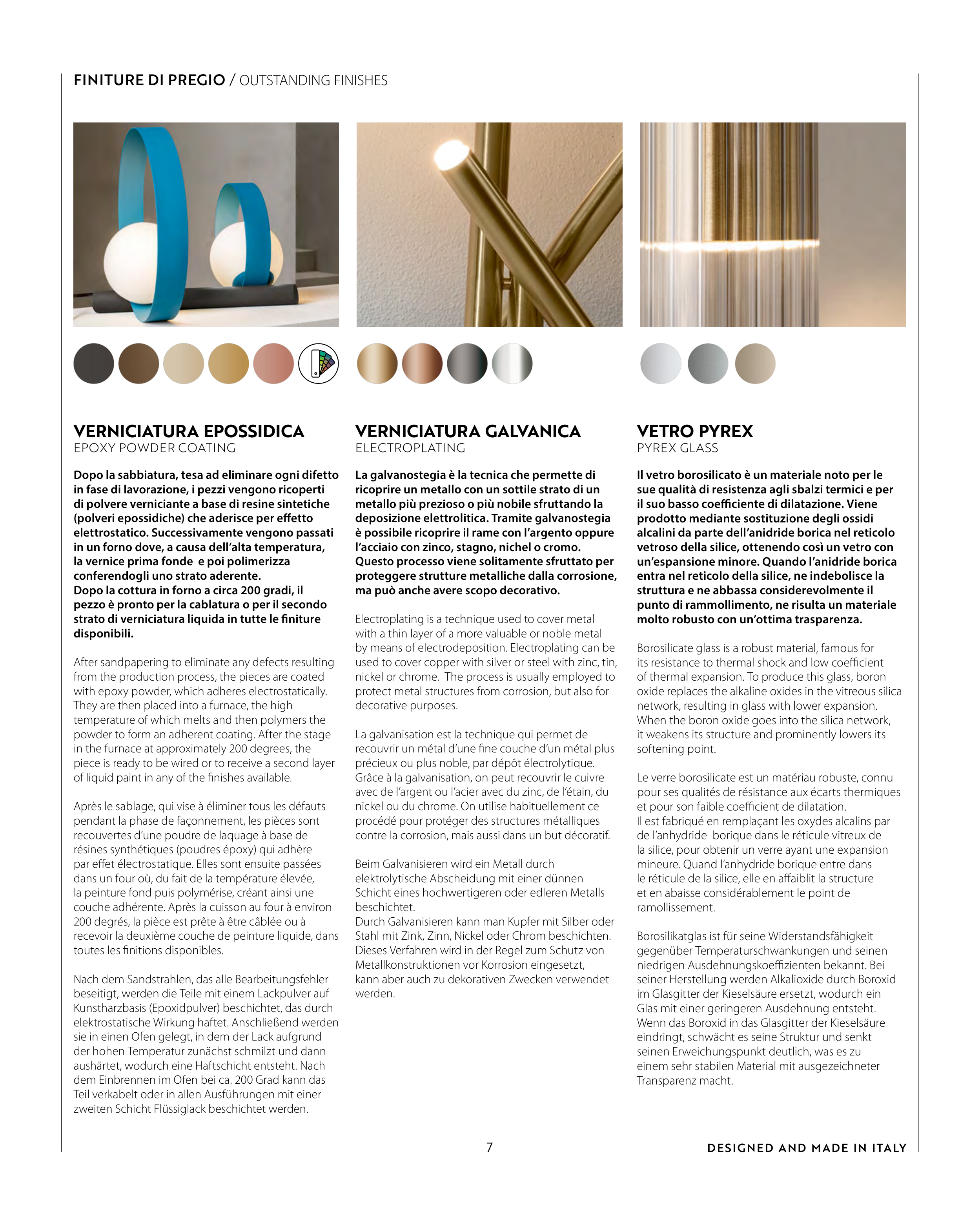
VERNICIATURA EPOSSIDICA
EPOXY POWDER COATING
Dopo la sabbiatura, tesa ad eliminare ogni difetto
in fase di lavorazione, i pezzi vengono ricoperti
di polvere verniciante a base di resine sintetiche
(polveri epossidiche) che aderisce per efetto
elettrostatico. Successivamente vengono passati
in un forno dove, a causa dell’alta temperatura,
la vernice prima fonde e poi polimerizza
conferendogli uno strato aderente.
Dopo la cottura in forno a circa 200 gradi, il
pezzo è pronto per la cablatura o per il secondo
strato di verniciatura liquida in tutte le fniture
disponibili.
After sandpapering to eliminate any defects resulting
from the production process, the pieces are coated
with epoxy powder, which adheres electrostatically.
They are then placed into a furnace, the high
temperature of which melts and then polymers the
powder to form an adherent coating. After the stage
in the furnace at approximately 200 degrees, the
piece is ready to be wired or to receive a second layer
of liquid paint in any of the finishes available.
Après le sablage, qui vise à éliminer tous les défauts
pendant la phase de façonnement, les pièces sont
recouvertes d’une poudre de laquage à base de
résines synthétiques (poudres époxy) qui adhère
par effet électrostatique. Elles sont ensuite passées
dans un four où, du fait de la température élevée,
la peinture fond puis polymérise, créant ainsi une
couche adhérente. Après la cuisson au four à environ
200 degrés, la pièce est prête à être câblée ou à
recevoir la deuxième couche de peinture liquide, dans
toutes les finitions disponibles.
Nach dem Sandstrahlen, das alle Bearbeitungsfehler
beseitigt, werden die Teile mit einem Lackpulver auf
Kunstharzbasis (Epoxidpulver) beschichtet, das durch
elektrostatische Wirkung haftet. Anschließend werden
sie in einen Ofen gelegt, in dem der Lack aufgrund
der hohen Temperatur zunächst schmilzt und dann
aushärtet, wodurch eine Haftschicht entsteht. Nach
dem Einbrennen im Ofen bei ca. 200 Grad kann das
Teil verkabelt oder in allen Ausführungen mit einer
zweiten Schicht Flüssiglack beschichtet werden.
VERNICIATURA GALVANICA
ELECTROPLATING
La galvanostegia è la tecnica che permette di
ricoprire un metallo con un sottile strato di un
metallo più prezioso o più nobile sfruttando la
deposizione elettrolitica. Tramite galvanostegia
è possibile ricoprire il rame con l’argento oppure
l’acciaio con zinco, stagno, nichel o cromo.
Questo processo viene solitamente sfruttato per
proteggere strutture metalliche dalla corrosione,
ma può anche avere scopo decorativo.
Electroplating is a technique used to cover metal
with a thin layer of a more valuable or noble metal
by means of electrodeposition. Electroplating can be
used to cover copper with silver or steel with zinc, tin,
nickel or chrome. The process is usually employed to
protect metal structures from corrosion, but also for
decorative purposes.
La galvanisation est la technique qui permet de
recouvrir un métal d’une fine couche d’un métal plus
précieux ou plus noble, par dépôt électrolytique.
Grâce à la galvanisation, on peut recouvrir le cuivre
avec de l’argent ou l’acier avec du zinc, de l’étain, du
nickel ou du chrome. On utilise habituellement ce
procédé pour protéger des structures métalliques
contre la corrosion, mais aussi dans un but décoratif.
Beim Galvanisieren wird ein Metall durch
elektrolytische Abscheidung mit einer dünnen
Schicht eines hochwertigeren oder edleren Metalls
beschichtet.
Durch Galvanisieren kann man Kupfer mit Silber oder
Stahl mit Zink, Zinn, Nickel oder Chrom beschichten.
Dieses Verfahren wird in der Regel zum Schutz von
Metallkonstruktionen vor Korrosion eingesetzt,
kann aber auch zu dekorativen Zwecken verwendet
werden.
VETRO PYREX
PYREX GLASS
Il vetro borosilicato è un materiale noto per le
sue qualità di resistenza agli sbalzi termici e per
il suo basso coefciente di dilatazione. Viene
prodotto mediante sostituzione degli ossidi
alcalini da parte dell’anidride borica nel reticolo
vetroso della silice, ottenendo così un vetro con
un’espansione minore. Quando l’anidride borica
entra nel reticolo della silice, ne indebolisce la
struttura e ne abbassa considerevolmente il
punto di rammollimento, ne risulta un materiale
molto robusto con un’ottima trasparenza.
Borosilicate glass is a robust material, famous for
its resistance to thermal shock and low coefficient
of thermal expansion. To produce this glass, boron
oxide replaces the alkaline oxides in the vitreous silica
network, resulting in glass with lower expansion.
When the boron oxide goes into the silica network,
it weakens its structure and prominently lowers its
softening point.
Le verre borosilicate est un matériau robuste, connu
pour ses qualités de résistance aux écarts thermiques
et pour son faible coefficient de dilatation.
Il est fabriqué en remplaçant les oxydes alcalins par
de l’anhydride borique dans le réticule vitreux de
la silice, pour obtenir un verre ayant une expansion
mineure. Quand l’anhydride borique entre dans
le réticule de la silice, elle en affaiblit la structure
et en abaisse considérablement le point de
ramollissement.
Borosilikatglas ist für seine Widerstandsfähigkeit
gegenüber Temperaturschwankungen und seinen
niedrigen Ausdehnungskoeffizienten bekannt. Bei
seiner Herstellung werden Alkalioxide durch Boroxid
im Glasgitter der Kieselsäure ersetzt, wodurch ein
Glas mit einer geringeren Ausdehnung entsteht.
Wenn das Boroxid in das Glasgitter der Kieselsäure
eindringt, schwächt es seine Struktur und senkt
seinen Erweichungspunkt deutlich, was es zu
einem sehr stabilen Material mit ausgezeichneter
Transparenz macht.
FINITURE DI PREGIO / OUTSTANDING FINISHES
DESIGNED AND MADE IN ITALY
7