335
Complements, Accessoires
Erganzungsmöbel, Zubehore
Complementary Units, Accessories
Complementi, Accessori
334
Poltrona Frau
I Tappeti — Billie
I
In occasione dei cento anni dalla nascita
di Max Huber, Poltrona Frau omaggia
il celebre grafico-artista svizzero con
Billie e Dizzy, collezione di tappeti
realizzati selezionando dall’archivio due
opere inedite su carta, rispettivamente
del 1936 e del 1947. I disegni originali
sono rimasti inalterati nelle proporzioni
e negli spessori delle linee e sono stati
semplicemente adattati alle dimensioni
dei tappeti.
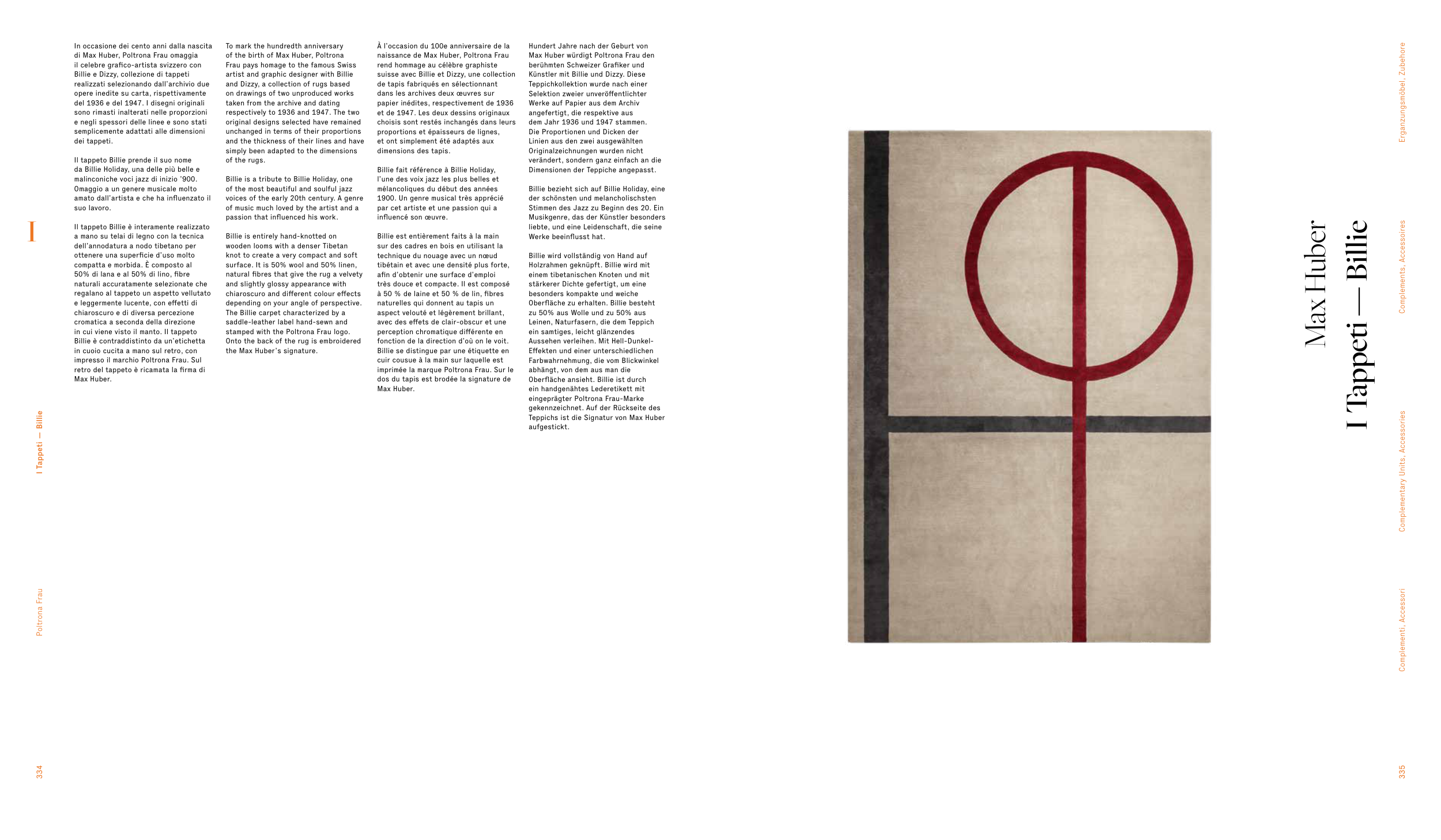
Il tappeto Billie prende il suo nome
da Billie Holiday, una delle più belle e
malinconiche voci jazz di inizio ’900.
Omaggio a un genere musicale molto
amato dall’artista e che ha influenzato il
suo lavoro.
Il tappeto Billie è interamente realizzato
a mano su telai di legno con la tecnica
dell’annodatura a nodo tibetano per
ottenere una superficie d’uso molto
compatta e morbida. È composto al
50% di lana e al 50% di lino, fibre
naturali accuratamente selezionate che
regalano al tappeto un aspetto vellutato
e leggermente lucente, con effetti di
chiaroscuro e di diversa percezione
cromatica a seconda della direzione
in cui viene visto il manto. Il tappeto
Billie è contraddistinto da un’etichetta
in cuoio cucita a mano sul retro, con
impresso il marchio Poltrona Frau. Sul
retro del tappeto è ricamata la firma di
Max Huber.
To mark the hundredth anniversary
of the birth of Max Huber, Poltrona
Frau pays homage to the famous Swiss
artist and graphic designer with Billie
and Dizzy, a collection of rugs based
on drawings of two unproduced works
taken from the archive and dating
respectively to 1936 and 1947. The two
original designs selected have remained
unchanged in terms of their proportions
and the thickness of their lines and have
simply been adapted to the dimensions
of the rugs.
Billie is a tribute to Billie Holiday, one
of the most beautiful and soulful jazz
voices of the early 20th century. A genre
of music much loved by the artist and a
passion that influenced his work.
Billie is entirely hand-knotted on
wooden looms with a denser Tibetan
knot to create a very compact and soft
surface. It is 50% wool and 50% linen,
natural fibres that give the rug a velvety
and slightly glossy appearance with
chiaroscuro and different colour effects
depending on your angle of perspective.
The Billie carpet characterized by a
saddle-leather label hand-sewn and
stamped with the Poltrona Frau logo.
Onto the back of the rug is embroidered
the Max Huber’s signature.
À l’occasion du 100e anniversaire de la
naissance de Max Huber, Poltrona Frau
rend hommage au célèbre graphiste
suisse avec Billie et Dizzy, une collection
de tapis fabriqués en sélectionnant
dans les archives deux œuvres sur
papier inédites, respectivement de 1936
et de 1947. Les deux dessins originaux
choisis sont restés inchangés dans leurs
proportions et épaisseurs de lignes,
et ont simplement été adaptés aux
dimensions des tapis.
Billie fait référence à Billie Holiday,
l’une des voix jazz les plus belles et
mélancoliques du début des années
1900. Un genre musical très apprécié
par cet artiste et une passion qui a
influencé son œuvre.
Billie est entièrement faits à la main
sur des cadres en bois en utilisant la
technique du nouage avec un nœud
tibétain et avec une densité plus forte,
afin d’obtenir une surface d’emploi
très douce et compacte. Il est composé
à 50 % de laine et 50 % de lin, fibres
naturelles qui donnent au tapis un
aspect velouté et légèrement brillant,
avec des effets de clair-obscur et une
perception chromatique différente en
fonction de la direction d’où on le voit.
Billie se distingue par une étiquette en
cuir cousue à la main sur laquelle est
imprimée la marque Poltrona Frau. Sur le
dos du tapis est brodée la signature de
Max Huber.
Hundert Jahre nach der Geburt von
Max Huber würdigt Poltrona Frau den
berühmten Schweizer Grafiker und
Künstler mit Billie und Dizzy. Diese
Teppichkollektion wurde nach einer
Selektion zweier unveröffentlichter
Werke auf Papier aus dem Archiv
angefertigt, die respektive aus
dem Jahr 1936 und 1947 stammen.
Die Proportionen und Dicken der
Linien aus den zwei ausgewählten
Originalzeichnungen wurden nicht
verändert, sondern ganz einfach an die
Dimensionen der Teppiche angepasst.
Billie bezieht sich auf Billie Holiday, eine
der schönsten und melancholischsten
Stimmen des Jazz zu Beginn des 20. Ein
Musikgenre, das der Künstler besonders
liebte, und eine Leidenschaft, die seine
Werke beeinflusst hat.
Billie wird vollständig von Hand auf
Holzrahmen geknüpft. Billie wird mit
einem tibetanischen Knoten und mit
stärkerer Dichte gefertigt, um eine
besonders kompakte und weiche
Oberfläche zu erhalten. Billie besteht
zu 50% aus Wolle und zu 50% aus
Leinen, Naturfasern, die dem Teppich
ein samtiges, leicht glänzendes
Aussehen verleihen. Mit Hell-Dunkel-
Effekten und einer unterschiedlichen
Farbwahrnehmung, die vom Blickwinkel
abhängt, von dem aus man die
Oberfläche ansieht. Billie ist durch
ein handgenähtes Lederetikett mit
eingeprägter Poltrona Frau-Marke
gekennzeichnet. Auf der Rückseite des
Teppichs ist die Signatur von Max Huber
aufgestickt.
I Tappeti — Billie
Max Huber