88
Poltrona Frau
Nel disegnare i tavolini Pierre, Jean-
Marie Massaud compie un grande lavoro
sulla materia, esplorando
le massime potenzialità espressive
del marmo e reinterpretandole in modo
completamente inedito.
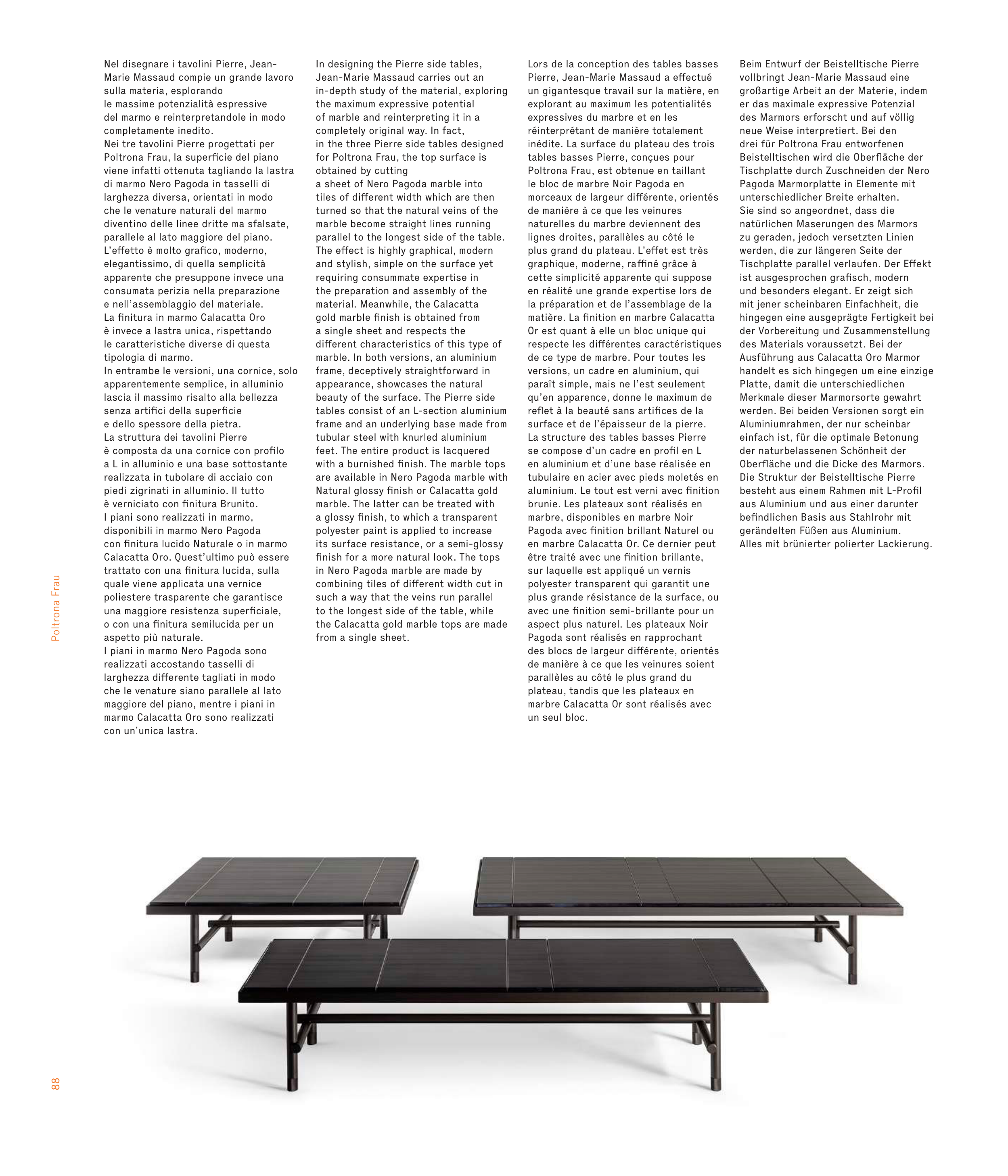
Nei tre tavolini Pierre progettati per
Poltrona Frau, la superficie del piano
viene infatti ottenuta tagliando la lastra
di marmo Nero Pagoda in tasselli di
larghezza diversa, orientati in modo
che le venature naturali del marmo
diventino delle linee dritte ma sfalsate,
parallele al lato maggiore del piano.
L’effetto è molto grafico, moderno,
elegantissimo, di quella semplicità
apparente che presuppone invece una
consumata perizia nella preparazione
e nell’assemblaggio del materiale.
La finitura in marmo Calacatta Oro
è invece a lastra unica, rispettando
le caratteristiche diverse di questa
tipologia di marmo.
In entrambe le versioni, una cornice, solo
apparentemente semplice, in alluminio
lascia il massimo risalto alla bellezza
senza artifici della superficie
e dello spessore della pietra.
La struttura dei tavolini Pierre
è composta da una cornice con profilo
a L in alluminio e una base sottostante
realizzata in tubolare di acciaio con
piedi zigrinati in alluminio. Il tutto
è verniciato con finitura Brunito.
I piani sono realizzati in marmo,
disponibili in marmo Nero Pagoda
con finitura lucido Naturale o in marmo
Calacatta Oro. Quest’ultimo può essere
trattato con una finitura lucida, sulla
quale viene applicata una vernice
poliestere trasparente che garantisce
una maggiore resistenza superficiale,
o con una finitura semilucida per un
aspetto più naturale.
I piani in marmo Nero Pagoda sono
realizzati accostando tasselli di
larghezza differente tagliati in modo
che le venature siano parallele al lato
maggiore del piano, mentre i piani in
marmo Calacatta Oro sono realizzati
con un’unica lastra.
In designing the Pierre side tables,
Jean-Marie Massaud carries out an
in-depth study of the material, exploring
the maximum expressive potential
of marble and reinterpreting it in a
completely original way. In fact,
in the three Pierre side tables designed
for Poltrona Frau, the top surface is
obtained by cutting
a sheet of Nero Pagoda marble into
tiles of different width which are then
turned so that the natural veins of the
marble become straight lines running
parallel to the longest side of the table.
The effect is highly graphical, modern
and stylish, simple on the surface yet
requiring consummate expertise in
the preparation and assembly of the
material. Meanwhile, the Calacatta
gold marble finish is obtained from
a single sheet and respects the
different characteristics of this type of
marble. In both versions, an aluminium
frame, deceptively straightforward in
appearance, showcases the natural
beauty of the surface. The Pierre side
tables consist of an L-section aluminium
frame and an underlying base made from
tubular steel with knurled aluminium
feet. The entire product is lacquered
with a burnished finish. The marble tops
are available in Nero Pagoda marble with
Natural glossy finish or Calacatta gold
marble. The latter can be treated with
a glossy finish, to which a transparent
polyester paint is applied to increase
its surface resistance, or a semi-glossy
finish for a more natural look. The tops
in Nero Pagoda marble are made by
combining tiles of different width cut in
such a way that the veins run parallel
to the longest side of the table, while
the Calacatta gold marble tops are made
from a single sheet.
Lors de la conception des tables basses
Pierre, Jean-Marie Massaud a effectué
un gigantesque travail sur la matière, en
explorant au maximum les potentialités
expressives du marbre et en les
réinterprétant de manière totalement
inédite. La surface du plateau des trois
tables basses Pierre, conçues pour
Poltrona Frau, est obtenue en taillant
le bloc de marbre Noir Pagoda en
morceaux de largeur différente, orientés
de manière à ce que les veinures
naturelles du marbre deviennent des
lignes droites, parallèles au côté le
plus grand du plateau. L’effet est très
graphique, moderne, raffiné grâce à
cette simplicité apparente qui suppose
en réalité une grande expertise lors de
la préparation et de l’assemblage de la
matière. La finition en marbre Calacatta
Or est quant à elle un bloc unique qui
respecte les différentes caractéristiques
de ce type de marbre. Pour toutes les
versions, un cadre en aluminium, qui
paraît simple, mais ne l’est seulement
qu’en apparence, donne le maximum de
reflet à la beauté sans artifices de la
surface et de l’épaisseur de la pierre.
La structure des tables basses Pierre
se compose d’un cadre en profil en L
en aluminium et d’une base réalisée en
tubulaire en acier avec pieds moletés en
aluminium. Le tout est verni avec finition
brunie. Les plateaux sont réalisés en
marbre, disponibles en marbre Noir
Pagoda avec finition brillant Naturel ou
en marbre Calacatta Or. Ce dernier peut
être traité avec une finition brillante,
sur laquelle est appliqué un vernis
polyester transparent qui garantit une
plus grande résistance de la surface, ou
avec une finition semi-brillante pour un
aspect plus naturel. Les plateaux Noir
Pagoda sont réalisés en rapprochant
des blocs de largeur différente, orientés
de manière à ce que les veinures soient
parallèles au côté le plus grand du
plateau, tandis que les plateaux en
marbre Calacatta Or sont réalisés avec
un seul bloc.
Beim Entwurf der Beistelltische Pierre
vollbringt Jean-Marie Massaud eine
großartige Arbeit an der Materie, indem
er das maximale expressive Potenzial
des Marmors erforscht und auf völlig
neue Weise interpretiert. Bei den
drei für Poltrona Frau entworfenen
Beistelltischen wird die Oberfläche der
Tischplatte durch Zuschneiden der Nero
Pagoda Marmorplatte in Elemente mit
unterschiedlicher Breite erhalten.
Sie sind so angeordnet, dass die
natürlichen Maserungen des Marmors
zu geraden, jedoch versetzten Linien
werden, die zur längeren Seite der
Tischplatte parallel verlaufen. Der Effekt
ist ausgesprochen grafisch, modern
und besonders elegant. Er zeigt sich
mit jener scheinbaren Einfachheit, die
hingegen eine ausgeprägte Fertigkeit bei
der Vorbereitung und Zusammenstellung
des Materials voraussetzt. Bei der
Ausführung aus Calacatta Oro Marmor
handelt es sich hingegen um eine einzige
Platte, damit die unterschiedlichen
Merkmale dieser Marmorsorte gewahrt
werden. Bei beiden Versionen sorgt ein
Aluminiumrahmen, der nur scheinbar
einfach ist, für die optimale Betonung
der naturbelassenen Schönheit der
Oberfläche und die Dicke des Marmors.
Die Struktur der Beistelltische Pierre
besteht aus einem Rahmen mit L-Profil
aus Aluminium und aus einer darunter
befindlichen Basis aus Stahlrohr mit
gerändelten Füßen aus Aluminium.
Alles mit brünierter polierter Lackierung.