272
Poltrona Frau
Albero
A
272
Poltrona Frau
Albero
Immaginato alla fi ne degli anni ‘50
come libreria da centro “terra-soffi tto”,
“Albero” nasce per un utilizzo in interni
piuttosto che per la produzione di serie.
“Albero” si lega formalmente al periodo
del neo-liberty e tipologicamente ai
sistemi di libreria terra-soffi tto che si
diff ondono per tutti gli anni ‘50 e ‘60.
La struttura disegnata da Frattini si
diff erenzia da un lato per il complesso
lavoro di ebanisteria, dall’altro per
l’utilizzo sculturale, come elemento
cardine di uno spazio. Albero ha la
struttura portante in legno massello
di noce Canaletto con speciale incastro
a cremagliera e mensole in fi bra di legno
a media densità impiallacciato
in essenza. Puntali, a soffi tto e a terra,
in ferro verniciato nero testurizzato con
eff etto raggrinzante. Al soffi tto viene
assicurato un “bicchiere” in metallo
al cui interno è inserito un perno
in acciaio con ghiere metalliche
regolabili. Il sistema è rotante a 360°.
Una foratura a passo sui montanti
verticali consente un libero montaggio
delle mensole in numero da 8 a 12.
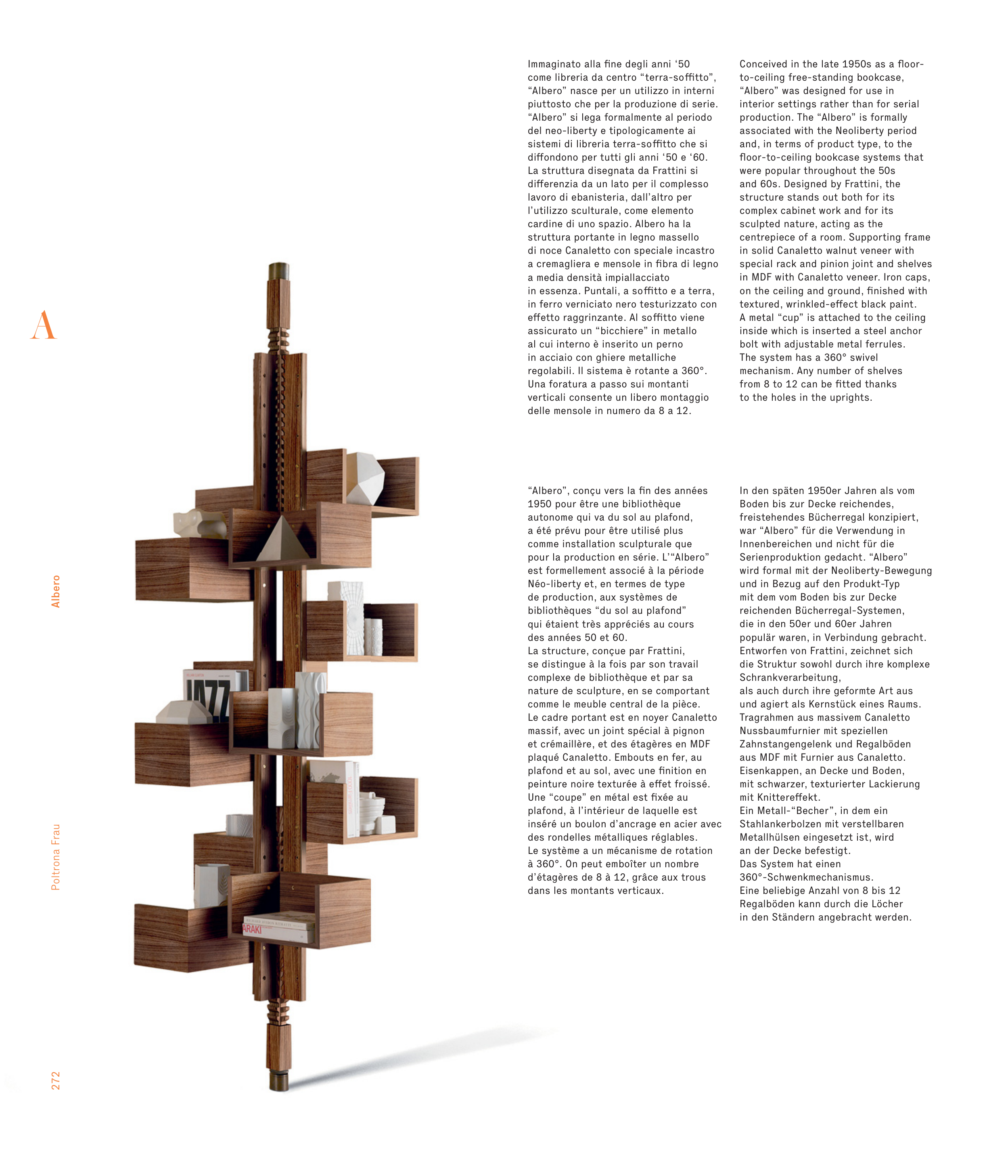
Conceived in the late 1950s as a fl oor-
to-ceiling free-standing bookcase,
“Albero” was designed for use in
interior settings rather than for serial
production. The “Albero” is formally
associated with the Neoliberty period
and, in terms of product type, to the
fl oor-to-ceiling bookcase systems that
were popular throughout the 50s
and 60s. Designed by Frattini, the
structure stands out both for its
complex cabinet work and for its
sculpted nature, acting as the
centrepiece of a room. Supporting frame
in solid Canaletto walnut veneer with
special rack and pinion joint and shelves
in MDF with Canaletto veneer. Iron caps,
on the ceiling and ground, fi nished with
textured, wrinkled-eff ect black paint.
A metal “cup” is attached to the ceiling
inside which is inserted a steel anchor
bolt with adjustable metal ferrules.
The system has a 360° swivel
mechanism. Any number of shelves
from 8 to 12 can be fi tted thanks
to the holes in the uprights.
“Albero”, conçu vers la fi n des années
1950 pour être une bibliothèque
autonome qui va du sol au plafond,
a été prévu pour être utilisé plus
comme installation sculpturale que
pour la production en série. L’“Albero”
est formellement associé à la période
Néo-liberty et, en termes de type
de production, aux systèmes de
bibliothèques “du sol au plafond”
qui étaient très appréciés au cours
des années 50 et 60.
La structure, conçue par Frattini,
se distingue à la fois par son travail
complexe de bibliothèque et par sa
nature de sculpture, en se comportant
comme le meuble central de la pièce.
Le cadre portant est en noyer Canaletto
massif, avec un joint spécial à pignon
et crémaillère, et des étagères en MDF
plaqué Canaletto. Embouts en fer, au
plafond et au sol, avec une fi nition en
peinture noire texturée à eff et froissé.
Une “coupe” en métal est fi xée au
plafond, à l’intérieur de laquelle est
inséré un boulon d’ancrage en acier avec
des rondelles métalliques réglables.
Le système a un mécanisme de rotation
à 360°. On peut emboîter un nombre
d’étagères de 8 à 12, grâce aux trous
dans les montants verticaux.
In den späten 1950er Jahren als vom
Boden bis zur Decke reichendes,
freistehendes Bücherregal konzipiert,
war “Albero” für die Verwendung in
Innenbereichen und nicht für die
Serienproduktion gedacht. “Albero”
wird formal mit der Neoliberty-Bewegung
und in Bezug auf den Produkt-Typ
mit dem vom Boden bis zur Decke
reichenden Bücherregal-Systemen,
die in den 50er und 60er Jahren
populär waren, in Verbindung gebracht.
Entworfen von Frattini, zeichnet sich
die Struktur sowohl durch ihre komplexe
Schrankverarbeitung,
als auch durch ihre geformte Art aus
und agiert als Kernstück eines Raums.
Tragrahmen aus massivem Canaletto
Nussbaumfurnier mit speziellen
Zahnstangengelenk und Regalböden
aus MDF mit Furnier aus Canaletto.
Eisenkappen, an Decke und Boden,
mit schwarzer, texturierter Lackierung
mit Knittereff ekt.
Ein Metall-“Becher”, in dem ein
Stahlankerbolzen mit verstellbaren
Metallhülsen eingesetzt ist, wird
an der Decke befestigt.
Das System hat einen
360°-Schwenkmechanismus.
Eine beliebige Anzahl von 8 bis 12
Regalböden kann durch die Löcher
in den Ständern angebracht werden.