50
51
True Heritage
100+10 Years of True Evolution
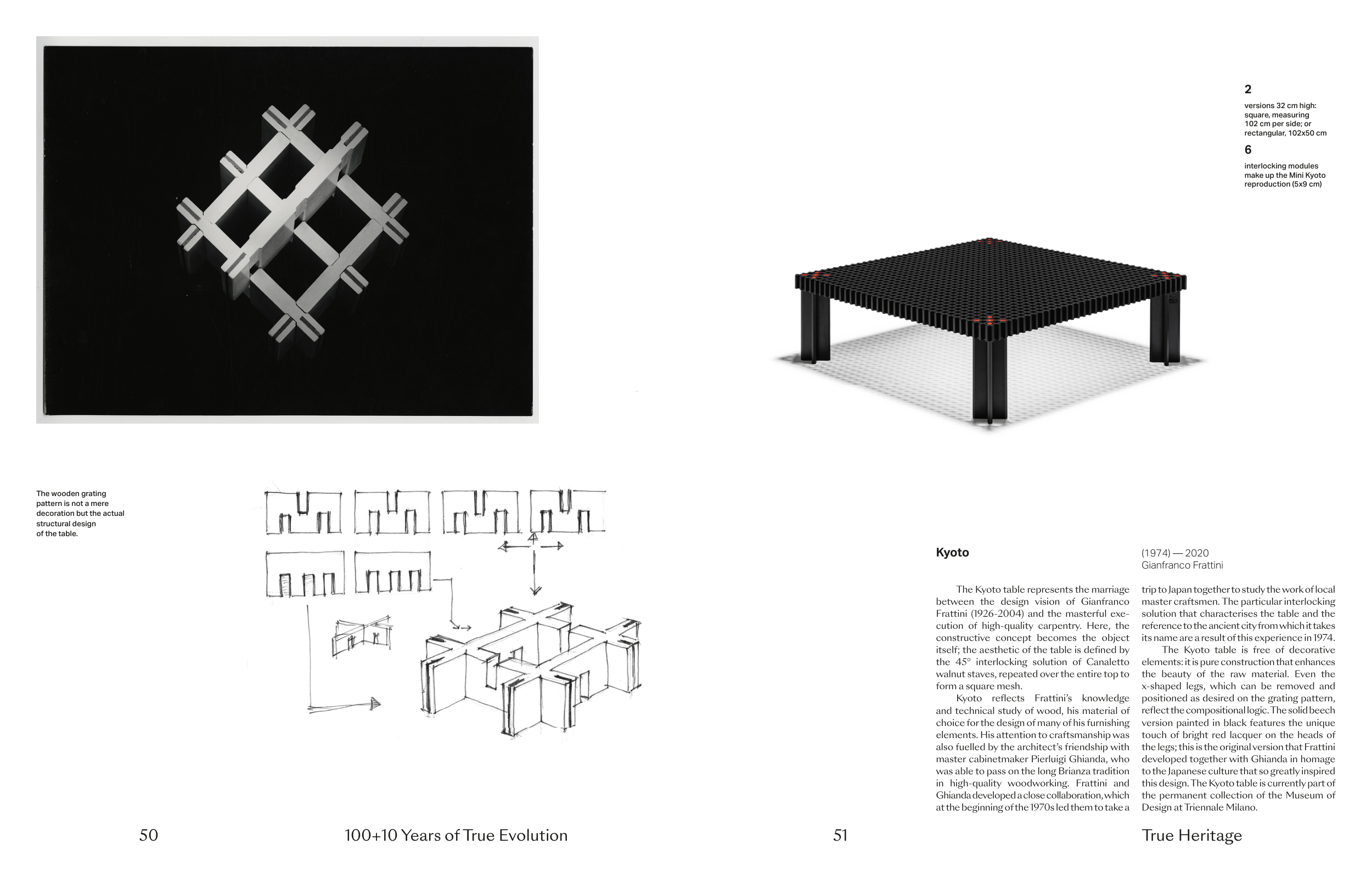
The Kyoto table represents the marriage
between the design vision of Gianfranco
Frattini (1926-2004) and the masterful exe-
cution of high-quality carpentry. Here, the
constructive concept becomes the object
itself; the aesthetic of the table is defi ned by
the 45° interlocking solution of Canaletto
walnut staves, repeated over the entire top to
form a square mesh.
Kyoto
refl ects
Frattini’s
knowledge
and technical study of wood, his material of
choice for the design of many of his furnishing
elements. His attention to craftsmanship was
also fuelled by the architect’s friendship with
master cabinetmaker Pierluigi Ghianda, who
was able to pass on the long Brianza tradition
in high-quality woodworking. Frattini and
Ghianda developed a close collaboration, which
at the beginning of the 1970s led them to take a
trip to Japan together to study the work of local
master craftsmen. The particular interlocking
solution that characterises the table and the
reference to the ancient city from which it takes
its name are a result of this experience in 1974.
The Kyoto table is free of decorative
elements: it is pure construction that enhances
the beauty of the raw material. Even the
x-shaped legs, which can be removed and
positioned as desired on the grating pattern,
refl ect the compositional logic. The solid beech
version painted in black features the unique
touch of bright red lacquer on the heads of
the legs; this is the original version that Frattini
developed together with Ghianda in homage
to the Japanese culture that so greatly inspired
this design. The Kyoto table is currently part of
the permanent collection of the Museum of
Design at Triennale Milano.
(1974) — 2020
Gianfranco Frattini
Kyoto
interlocking modules
make up the Mini Kyoto
reproduction (5x9 cm)
versions 32 cm high:
square, measuring
102 cm per side; or
rectangular, 102x50 cm
2
6
The wooden grating
pattern is not a mere
decoration but the actual
structural design
of the table.