40
41
True Heritage
100+10 Years of True Evolution
length of the bench
and 43 cm of width
elements that make
up the seat of DU 30:
steel monocoque, foam
padding, 2 folded tubes
for the legs, upholstery
in Pelle Frau® leather
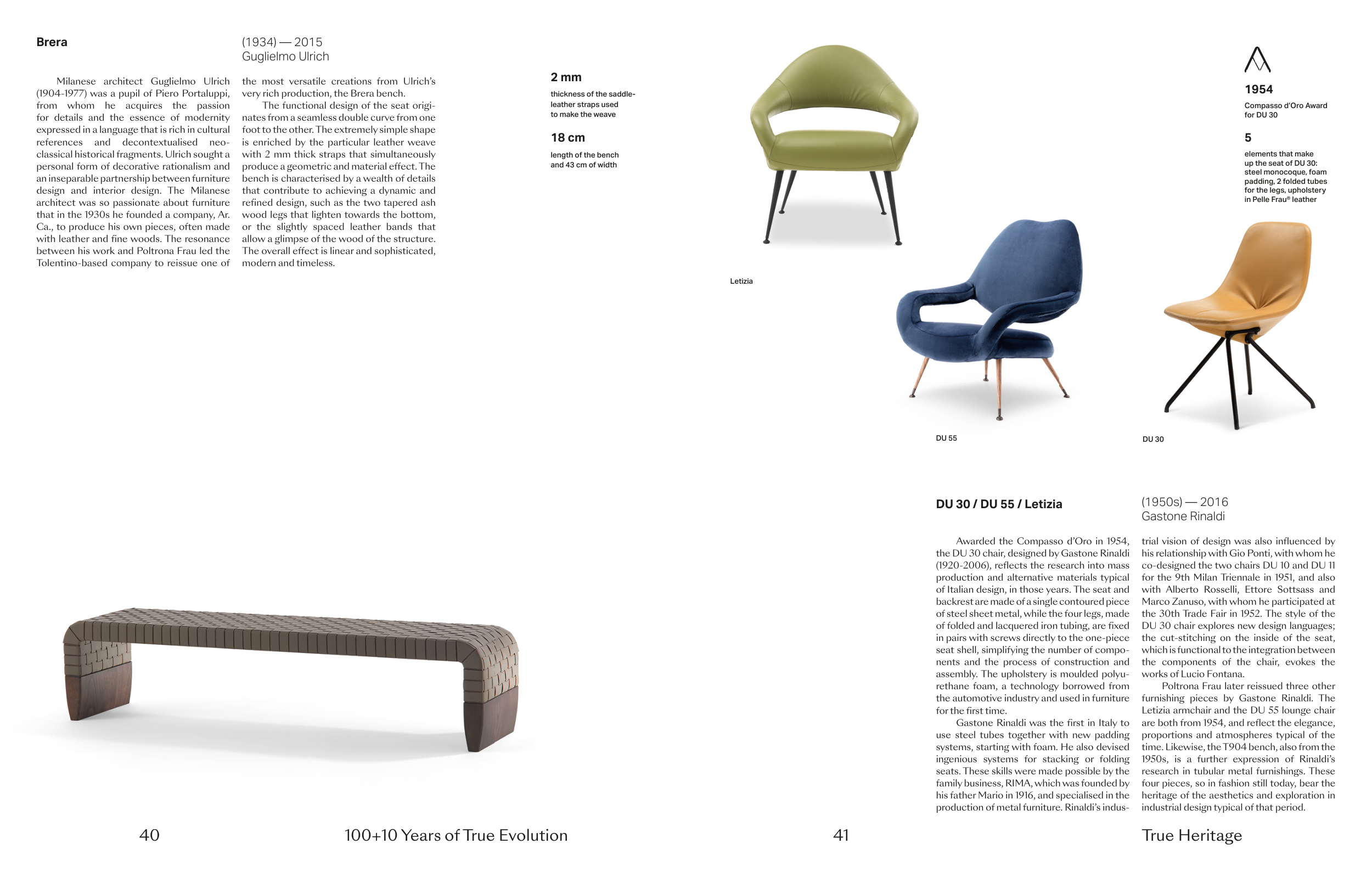
DU 30
DU 55
Letizia
thickness of the saddle-
leather straps used
to make the weave
Compasso d’Oro Award
for DU 30
2 mm
1954
18 cm
5
Milanese architect Guglielmo Ulrich
(1904-1977) was a pupil of Piero Portaluppi,
from
whom
he
acquires
the
passion
for details and the essence of modernity
expressed in a language that is rich in cultural
references
and
decontextualised
neo-
classical historical fragments. Ulrich sought a
personal form of decorative rationalism and
an inseparable partnership between furniture
design and interior design. The Milanese
architect was so passionate about furniture
that in the 1930s he founded a company, Ar.
Ca., to produce his own pieces, often made
with leather and fine woods. The resonance
between his work and Poltrona Frau led the
Tolentino-based company to reissue one of
the most versatile creations from Ulrich’s
very rich production, the Brera bench.
The functional design of the seat origi-
nates from a seamless double curve from one
foot to the other. The extremely simple shape
is enriched by the particular leather weave
with 2 mm thick straps that simultaneously
produce a geometric and material effect. The
bench is characterised by a wealth of details
that contribute to achieving a dynamic and
refined design, such as the two tapered ash
wood legs that lighten towards the bottom,
or the slightly spaced leather bands that
allow a glimpse of the wood of the structure.
The overall effect is linear and sophisticated,
modern and timeless.
(1934) — 2015
Guglielmo Ulrich
Brera
Awarded the Compasso d’Oro in 1954,
the DU 30 chair, designed by Gastone Rinaldi
(1920-2006), reflects the research into mass
production and alternative materials typical
of Italian design, in those years. The seat and
backrest are made of a single contoured piece
of steel sheet metal, while the four legs, made
of folded and lacquered iron tubing, are fixed
in pairs with screws directly to the one-piece
seat shell, simplifying the number of compo-
nents and the process of construction and
assembly. The upholstery is moulded polyu-
rethane foam, a technology borrowed from
the automotive industry and used in furniture
for the first time.
Gastone Rinaldi was the first in Italy to
use steel tubes together with new padding
systems, starting with foam. He also devised
ingenious systems for stacking or folding
seats. These skills were made possible by the
family business, RIMA, which was founded by
his father Mario in 1916, and specialised in the
production of metal furniture. Rinaldi’s indus-
trial vision of design was also influenced by
his relationship with Gio Ponti, with whom he
co-designed the two chairs DU 10 and DU 11
for the 9th Milan Triennale in 1951, and also
with Alberto Rosselli, Ettore Sottsass and
Marco Zanuso, with whom he participated at
the 30th Trade Fair in 1952. The style of the
DU 30 chair explores new design languages;
the cut-stitching on the inside of the seat,
which is functional to the integration between
the components of the chair, evokes the
works of Lucio Fontana.
Poltrona Frau later reissued three other
furnishing pieces by Gastone Rinaldi. The
Letizia armchair and the DU 55 lounge chair
are both from 1954, and reflect the elegance,
proportions and atmospheres typical of the
time. Likewise, the T904 bench, also from the
1950s, is a further expression of Rinaldi’s
research in tubular metal furnishings. These
four pieces, so in fashion still today, bear the
heritage of the aesthetics and exploration in
industrial design typical of that period.
(1950s) — 2016
Gastone Rinaldi
DU 30 / DU 55 / Letizia
40
100+10 Years of True Evolution
steel monocoque, foam
padding, 2 folded tubes
for the legs, upholstery
in Pelle Frau® leather
DU 30
DU 55
Letizia