199
True Tomorrow
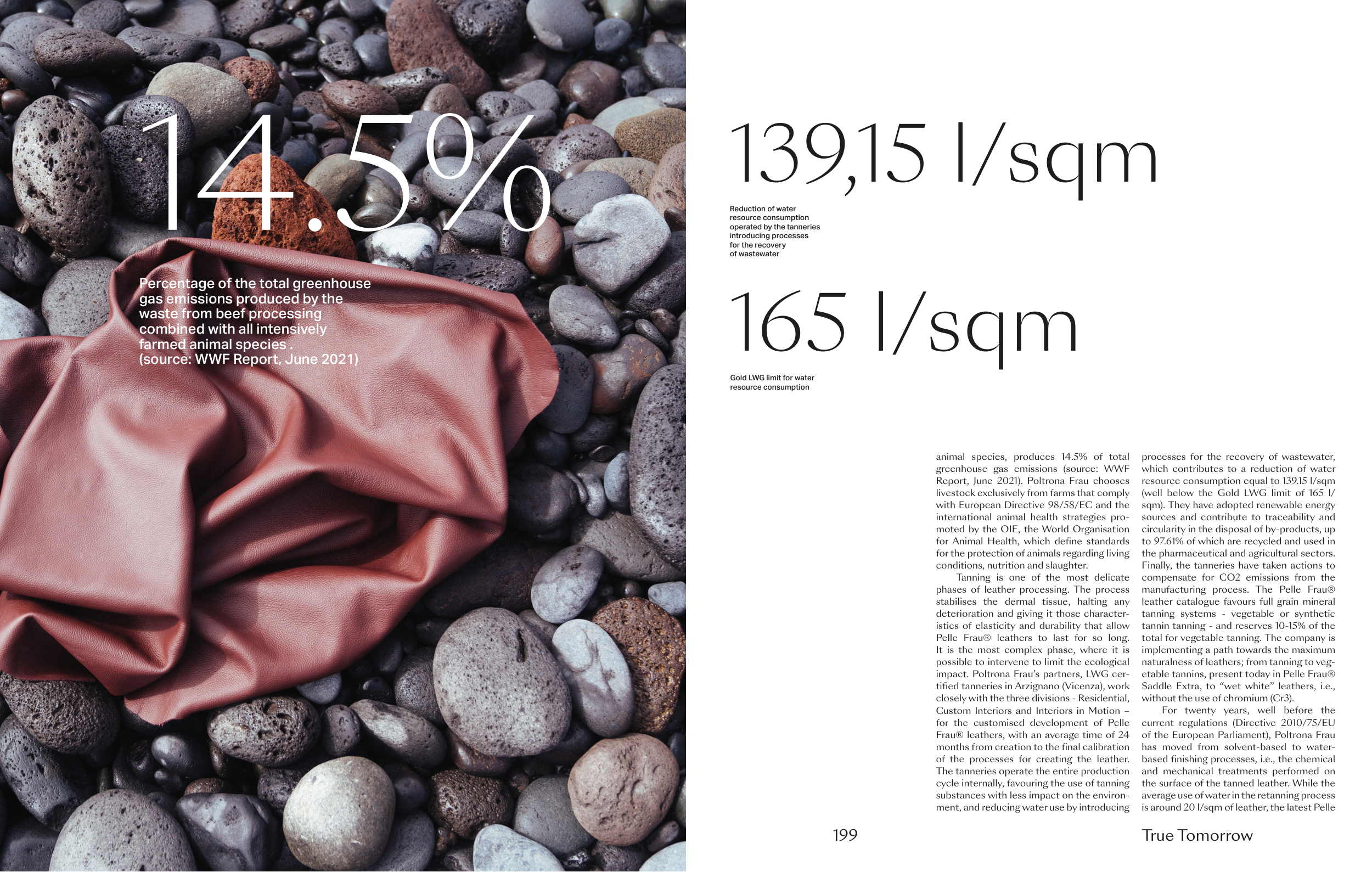
animal species, produces 14.5% of total
greenhouse gas emissions (source: WWF
Report, June 2021). Poltrona Frau chooses
livestock exclusively from farms that comply
with European Directive 98/58/EC and the
international animal health strategies pro-
moted by the OIE, the World Organisation
for Animal Health, which defi ne standards
for the protection of animals regarding living
conditions, nutrition and slaughter.
Tanning is one of the most delicate
phases of leather processing. The process
stabilises the dermal tissue, halting any
deterioration and giving it those character-
istics of elasticity and durability that allow
Pelle Frau® leathers to last for so long.
It is the most complex phase, where it is
possible to intervene to limit the ecological
impact. Poltrona Frau’s partners, LWG cer-
tifi ed tanneries in Arzignano (Vicenza), work
closely with the three divisions - Residential,
Custom Interiors and Interiors in Motion –
for the customised development of Pelle
Frau® leathers, with an average time of 24
months from creation to the fi nal calibration
of the processes for creating the leather.
The tanneries operate the entire production
cycle internally, favouring the use of tanning
substances with less impact on the environ-
ment, and reducing water use by introducing
processes for the recovery of wastewater,
which contributes to a reduction of water
resource consumption equal to 139.15 l/sqm
(well below the Gold LWG limit of 165 l/
sqm). They have adopted renewable energy
sources and contribute to traceability and
circularity in the disposal of by-products, up
to 97.61% of which are recycled and used in
the pharmaceutical and agricultural sectors.
Finally, the tanneries have taken actions to
compensate for CO2 emissions from the
manufacturing process. The Pelle Frau®
leather catalogue favours full grain mineral
tanning systems - vegetable or synthetic
tannin tanning - and reserves 10-15% of the
total for vegetable tanning. The company is
implementing a path towards the maximum
naturalness of leathers; from tanning to veg-
etable tannins, present today in Pelle Frau®
Saddle Extra, to “wet white” leathers, i.e.,
without the use of chromium (Cr3).
For twenty years, well before the
current regulations (Directive 2010/75/EU
of the European Parliament), Poltrona Frau
has moved from solvent-based to water-
based fi nishing processes, i.e., the chemical
and mechanical treatments performed on
the surface of the tanned leather. While the
average use of water in the retanning process
is around 20 l/sqm of leather, the latest Pelle
14.5%
139,15 l/sqm
165 l/sqm
Percentage of the total greenhouse
gas emissions produced by the
waste from beef processing
combined with all intensively
farmed animal species .
(source: WWF Report, June 2021)
Reduction of water
resource consumption
operated by the tanneries
introducing processes
for the recovery
of wastewater
Gold LWG limit for water
resource consumption