of Art. When he saw my sketches, he
bought the entire folder. But then he said
something curious: ‘I can see talent in
what you’re doing, but I’ll never produce
something from these drawings.’ He then
asked if I wanted to visit the Salviati
factory and learn about the briefing
process. Thanks to that experience I met
a lot of art and design heroes: Ross
Lovegrove, Tom Dixon, Anish Kapoor,
Ingo Maurer. I saw how people with
different personalities express their ideas
in different ways, through drawings,
renderings, talking or small models.
After two years of frequent factory
visits, Simon finally gave me a proper
brief. I designed a collection of vases
called Millebolle, which became a
bestseller and are still in production
today. I also completed an internship
with Foscarini, which was then based in
Murano. During that period the lighting
company was moving away from
working solely with glass. In 2001 I
designed my first lamp for the brand,
made from aluminium. Slowly my name
became known in the Italian design
industry and I was approached by other
brands to develop products, including
furniture.
When did Moooi come
into the picture?
ln: I met Marcel many times during
Milan Design Week, and I know a
number of people who work in his
studio. Around three years ago I
designed a large lamp for Foscarini,
called Plass. Marcel really appreciated
that product and wanted me to create
something for Moooi. I began to wonder
what I could design for such a strong
brand with strong pieces.
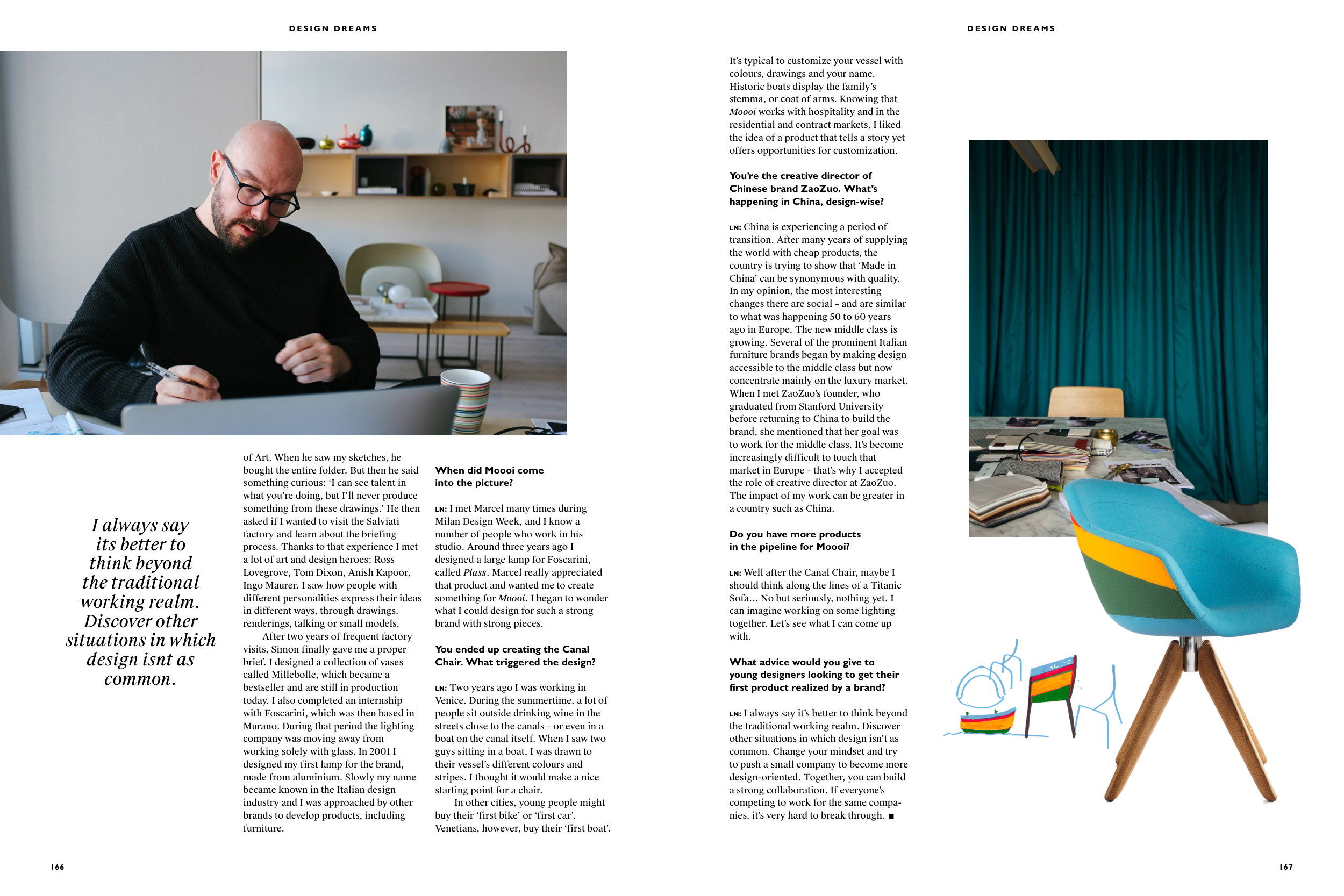
You ended up creating the Canal
Chair. What triggered the design?
ln: Two years ago I was working in
Venice. During the summertime, a lot of
people sit outside drinking wine in the
streets close to the canals – or even in a
boat on the canal itself. When I saw two
guys sitting in a boat, I was drawn to
their vessel’s different colours and
stripes. I thought it would make a nice
starting point for a chair.
In other cities, young people might
buy their ‘first bike’ or ‘first car’.
Venetians, however, buy their ‘first boat’.
I always say
its better to
think beyond
the traditional
working realm.
Discover other
situations in which
design isnt as
common.
D E S I G N D R E A M S
It’s typical to customize your vessel with
colours, drawings and your name.
Historic boats display the family’s
stemma, or coat of arms. Knowing that
Moooi works with hospitality and in the
residential and contract markets, I liked
the idea of a product that tells a story yet
offers opportunities for customization.
You’re the creative director of
Chinese brand ZaoZuo. What’s
happening in China, design-wise?
ln: China is experiencing a period of
transition. After many years of supplying
the world with cheap products, the
country is trying to show that ‘Made in
China’ can be synonymous with quality.
In my opinion, the most interesting
changes there are social – and are similar
to what was happening 50 to 60 years
ago in Europe. The new middle class is
growing. Several of the prominent Italian
furniture brands began by making design
accessible to the middle class but now
concentrate mainly on the luxury market.
When I met ZaoZuo’s founder, who
graduated from Stanford University
before returning to China to build the
brand, she mentioned that her goal was
to work for the middle class. It’s become
increasingly difficult to touch that
market in Europe – that’s why I accepted
the role of creative director at ZaoZuo.
The impact of my work can be greater in
a country such as China.
Do you have more products
in the pipeline for Moooi?
ln: Well after the Canal Chair, maybe I
should think along the lines of a Titanic
Sofa… No but seriously, nothing yet. I
can imagine working on some lighting
together. Let’s see what I can come up
with.
What advice would you give to
young designers looking to get their
fi rst product realized by a brand?
ln: I always say it’s better to think beyond
the traditional working realm. Discover
other situations in which design isn’t as
common. Change your mindset and try
to push a small company to become more
design-oriented. Together, you can build
a strong collaboration. If everyone’s
competing to work for the same compa-
nies, it’s very hard to break through. ■
D E S I G N D R E A M S
166
167