INTERVIEW BY TRACEY INGRAM
What was your upbringing like?
luca nichetto: I grew up in Murano, a
small island close to Venice that’s famous
for its glass making. Like 99 per cent of
the area’s residents, my family was
involved in the glass industry – my
mother was a decorator and my grandfa-
ther, a glass blower. Seeing a drawing
become an object was normal to me – it
happened every day. I had a talent for
drawing and decided to study at the
Venice Institute of Art. During the
school’s summer holidays, a classmate
and I would go door to door in Murano,
trying to sell our drawings. At that point
I didn’t want to be a designer – I didn’t
even realize it was a job title – I just
wanted to make some money and
have fun.
Was there family pressure to go
into the Murano glass business?
ln: My parents never pushed me into
anything. I tried working with glass, tried
to experience the material, but if you
really want to be part of the industry you
have to dive into it from a very young
age. You don’t go off to study; you
immediately start working. My parents
valued my education. I tried to find my
own space within the creative industry.
That was drawing.
How did your ‘summer job’ of selling
drawings turn into a design career?
ln: Eventually I knocked on the door of
Salviati glassmakers, a very important
brand at that time. The creative director
back then was Simon Moore, a British
man who also taught at the Royal College
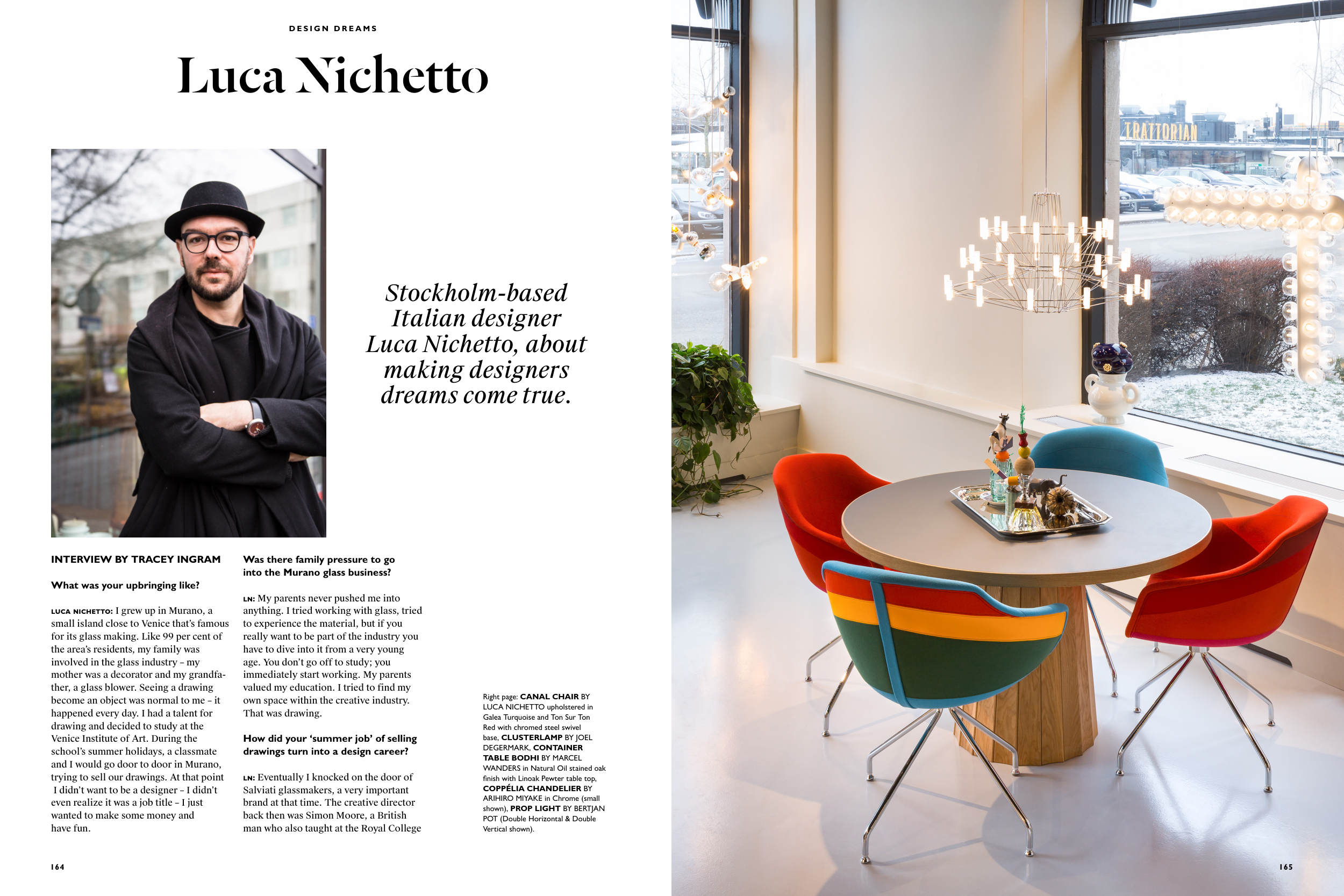
Right page: CANAL CHAIR BY
LUCA NICHETTO upholstered in
Galea Turquoise and Ton Sur Ton
Red with chromed steel swivel
base, CLUSTERLAMP BY JOEL
DEGERMARK, CONTAINER
TABLE BODHI BY MARCEL
WANDERS in Natural Oil stained oak
fi nish with Linoak Pewter table top,
COPPÉLIA CHANDELIER BY
ARIHIRO MIYAKE in Chrome (small
shown), PROP LIGHT BY BERTJAN
POT (Double Horizontal & Double
Vertical shown).
D E S I G N D R E A M S
Luca Nichetto
Stockholm-based
Italian designer
Luca Nichetto, about
making designers
dreams come true.
164
165