times. Eventually I came up with the idea
of making the Smoke furniture
collection.
How did Smoke come into being?
mb: I needed to choose a theme for my
graduation work and wanted to challenge
the definition of beauty. I questioned
why we need to preserve products, as if
time doesn’t exist, when nature itself is in
constant flux. We typically try to not
damage our furniture, but I did the
opposite: I burned it. The pieces took on
a new kind of beauty and made people
look at them in another way.
You tried other ways of altering
the furniture: soaking it in
water, throwing it of a clif …
mb: I experimented a lot within the theme
of preservation and natural evolution. In
retrospect, some of the results resemble
the Clay Furniture I developed a number
of years later. Clay was also a balance
between rigidity and natural expression.
Smoke ended up taking on a life
of its own. How did that happen?
mb: Straight after I graduated it was
launched by Moooi and shown in Moss,
the most prominent gallery in New York
City. I knew my circumstances were
extraordinary but I didn’t know any
different either. It wasn’t always easy. I
was trying to build up my own studio
while all kinds of assignments rolled in,
but I enjoyed the momentum.
There were four years between
Smoke and Clay. After the success
of Smoke, did you feel pressured to
come up with an amazing new idea?
mb: There were two kinds of pressure.
Greater than the stress of outsiders
looking at me, wondering if I was a
one-hit wonder, was the pressure I put on
myself. I wanted to move on and make
something new. It was exciting to come
up with a new collection, and my
intuition told me to make something
fragile. I felt vulnerable, especially
working with clay. My choices were to go
through with it or risk bankruptcy.
Thankfully, it was a success.
Now you’ve developed your
fi rst of cial industrial product:
Something Like This.
mb: A lot of my work has a naive
aesthetic, which I like, but Something
Like This is ‘Maarten Baas grows up’. It’s
a modular sofa system that looks like a
sketch. If you want something to be
modular it’s better to work with straight
lines and fixed sizes, so it was an extra
challenge to make Something Like This
suitable for industrial production. That’s
where Moooi came in. I was so happy to
see that they have an online tool for
clients to modify it and choose fabrics.
That makes it even crazier – that what
was once a little hand-drawn sketch now
has an extremely well developed system
behind it. A recurring theme in my work
is to make products that look as simple
as possible, like there’s no effort behind
them.
Your Turbo tables also resemble
cartoon-like sketches. What’s
the idea behind those?
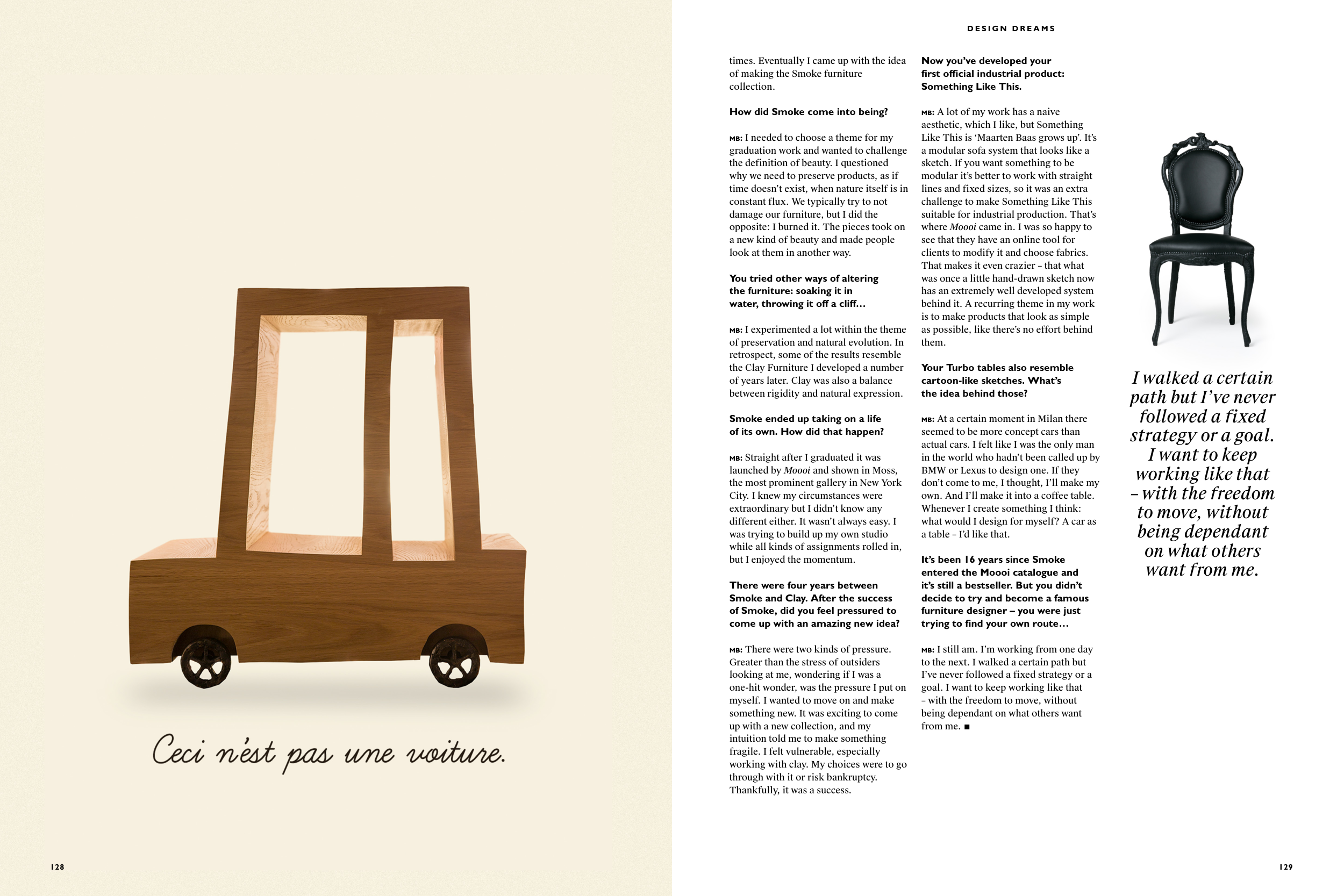
mb: At a certain moment in Milan there
seemed to be more concept cars than
actual cars. I felt like I was the only man
in the world who hadn’t been called up by
BMW or Lexus to design one. If they
don’t come to me, I thought, I’ll make my
own. And I’ll make it into a coffee table.
Whenever I create something I think:
what would I design for myself? A car as
a table – I’d like that.
It’s been 16 years since Smoke
entered the Moooi catalogue and
it’s still a bestseller. But you didn’t
decide to try and become a famous
furniture designer – you were just
trying to fi nd your own route…
mb: I still am. I’m working from one day
to the next. I walked a certain path but
I’ve never followed a fixed strategy or a
goal. I want to keep working like that
– with the freedom to move, without
being dependant on what others want
from me. ■
D E S I G N D R E A M S
I walked a certain
path but I’ve never
followed a fixed
strategy or a goal.
I want to keep
working like that
– with the freedom
to move, without
being dependant
on what others
want from me.
128
129