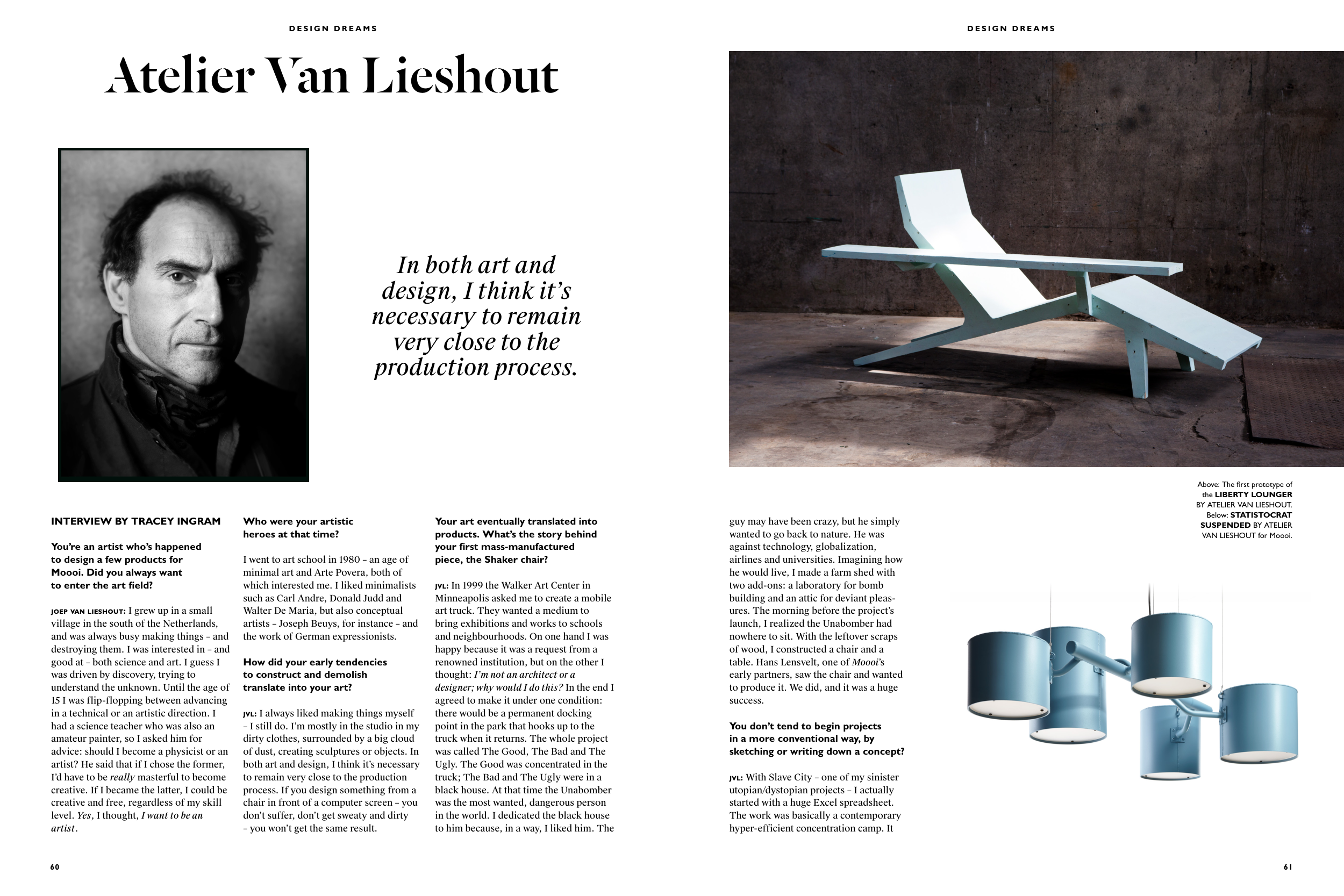
INTERVIEW BY TRACEY INGRAM
You’re an artist who’s happened
to design a few products for
Moooi. Did you always want
to enter the art fi eld?
joep van lieshout: I grew up in a small
village in the south of the Netherlands,
and was always busy making things – and
destroying them. I was interested in – and
good at – both science and art. I guess I
was driven by discovery, trying to
understand the unknown. Until the age of
15 I was flip-flopping between advancing
in a technical or an artistic direction. I
had a science teacher who was also an
amateur painter, so I asked him for
advice: should I become a physicist or an
artist? He said that if I chose the former,
I’d have to be really masterful to become
creative. If I became the latter, I could be
creative and free, regardless of my skill
level. Yes, I thought, I want to be an
artist.
Who were your artistic
heroes at that time?
I went to art school in 1980 – an age of
minimal art and Arte Povera, both of
which interested me. I liked minimalists
such as Carl Andre, Donald Judd and
Walter De Maria, but also conceptual
artists – Joseph Beuys, for instance – and
the work of German expressionists.
How did your early tendencies
to construct and demolish
translate into your art?
jvl: I always liked making things myself
– I still do. I’m mostly in the studio in my
dirty clothes, surrounded by a big cloud
of dust, creating sculptures or objects. In
both art and design, I think it’s necessary
to remain very close to the production
process. If you design something from a
chair in front of a computer screen – you
don’t suffer, don’t get sweaty and dirty
– you won’t get the same result.
Your art eventually translated into
products. What’s the story behind
your fi rst mass-manufactured
piece, the Shaker chair?
jvl: In 1999 the Walker Art Center in
Minneapolis asked me to create a mobile
art truck. They wanted a medium to
bring exhibitions and works to schools
and neighbourhoods. On one hand I was
happy because it was a request from a
renowned institution, but on the other I
thought: I’m not an architect or a
designer; why would I do this? In the end I
agreed to make it under one condition:
there would be a permanent docking
point in the park that hooks up to the
truck when it returns. The whole project
was called The Good, The Bad and The
Ugly. The Good was concentrated in the
truck; The Bad and The Ugly were in a
black house. At that time the Unabomber
was the most wanted, dangerous person
in the world. I dedicated the black house
to him because, in a way, I liked him. The
Atelier Van Lieshout
D E S I G N D R E A M S
In both art and
design, I think it’s
necessary to remain
very close to the
production process.
D E S I G N D R E A M S
guy may have been crazy, but he simply
wanted to go back to nature. He was
against technology, globalization,
airlines and universities. Imagining how
he would live, I made a farm shed with
two add-ons: a laboratory for bomb
building and an attic for deviant pleas-
ures. The morning before the project’s
launch, I realized the Unabomber had
nowhere to sit. With the leftover scraps
of wood, I constructed a chair and a
table. Hans Lensvelt, one of Moooi’s
early partners, saw the chair and wanted
to produce it. We did, and it was a huge
success.
You don’t tend to begin projects
in a more conventional way, by
sketching or writing down a concept?
jvl: With Slave City – one of my sinister
utopian/dystopian projects – I actually
started with a huge Excel spreadsheet.
The work was basically a contemporary
hyper-efficient concentration camp. It
Above: The fi rst prototype of
the LIBERTY LOUNGER
BY ATELIER VAN LIESHOUT.
Below: STATISTOCRAT
SUSPENDED BY ATELIER
VAN LIESHOUT for Moooi.
60
61