was about maximizing profits while
being sustainable. Everything is recycled
– even the slaves themselves, which are
harvested for organs, consumed or
composted. I used the spreadsheet to
calculate exactly what percentage of the
slaves would be suitable, what the life
cycle would be – everything I could think
of. Then I started to build a system and
models.
Slave City led to your second product
for Moooi, the Statistocrat lamp.
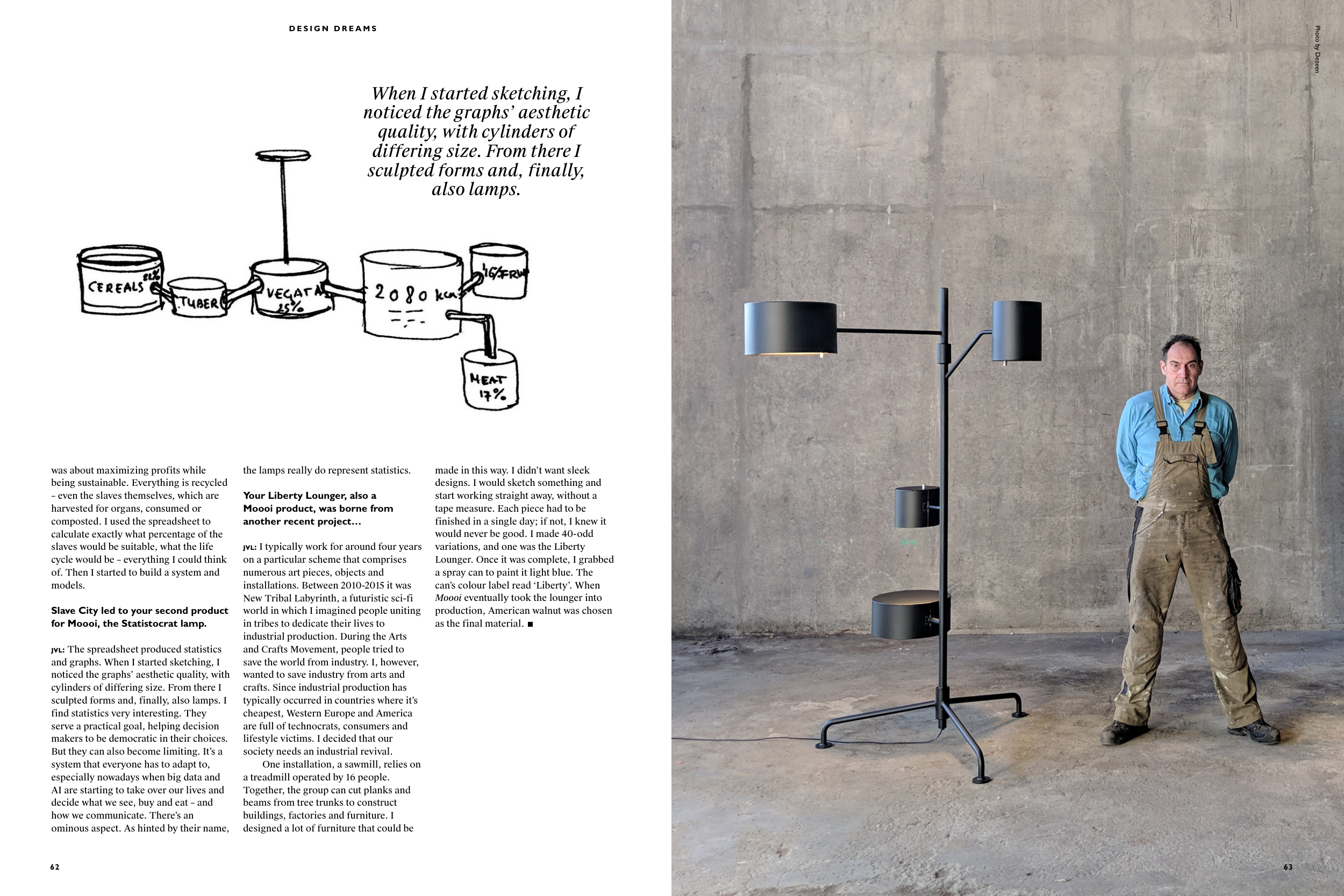
jvl: The spreadsheet produced statistics
and graphs. When I started sketching, I
noticed the graphs’ aesthetic quality, with
cylinders of differing size. From there I
sculpted forms and, finally, also lamps. I
find statistics very interesting. They
serve a practical goal, helping decision
makers to be democratic in their choices.
But they can also become limiting. It’s a
system that everyone has to adapt to,
especially nowadays when big data and
AI are starting to take over our lives and
decide what we see, buy and eat – and
how we communicate. There’s an
ominous aspect. As hinted by their name,
the lamps really do represent statistics.
Your Liberty Lounger, also a
Moooi product, was borne from
another recent project…
jvl: I typically work for around four years
on a particular scheme that comprises
numerous art pieces, objects and
installations. Between 2010-2015 it was
New Tribal Labyrinth, a futuristic sci-fi
world in which I imagined people uniting
in tribes to dedicate their lives to
industrial production. During the Arts
and Crafts Movement, people tried to
save the world from industry. I, however,
wanted to save industry from arts and
crafts. Since industrial production has
typically occurred in countries where it’s
cheapest, Western Europe and America
are full of technocrats, consumers and
lifestyle victims. I decided that our
society needs an industrial revival.
One installation, a sawmill, relies on
a treadmill operated by 16 people.
Together, the group can cut planks and
beams from tree trunks to construct
buildings, factories and furniture. I
designed a lot of furniture that could be
made in this way. I didn’t want sleek
designs. I would sketch something and
start working straight away, without a
tape measure. Each piece had to be
finished in a single day; if not, I knew it
would never be good. I made 40-odd
variations, and one was the Liberty
Lounger. Once it was complete, I grabbed
a spray can to paint it light blue. The
can’s colour label read ‘Liberty’. When
Moooi eventually took the lounger into
production, American walnut was chosen
as the final material. ■
D E S I G N D R E A M S
When I started sketching, I
noticed the graphs’ aesthetic
quality, with cylinders of
differing size. From there I
sculpted forms and, finally,
also lamps.
Photo by Dezeen
62
63