06
07
GOOD ACOUSTICS ARE EFFECTIVE
Persistent noise sources like background noise and voices can cause significant stress, reduce concentration, and negatively
impact well-being. They increase physical strain, lead to mental exhaustion, hinder communication, and can even cause long-term
health issues such as high blood pressure or sleep disorders. Offices, restaurants, shops, schools, and public spaces are particularly
affected. Targeted acoustic solutions help reduce disruptive noise and create a calm, productive environment.
Modern acoustic solutions can reduce sound levels by up to 80%. Depending on the material and placement, the reverberation
time can be reduced by up to 70% – a noticeable difference for any space. The sound pressure level in dB, which indicates how
loud or quiet a sound is, is crucial to our acoustic development work. Prolonged exposure to sound levels above 85 dB can cause
hearing damage, making soundproofing in workspaces, offices, or gastronomy essential. The dB damage scale provides a clear
overview:
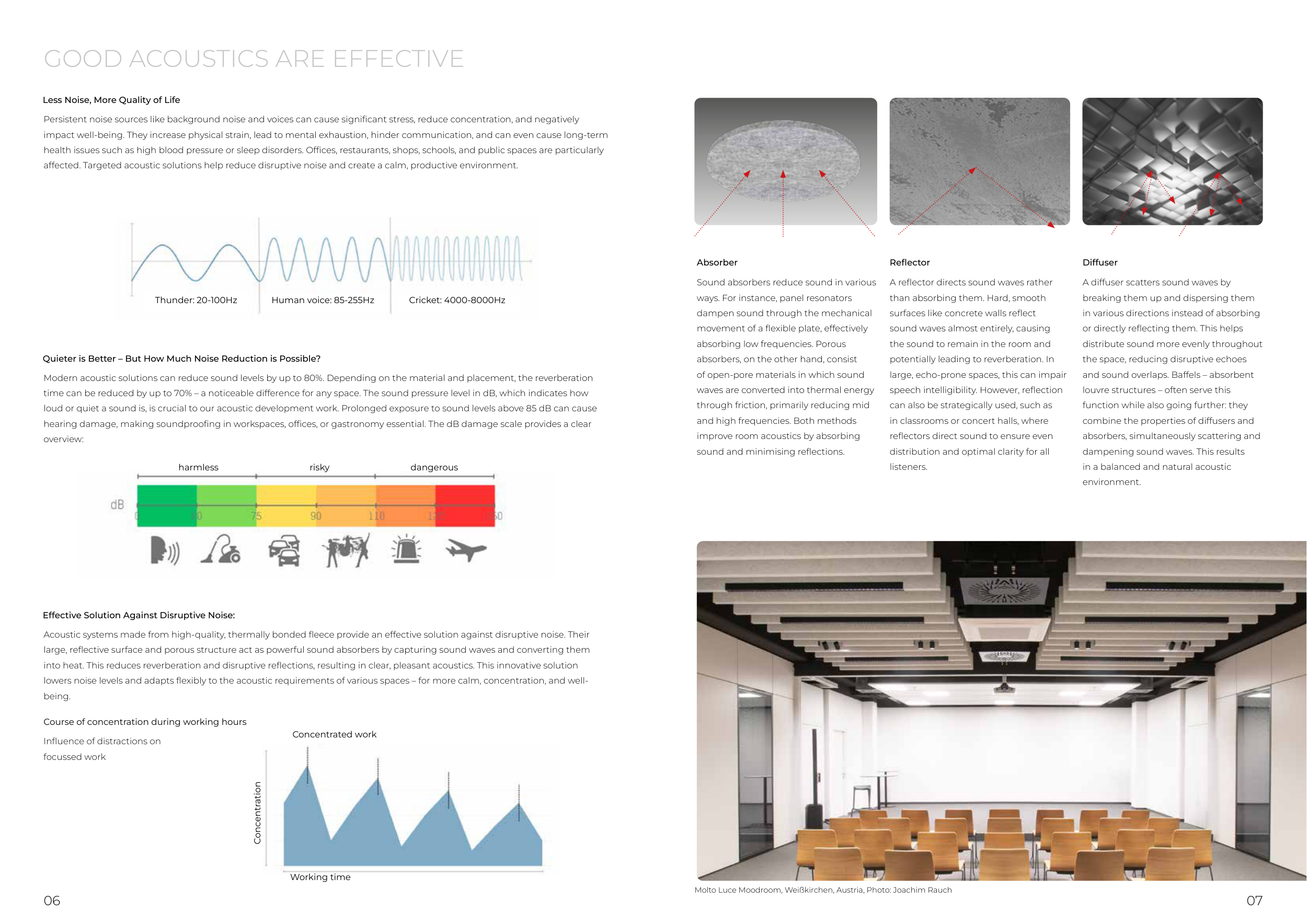
Acoustic systems made from high-quality, thermally bonded fleece provide an effective solution against disruptive noise. Their
large, reflective surface and porous structure act as powerful sound absorbers by capturing sound waves and converting them
into heat. This reduces reverberation and disruptive reflections, resulting in clear, pleasant acoustics. This innovative solution
lowers noise levels and adapts flexibly to the acoustic requirements of various spaces – for more calm, concentration, and well-
being.
A reflector directs sound waves rather
than absorbing them. Hard, smooth
surfaces like concrete walls reflect
sound waves almost entirely, causing
the sound to remain in the room and
potentially leading to reverberation. In
large, echo-prone spaces, this can impair
speech intelligibility. However, reflection
can also be strategically used, such as
in classrooms or concert halls, where
reflectors direct sound to ensure even
distribution and optimal clarity for all
listeners.
A diffuser scatters sound waves by
breaking them up and dispersing them
in various directions instead of absorbing
or directly reflecting them. This helps
distribute sound more evenly throughout
the space, reducing disruptive echoes
and sound overlaps. Baffels – absorbent
louvre structures – often serve this
function while also going further: they
combine the properties of diffusers and
absorbers, simultaneously scattering and
dampening sound waves. This results
in a balanced and natural acoustic
environment.
Sound absorbers reduce sound in various
ways. For instance, panel resonators
dampen sound through the mechanical
movement of a flexible plate, effectively
absorbing low frequencies. Porous
absorbers, on the other hand, consist
of open-pore materials in which sound
waves are converted into thermal energy
through friction, primarily reducing mid
and high frequencies. Both methods
improve room acoustics by absorbing
sound and minimising reflections.
harmless
risky
Concentrated work
Working time
Concentration
dangerous
Less Noise, More Quality of Life
Quieter is Better – But How Much Noise Reduction is Possible?
Effective Solution Against Disruptive Noise:
Absorber
Reflector
Diffuser
Molto Luce Moodroom, Weißkirchen, Austria, Photo: Joachim Rauch
Human voice: 85-255Hz
Thunder: 20-100Hz
Cricket: 4000-8000Hz
Influence of distractions on
focussed work
Course of concentration during working hours