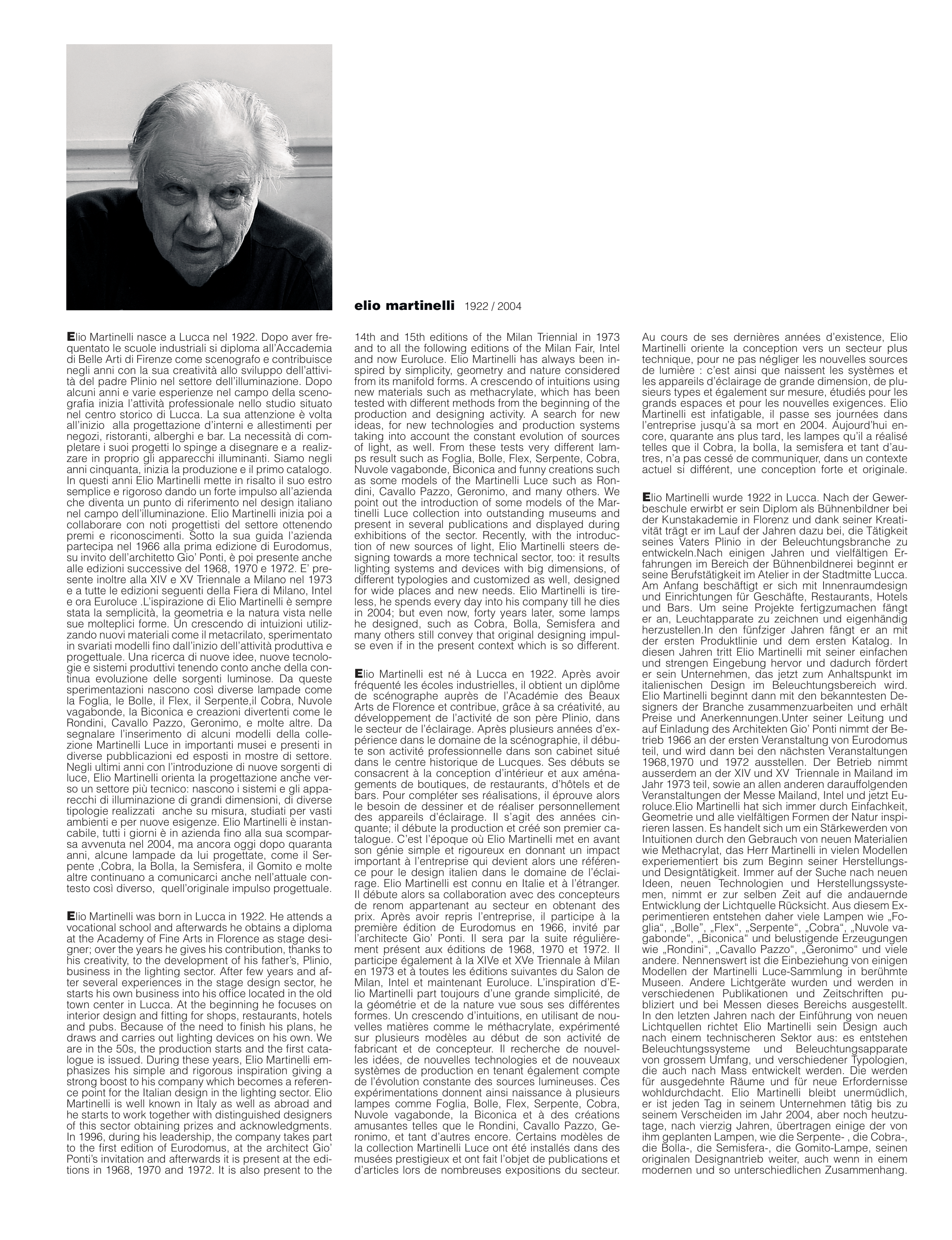
Elio Martinelli nasce a Lucca nel 1922. Dopo aver fre-
quentato le scuole industriali si diploma all’Accademia
di Belle Arti di Firenze come scenografo e contribuisce
negli anni con la sua creatività allo sviluppo dell’attivi-
tà del padre Plinio nel settore dell’illuminazione. Dopo
alcuni anni e varie esperienze nel campo della sceno-
grafia inizia l’attività professionale nello studio situato
nel centro storico di Lucca. La sua attenzione è volta
all’inizio alla progettazione d’interni e allestimenti per
negozi, ristoranti, alberghi e bar. La necessità di com-
pletare i suoi progetti lo spinge a disegnare e a realiz-
zare in proprio gli apparecchi illuminanti. Siamo negli
anni cinquanta, inizia la produzione e il primo catalogo.
In questi anni Elio Martinelli mette in risalto il suo estro
semplice e rigoroso dando un forte impulso all’azienda
che diventa un punto di riferimento nel design italiano
nel campo dell’illuminazione. Elio Martinelli inizia poi a
collaborare con noti progettisti del settore ottenendo
premi e riconoscimenti. Sotto la sua guida l’azienda
partecipa nel 1966 alla prima edizione di Eurodomus,
su invito dell’architetto Gio’ Ponti, è poi presente anche
alle edizioni successive del 1968, 1970 e 1972. E’ pre-
sente inoltre alla XIV e XV Triennale a Milano nel 1973
e a tutte le edizioni seguenti della Fiera di Milano, Intel
e ora Euroluce .L’ispirazione di Elio Martinelli è sempre
stata la semplicità, la geometria e la natura vista nelle
sue molteplici forme. Un crescendo di intuizioni utiliz-
zando nuovi materiali come il metacrilato, sperimentato
in svariati modelli fino dall’inizio dell’attività produttiva e
progettuale. Una ricerca di nuove idee, nuove tecnolo-
gie e sistemi produttivi tenendo conto anche della con-
tinua evoluzione delle sorgenti luminose. Da queste
sperimentazioni nascono così diverse lampade come
la Foglia, le Bolle, il Flex, il Serpente,il Cobra, Nuvole
vagabonde, la Biconica e creazioni divertenti come le
Rondini, Cavallo Pazzo, Geronimo, e molte altre. Da
segnalare l’inserimento di alcuni modelli della colle-
zione Martinelli Luce in importanti musei e presenti in
diverse pubblicazioni ed esposti in mostre di settore.
Negli ultimi anni con l’introduzione di nuove sorgenti di
luce, Elio Martinelli orienta la progettazione anche ver-
so un settore più tecnico: nascono i sistemi e gli appa-
recchi di illuminazione di grandi dimensioni, di diverse
tipologie realizzati anche su misura, studiati per vasti
ambienti e per nuove esigenze. Elio Martinelli è instan-
cabile, tutti i giorni è in azienda fino alla sua scompar-
sa avvenuta nel 2004, ma ancora oggi dopo quaranta
anni, alcune lampade da lui progettate, come il Ser-
pente ,Cobra, la Bolla, la Semisfera, il Gomito e molte
altre continuano a comunicarci anche nell’attuale con-
testo così diverso, quell’originale impulso progettuale.
Elio Martinelli was born in Lucca in 1922. He attends a
vocational school and afterwards he obtains a diploma
at the Academy of Fine Arts in Florence as stage desi-
gner; over the years he gives his contribution, thanks to
his creativity, to the development of his father’s, Plinio,
business in the lighting sector. After few years and af-
ter several experiences in the stage design sector, he
starts his own business into his office located in the old
town center in Lucca. At the beginning he focuses on
interior design and fitting for shops, restaurants, hotels
and pubs. Because of the need to finish his plans, he
draws and carries out lighting devices on his own. We
are in the 50s, the production starts and the first cata-
logue is issued. During these years, Elio Martinelli em-
phasizes his simple and rigorous inspiration giving a
strong boost to his company which becomes a referen-
ce point for the Italian design in the lighting sector. Elio
Martinelli is well known in Italy as well as abroad and
he starts to work together with distinguished designers
of this sector obtaining prizes and acknowledgments.
In 1996, during his leadership, the company takes part
to the first edition of Eurodomus, at the architect Gio’
Ponti’s invitation and afterwards it is present at the edi-
tions in 1968, 1970 and 1972. It is also present to the
elio martinelli
14th and 15th editions of the Milan Triennial in 1973
and to all the following editions of the Milan Fair, Intel
and now Euroluce. Elio Martinelli has always been in-
spired by simplicity, geometry and nature considered
from its manifold forms. A crescendo of intuitions using
new materials such as methacrylate, which has been
tested with different methods from the beginning of the
production and designing activity. A search for new
ideas, for new technologies and production systems
taking into account the constant evolution of sources
of light, as well. From these tests very different lam-
ps result such as Foglia, Bolle, Flex, Serpente, Cobra,
Nuvole vagabonde, Biconica and funny creations such
as some models of the Martinelli Luce such as Ron-
dini, Cavallo Pazzo, Geronimo, and many others. We
point out the introduction of some models of the Mar-
tinelli Luce collection into outstanding museums and
present in several publications and displayed during
exhibitions of the sector. Recently, with the introduc-
tion of new sources of light, Elio Martinelli steers de-
signing towards a more technical sector, too: it results
lighting systems and devices with big dimensions, of
different typologies and customized as well, designed
for wide places and new needs. Elio Martinelli is tire-
less, he spends every day into his company till he dies
in 2004; but even now, forty years later, some lamps
he designed, such as Cobra, Bolla, Semisfera and
many others still convey that original designing impul-
se even if in the present context which is so different.
Elio Martinelli est né à Lucca en 1922. Après avoir
fréquenté les écoles industrielles, il obtient un diplôme
de scénographe auprès de l’Académie des Beaux
Arts de Florence et contribue, grâce à sa créativité, au
développement de l’activité de son père Plinio, dans
le secteur de l’éclairage. Après plusieurs années d’ex-
périence dans le domaine de la scénographie, il débu-
te son activité professionnelle dans son cabinet situé
dans le centre historique de Lucques. Ses débuts se
consacrent à la conception d’intérieur et aux aména-
gements de boutiques, de restaurants, d’hôtels et de
bars. Pour compléter ses réalisations, il éprouve alors
le besoin de dessiner et de réaliser personnellement
des appareils d’éclairage. Il s’agit des années cin-
quante; il débute la production et créé son premier ca-
talogue. C’est l’époque où Elio Martinelli met en avant
son génie simple et rigoureux en donnant un impact
important à l’entreprise qui devient alors une référen-
ce pour le design italien dans le domaine de l’éclai-
rage. Elio Martinelli est connu en Italie et à l’étranger.
Il débute alors sa collaboration avec des concepteurs
de renom appartenant au secteur en obtenant des
prix. Après avoir repris l’entreprise, il participe à la
première édition de Eurodomus en 1966, invité par
l’architecte Gio’ Ponti. Il sera par la suite régulière-
ment présent aux éditions de 1968, 1970 et 1972. Il
participe également à la XIVe et XVe Triennale à Milan
en 1973 et à toutes les éditions suivantes du Salon de
Milan, Intel et maintenant Euroluce. L’inspiration d’E-
lio Martinelli part toujours d’une grande simplicité, de
la géométrie et de la nature vue sous ses différentes
formes. Un crescendo d’intuitions, en utilisant de nou-
velles matières comme le méthacrylate, expérimenté
sur plusieurs modèles au début de son activité de
fabricant et de concepteur. Il recherche de nouvel-
les idées, de nouvelles technologies et de nouveaux
systèmes de production en tenant également compte
de l’évolution constante des sources lumineuses. Ces
expérimentations donnent ainsi naissance à plusieurs
lampes comme Foglia, Bolle, Flex, Serpente, Cobra,
Nuvole vagabonde, la Biconica et à des créations
amusantes telles que le Rondini, Cavallo Pazzo, Ge-
ronimo, et tant d’autres encore. Certains modèles de
la collection Martinelli Luce ont été installés dans des
musées prestigieux et ont fait l’objet de publications et
d’articles lors de nombreuses expositions du secteur.
Au cours de ses dernières années d’existence, Elio
Martinelli oriente la conception vers un secteur plus
technique, pour ne pas négliger les nouvelles sources
de lumière : c’est ainsi que naissent les systèmes et
les appareils d’éclairage de grande dimension, de plu-
sieurs types et également sur mesure, étudiés pour les
grands espaces et pour les nouvelles exigences. Elio
Martinelli est infatigable, il passe ses journées dans
l’entreprise jusqu’à sa mort en 2004. Aujourd’hui en-
core, quarante ans plus tard, les lampes qu’il a réalisé
telles que il Cobra, la bolla, la semisfera et tant d’au-
tres, n’a pas cessé de communiquer, dans un contexte
actuel si différent, une conception forte et originale.
Elio Martinelli wurde 1922 in Lucca. Nach der Gewer-
beschule erwirbt er sein Diplom als Bühnenbildner bei
der Kunstakademie in Florenz und dank seiner Kreati-
vität trägt er im Lauf der Jahren dazu bei, die Tätigkeit
seines Vaters Plinio in der Beleuchtungsbranche zu
entwickeln.Nach einigen Jahren und vielfältigen Er-
fahrungen im Bereich der Bühnenbildnerei beginnt er
seine Berufstätigkeit im Atelier in der Stadtmitte Lucca.
Am Anfang beschäftigt er sich mit Innenraumdesign
und Einrichtungen für Geschäfte, Restaurants, Hotels
und Bars. Um seine Projekte fertigzumachen fängt
er an, Leuchtapparate zu zeichnen und eigenhändig
herzustellen.In den fünfziger Jahren fängt er an mit
der ersten Produktlinie und dem ersten Katalog. In
diesen Jahren tritt Elio Martinelli mit seiner einfachen
und strengen Eingebung hervor und dadurch fördert
er sein Unternehmen, das jetzt zum Anhaltspunkt im
italienischen Design im Beleuchtungsbereich wird.
Elio Martinelli beginnt dann mit den bekanntesten De-
signers der Branche zusammenzuarbeiten und erhält
Preise und Anerkennungen.Unter seiner Leitung und
auf Einladung des Architekten Gio’ Ponti nimmt der Be-
trieb 1966 an der ersten Veranstaltung von Eurodomus
teil, und wird dann bei den nächsten Veranstaltungen
1968,1970 und 1972 ausstellen. Der Betrieb nimmt
ausserdem an der XIV und XV Triennale in Mailand im
Jahr 1973 teil, sowie an allen anderen darauffolgenden
Veranstaltungen der Messe Mailand, Intel und jetzt Eu-
roluce.Elio Martinelli hat sich immer durch Einfachkeit,
Geometrie und alle vielfältigen Formen der Natur inspi-
rieren lassen. Es handelt sich um ein Stärkewerden von
Intuitionen durch den Gebrauch von neuen Materialien
wie Methacrylat, das Herr Martinelli in vielen Modellen
experiementiert bis zum Beginn seiner Herstellungs-
und Designtätigkeit. Immer auf der Suche nach neuen
Ideen, neuen Technologien und Herstellungssyste-
men, nimmt er zur selben Zeit auf die andauernde
Entwicklung der Lichtquelle Rücksicht. Aus diesem Ex-
perimentieren entstehen daher viele Lampen wie „Fo-
glia“, „Bolle”, „Flex“, „Serpente“, „Cobra“, „Nuvole va-
gabonde“, „Biconica“ und belustigende Erzeugungen
wie „Rondini“, „Cavallo Pazzo“, „Geronimo“ und viele
andere. Nennenswert ist die Einbeziehung von einigen
Modellen der Martinelli Luce-Sammlung in berühmte
Museen. Andere Lichtgeräte wurden und werden in
verschiedenen Publikationen und Zeitschriften pu-
bliziert und bei Messen dieses Bereichs ausgestellt.
In den letzten Jahren nach der Einführung von neuen
Lichtquellen richtet Elio Martinelli sein Design auch
nach einem technischeren Sektor aus: es entstehen
Beleuchtungssysteme
und
Beleuchtungsapparate
von grossem Umfang, und verschiedener Typologien,
die auch nach Mass entwickelt werden. Die werden
für ausgedehnte Räume und für neue Erfordernisse
wohldurchdacht. Elio Martinelli bleibt unermüdlich,
er ist jeden Tag in seinem Unternehmen tätig bis zu
seinem Verscheiden im Jahr 2004, aber noch heutzu-
tage, nach vierzig Jahren, übertragen einige der von
ihm geplanten Lampen, wie die Serpente- , die Cobra-,
die Bolla-, die Semisfera-, die Gomito-Lampe, seinen
originalen Designantrieb weiter, auch wenn in einem
modernen und so unterschiedlichen Zusammenhang.
1922 / 2004