140
141
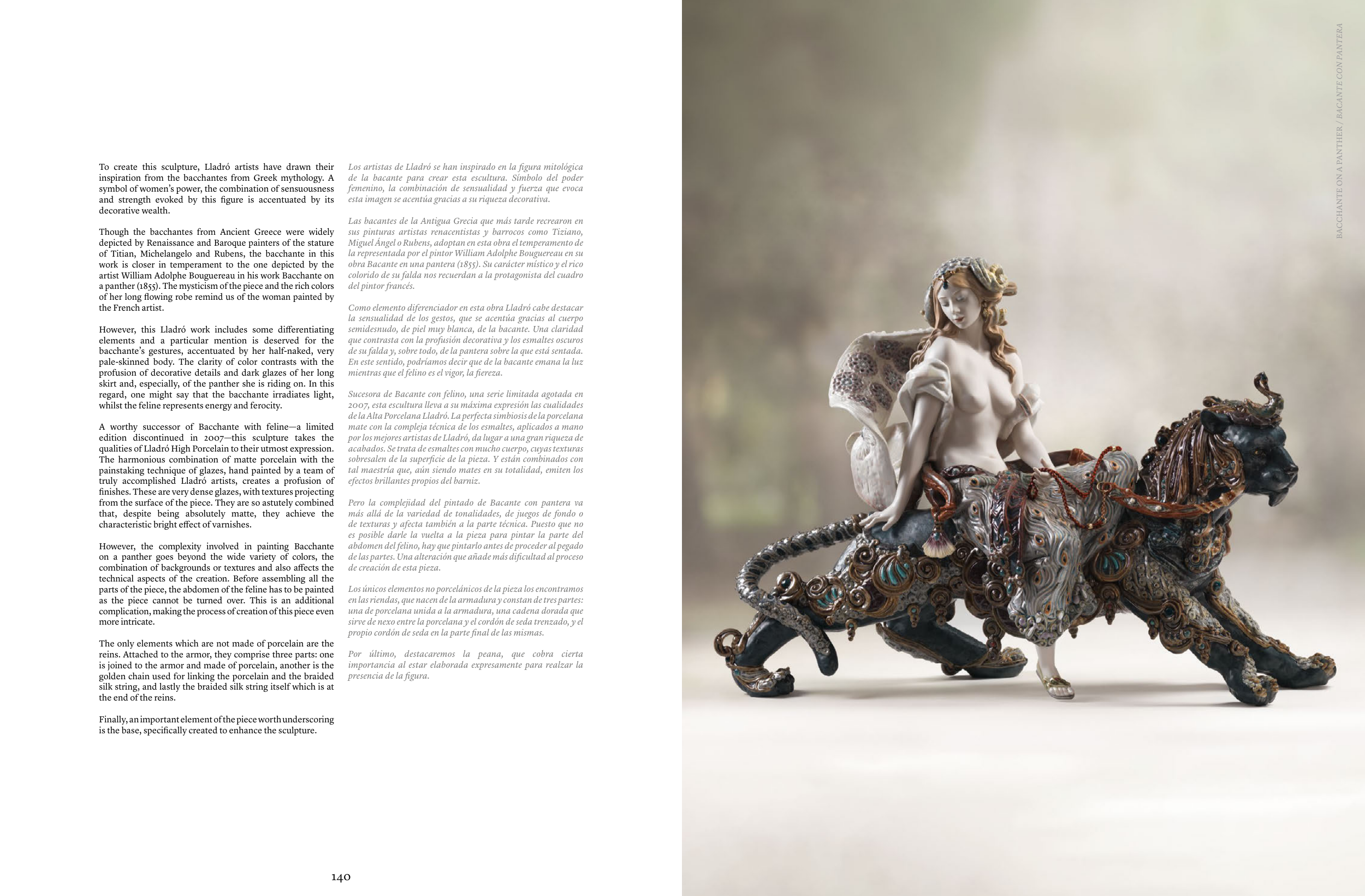
To create this sculpture, Lladró artists have drawn their
inspiration from the bacchantes from Greek mythology. A
symbol of women’s power, the combination of sensuousness
and strength evoked by this figure is accentuated by its
decorative wealth.
Though the bacchantes from Ancient Greece were widely
depicted by Renaissance and Baroque painters of the stature
of Titian, Michelangelo and Rubens, the bacchante in this
work is closer in temperament to the one depicted by the
artist William Adolphe Bouguereau in his work Bacchante on
a panther (1855). The mysticism of the piece and the rich colors
of her long flowing robe remind us of the woman painted by
the French artist.
However, this Lladró work includes some differentiating
elements and a particular mention is deserved for the
bacchante’s gestures, accentuated by her half-naked, very
pale-skinned body. The clarity of color contrasts with the
profusion of decorative details and dark glazes of her long
skirt and, especially, of the panther she is riding on. In this
regard, one might say that the bacchante irradiates light,
whilst the feline represents energy and ferocity.
A worthy successor of Bacchante with feline—a limited
edition discontinued in 2007—this sculpture takes the
qualities of Lladró High Porcelain to their utmost expression.
The harmonious combination of matte porcelain with the
painstaking technique of glazes, hand painted by a team of
truly accomplished Lladró artists, creates a profusion of
finishes. These are very dense glazes, with textures projecting
from the surface of the piece. They are so astutely combined
that, despite being absolutely matte, they achieve the
characteristic bright effect of varnishes.
However, the complexity involved in painting Bacchante
on a panther goes beyond the wide variety of colors, the
combination of backgrounds or textures and also affects the
technical aspects of the creation. Before assembling all the
parts of the piece, the abdomen of the feline has to be painted
as the piece cannot be turned over. This is an additional
complication, making the process of creation of this piece even
more intricate.
The only elements which are not made of porcelain are the
reins. Attached to the armor, they comprise three parts: one
is joined to the armor and made of porcelain, another is the
golden chain used for linking the porcelain and the braided
silk string, and lastly the braided silk string itself which is at
the end of the reins.
Finally, an important element of the piece worth underscoring
is the base, specifically created to enhance the sculpture.
Los artistas de Lladró se han inspirado en la figura mitológica
de la bacante para crear esta escultura. Símbolo del poder
femenino, la combinación de sensualidad y fuerza que evoca
esta imagen se acentúa gracias a su riqueza decorativa.
Las bacantes de la Antigua Grecia que más tarde recrearon en
sus pinturas artistas renacentistas y barrocos como Tiziano,
Miguel Ángel o Rubens, adoptan en esta obra el temperamento de
la representada por el pintor William Adolphe Bouguereau en su
obra Bacante en una pantera (1855). Su carácter místico y el rico
colorido de su falda nos recuerdan a la protagonista del cuadro
del pintor francés.
Como elemento diferenciador en esta obra Lladró cabe destacar
la sensualidad de los gestos, que se acentúa gracias al cuerpo
semidesnudo, de piel muy blanca, de la bacante. Una claridad
que contrasta con la profusión decorativa y los esmaltes oscuros
de su falda y, sobre todo, de la pantera sobre la que está sentada.
En este sentido, podríamos decir que de la bacante emana la luz
mientras que el felino es el vigor, la fiereza.
Sucesora de Bacante con felino, una serie limitada agotada en
2007, esta escultura lleva a su máxima expresión las cualidades
de la Alta Porcelana Lladró. La perfecta simbiosis de la porcelana
mate con la compleja técnica de los esmaltes, aplicados a mano
por los mejores artistas de Lladró, da lugar a una gran riqueza de
acabados. Se trata de esmaltes con mucho cuerpo, cuyas texturas
sobresalen de la superficie de la pieza. Y están combinados con
tal maestría que, aún siendo mates en su totalidad, emiten los
efectos brillantes propios del barniz.
Pero la complejidad del pintado de Bacante con pantera va
más allá de la variedad de tonalidades, de juegos de fondo o
de texturas y afecta también a la parte técnica. Puesto que no
es posible darle la vuelta a la pieza para pintar la parte del
abdomen del felino, hay que pintarlo antes de proceder al pegado
de las partes. Una alteración que añade más dificultad al proceso
de creación de esta pieza.
Los únicos elementos no porcelánicos de la pieza los encontramos
en las riendas, que nacen de la armadura y constan de tres partes:
una de porcelana unida a la armadura, una cadena dorada que
sirve de nexo entre la porcelana y el cordón de seda trenzado, y el
propio cordón de seda en la parte final de las mismas.
Por último, destacaremos la peana, que cobra cierta
importancia al estar elaborada expresamente para realzar la
presencia de la figura.
BACCHANTE ON A PANTHER / BACANTE CON PANTERA