8
9
Aztec Dance
The origins of Aztec dances take us back to pre-Hispanic
Mexico. They started off as ritual dances to worship the gods
and to stay in contact with nature. The dancers were arranged
in large circles and offerings were placed in the center, where
they believed all energy to be concentrated.
Every movement, to the music of percussion instruments,
had its meaning. The serpent-like actions represent fertility,
the squatting to the floor represent the earth and crops,
the twirling in the air represent the soul, the alternating of
forward and backward steps represent fire, and the zigzag
steps represent water. Always related with the four elements:
water, fire, air and earth, and the four cardinal points: north,
south, east and west.
Aztec dances were also considered a ritual cleansing of body
and soul and believed to be a medium to reach a higher plane
of consciousness closer to the origins and fate of man.
Part of the traditions and cultural heritage of Mexico, these
dances are still practiced in celebrations, festivals, cultural
acts and even as a contemporary way of reconnecting with
the Earth and nature.
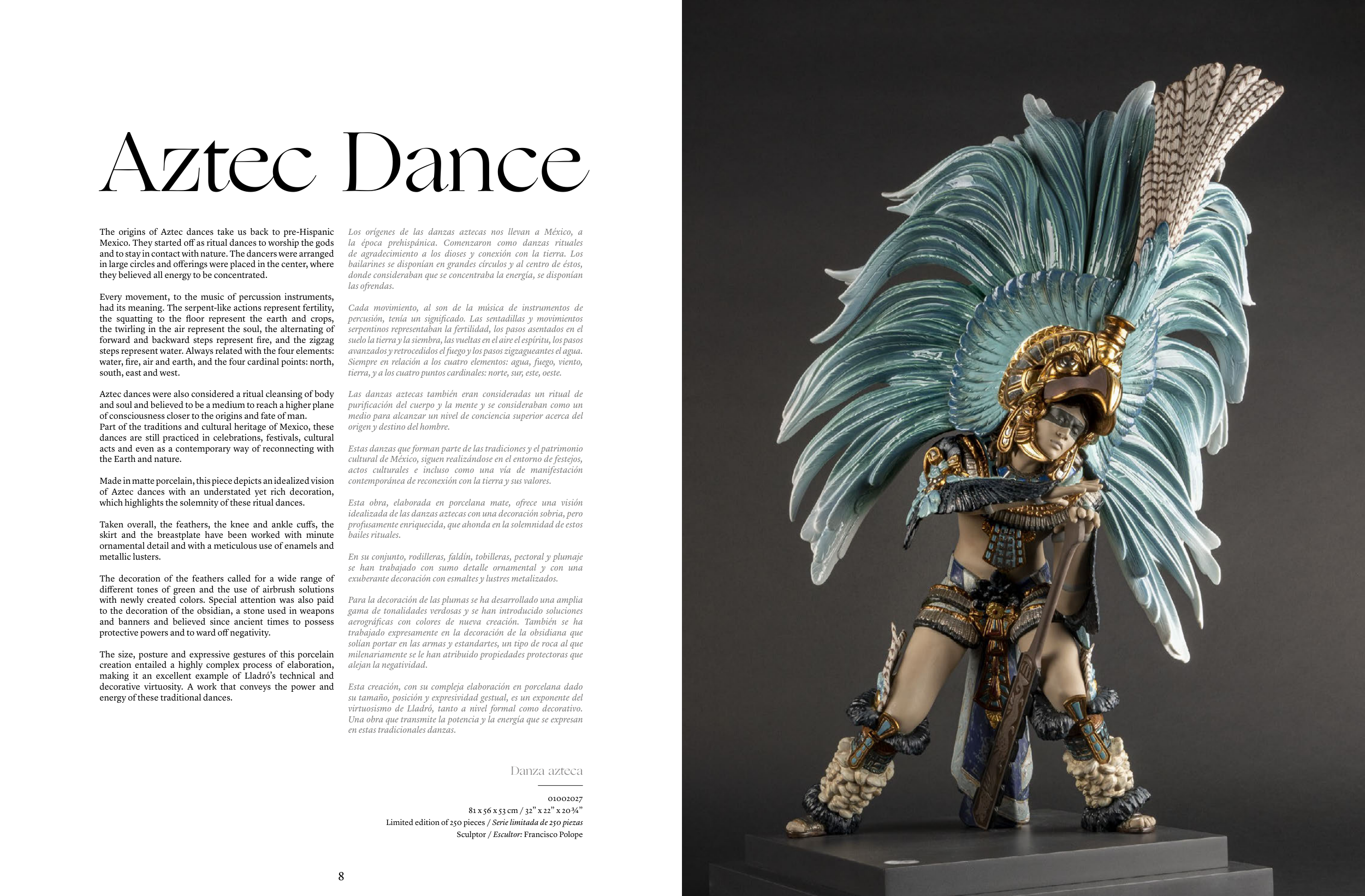
Made in matte porcelain, this piece depicts an idealized vision
of Aztec dances with an understated yet rich decoration,
which highlights the solemnity of these ritual dances.
Taken overall, the feathers, the knee and ankle cuffs, the
skirt and the breastplate have been worked with minute
ornamental detail and with a meticulous use of enamels and
metallic lusters.
The decoration of the feathers called for a wide range of
different tones of green and the use of airbrush solutions
with newly created colors. Special attention was also paid
to the decoration of the obsidian, a stone used in weapons
and banners and believed since ancient times to possess
protective powers and to ward off negativity.
The size, posture and expressive gestures of this porcelain
creation entailed a highly complex process of elaboration,
making it an excellent example of Lladró’s technical and
decorative virtuosity. A work that conveys the power and
energy of these traditional dances.
Los orígenes de las danzas aztecas nos llevan a México, a
la época prehispánica. Comenzaron como danzas rituales
de agradecimiento a los dioses y conexión con la tierra. Los
bailarines se disponían en grandes círculos y al centro de éstos,
donde consideraban que se concentraba la energía, se disponían
las ofrendas.
Cada movimiento, al son de la música de instrumentos de
percusión, tenía un significado. Las sentadillas y movimientos
serpentinos representaban la fertilidad, los pasos asentados en el
suelo la tierra y la siembra, las vueltas en el aire el espíritu, los pasos
avanzados y retrocedidos el fuego y los pasos zigzagueantes el agua.
Siempre en relación a los cuatro elementos: agua, fuego, viento,
tierra, y a los cuatro puntos cardinales: norte, sur, este, oeste.
Las danzas aztecas también eran consideradas un ritual de
purificación del cuerpo y la mente y se consideraban como un
medio para alcanzar un nivel de conciencia superior acerca del
origen y destino del hombre.
Estas danzas que forman parte de las tradiciones y el patrimonio
cultural de México, siguen realizándose en el entorno de festejos,
actos culturales e incluso como una vía de manifestación
contemporánea de reconexión con la tierra y sus valores.
Esta obra, elaborada en porcelana mate, ofrece una visión
idealizada de las danzas aztecas con una decoración sobria, pero
profusamente enriquecida, que ahonda en la solemnidad de estos
bailes rituales.
En su conjunto, rodilleras, faldín, tobilleras, pectoral y plumaje
se han trabajado con sumo detalle ornamental y con una
exuberante decoración con esmaltes y lustres metalizados.
Para la decoración de las plumas se ha desarrollado una amplia
gama de tonalidades verdosas y se han introducido soluciones
aerográficas con colores de nueva creación. También se ha
trabajado expresamente en la decoración de la obsidiana que
solían portar en las armas y estandartes, un tipo de roca al que
milenariamente se le han atribuido propiedades protectoras que
alejan la negatividad.
Esta creación, con su compleja elaboración en porcelana dado
su tamaño, posición y expresividad gestual, es un exponente del
virtuosismo de Lladró, tanto a nivel formal como decorativo.
Una obra que transmite la potencia y la energía que se expresan
en estas tradicionales danzas.
01002027
81 x 56 x 53 cm / 32” x 22” x 20 ¾”
Limited edition of 250 pieces / Serie limitada de 250 piezas
Sculptor / Escultor: Francisco Polope
Danza azteca