186
187
01002017
65 x 86 x 42 cm / 25 ½ ” x 33 ¾ ” x 16 ½ ”
Limited edition of 299 pieces / Serie limitada de 299 piezas
Sculptor / Escultor: Francisco Polope
Gita Saar
“Siempre que, oh descendiente de Bharata,
hay un declive del Dharma y surge el Adharma,
entonces Yo me presento.
Para la protección de los buenos,
por la destrucción de los impíos,
y por la establecimiento del Dharma,
yo nací en todas las épocas.”
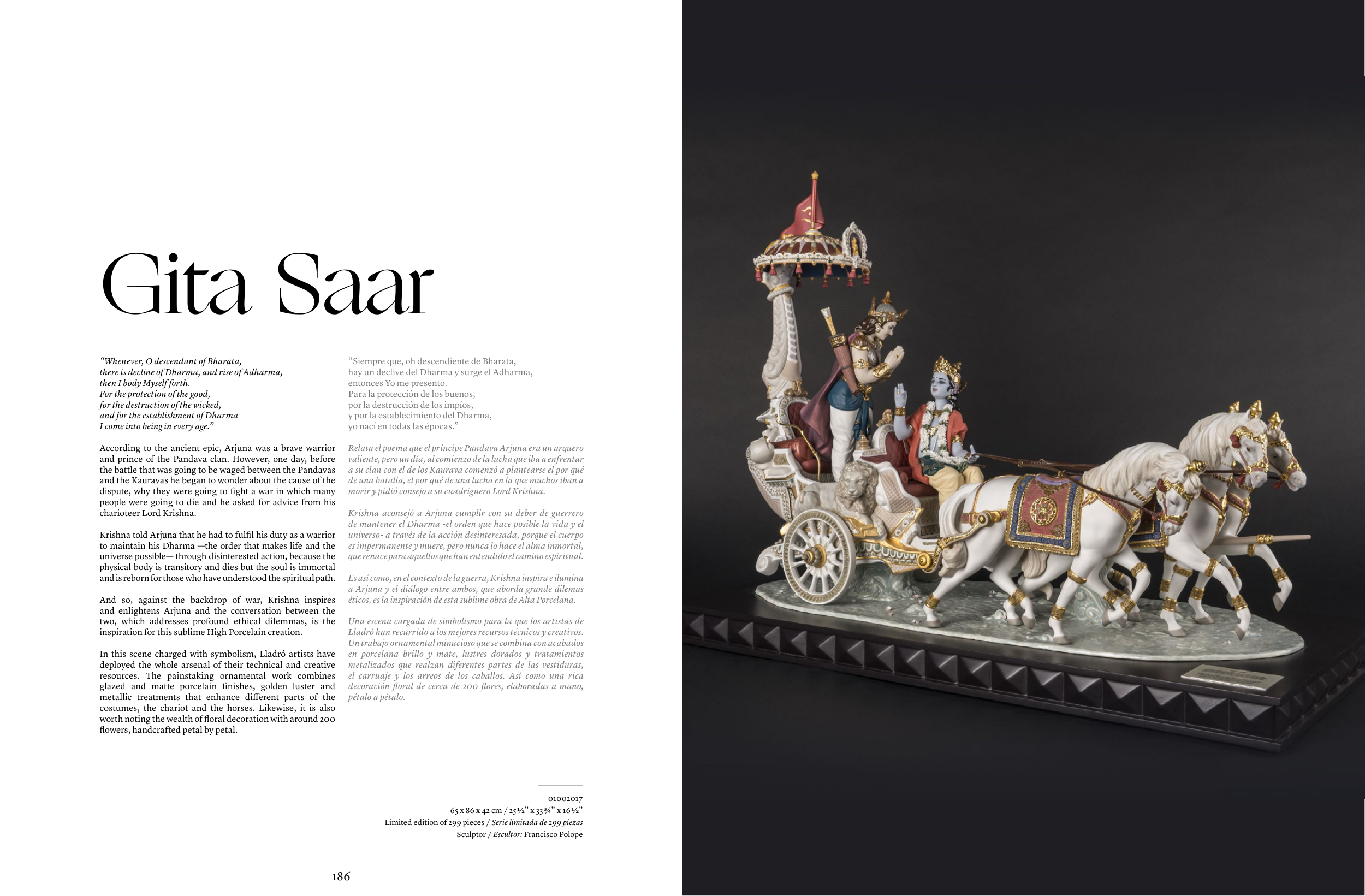
Relata el poema que el príncipe Pandava Arjuna era un arquero
valiente, pero un día, al comienzo de la lucha que iba a enfrentar
a su clan con el de los Kaurava comenzó a plantearse el por qué
de una batalla, el por qué de una lucha en la que muchos iban a
morir y pidió consejo a su cuadriguero Lord Krishna.
Krishna aconsejó a Arjuna cumplir con su deber de guerrero
de mantener el Dharma -el orden que hace posible la vida y el
universo- a través de la acción desinteresada, porque el cuerpo
es impermanente y muere, pero nunca lo hace el alma inmortal,
que renace para aquellos que han entendido el camino espiritual.
Es así como, en el contexto de la guerra, Krishna inspira e ilumina
a Arjuna y el diálogo entre ambos, que aborda grande dilemas
éticos, es la inspiración de esta sublime obra de Alta Porcelana.
Una escena cargada de simbolismo para la que los artistas de
Lladró han recurrido a los mejores recursos técnicos y creativos.
Un trabajo ornamental minucioso que se combina con acabados
en porcelana brillo y mate, lustres dorados y tratamientos
metalizados que realzan diferentes partes de las vestiduras,
el carruaje y los arreos de los caballos. Así como una rica
decoración fl oral de cerca de 200 fl ores, elaboradas a mano,
pétalo a pétalo.
“Whenever, O descendant of Bharata,
there is decline of Dharma, and rise of Adharma,
then I body Myself forth.
For the protection of the good,
for the destruction of the wicked,
and for the establishment of Dharma
I come into being in every age.”
According to the ancient epic, Arjuna was a brave warrior
and prince of the Pandava clan. However, one day, before
the battle that was going to be waged between the Pandavas
and the Kauravas he began to wonder about the cause of the
dispute, why they were going to fi ght a war in which many
people were going to die and he asked for advice from his
charioteer Lord Krishna.
Krishna told Arjuna that he had to fulfi l his duty as a warrior
to maintain his Dharma —the order that makes life and the
universe possible— through disinterested action, because the
physical body is transitory and dies but the soul is immortal
and is reborn for those who have understood the spiritual path.
And so, against the backdrop of war, Krishna inspires
and enlightens Arjuna and the conversation between the
two, which addresses profound ethical dilemmas, is the
inspiration for this sublime High Porcelain creation.
In this scene charged with symbolism, Lladró artists have
deployed the whole arsenal of their technical and creative
resources. The painstaking ornamental work combines
glazed and matte porcelain fi nishes, golden luster and
metallic treatments that enhance diff erent parts of the
costumes, the chariot and the horses. Likewise, it is also
worth noting the wealth of fl oral decoration with around 200
fl owers, handcrafted petal by petal.