212
213
El historiador griego Heródoto recoge en sus obras cómo los
persas enseñaban a sus hijos, de los cinco a los veinte años,
solo tres cosas: a montar a caballo, a tirar con arco y a decir la
verdad. Por eso sus arqueros eran los más hábiles del mundo y
sus jinetes sabían disparar las fl echas hacia atrás.
En aquel enclave estratégico, entre las fértiles riberas de los
ríos Tigris y Éufrates, fl orecieron prósperas civilizaciones,
como la mesopotámica y la persa, cuando el mundo todavía
era primitivo y los romanos o los griegos no habían salido de la
oscuridad de la historia.
La imponente belleza de las joyas arquitectónicas construidas
en las primeras ciudades del mundo ha servido de inspiración
para dar vida a este jarrón de Alta Porcelana.
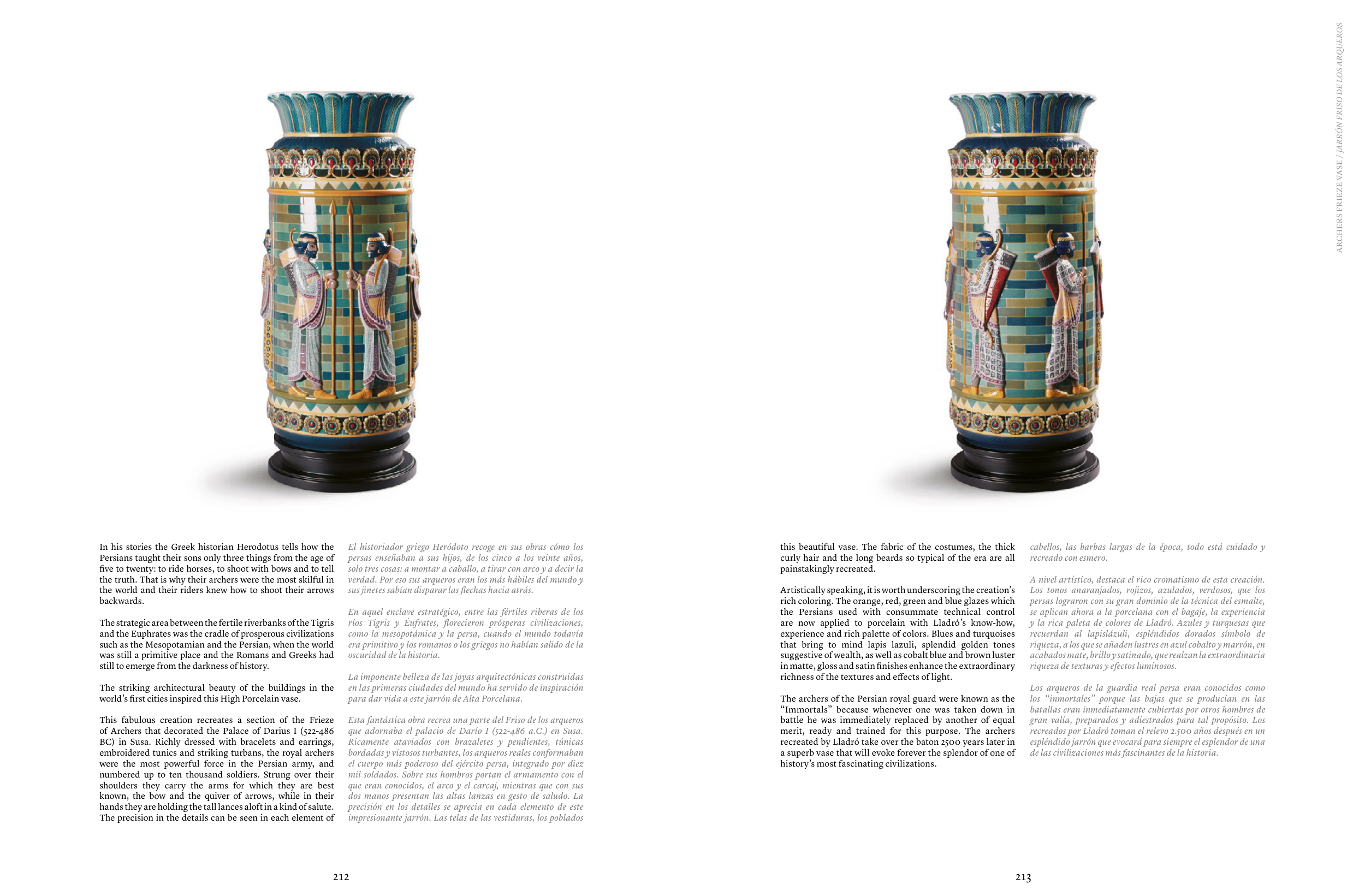
Esta fantástica obra recrea una parte del Friso de los arqueros
que adornaba el palacio de Darío I (522-486 a.C.) en Susa.
Ricamente ataviados con brazaletes y pendientes, túnicas
bordadas y vistosos turbantes, los arqueros reales conformaban
el cuerpo más poderoso del ejército persa, integrado por diez
mil soldados. Sobre sus hombros portan el armamento con el
que eran conocidos, el arco y el carcaj, mientras que con sus
dos manos presentan las altas lanzas en gesto de saludo. La
precisión en los detalles se aprecia en cada elemento de este
impresionante jarrón. Las telas de las vestiduras, los poblados
In his stories the Greek historian Herodotus tells how the
Persians taught their sons only three things from the age of
fi ve to twenty: to ride horses, to shoot with bows and to tell
the truth. That is why their archers were the most skilful in
the world and their riders knew how to shoot their arrows
backwards.
The strategic area between the fertile riverbanks of the Tigris
and the Euphrates was the cradle of prosperous civilizations
such as the Mesopotamian and the Persian, when the world
was still a primitive place and the Romans and Greeks had
still to emerge from the darkness of history.
The striking architectural beauty of the buildings in the
world’s fi rst cities inspired this High Porcelain vase.
This fabulous creation recreates a section of the Frieze
of Archers that decorated the Palace of Darius I (522-486
BC) in Susa. Richly dressed with bracelets and earrings,
embroidered tunics and striking turbans, the royal archers
were the most powerful force in the Persian army, and
numbered up to ten thousand soldiers. Strung over their
shoulders they carry the arms for which they are best
known, the bow and the quiver of arrows, while in their
hands they are holding the tall lances aloft in a kind of salute.
The precision in the details can be seen in each element of
this beautiful vase. The fabric of the costumes, the thick
curly hair and the long beards so typical of the era are all
painstakingly recreated.
Artistically speaking, it is worth underscoring the creation’s
rich coloring. The orange, red, green and blue glazes which
the Persians used with consummate technical control
are now applied to porcelain with Lladró’s know-how,
experience and rich palette of colors. Blues and turquoises
that bring to mind lapis lazuli, splendid golden tones
suggestive of wealth, as well as cobalt blue and brown luster
in matte, gloss and satin fi nishes enhance the extraordinary
richness of the textures and eff ects of light.
The archers of the Persian royal guard were known as the
“Immortals” because whenever one was taken down in
battle he was immediately replaced by another of equal
merit, ready and trained for this purpose. The archers
recreated by Lladró take over the baton 2500 years later in
a superb vase that will evoke forever the splendor of one of
history’s most fascinating civilizations.
cabellos, las barbas largas de la época, todo está cuidado y
recreado con esmero.
A nivel artístico, destaca el rico cromatismo de esta creación.
Los tonos anaranjados, rojizos, azulados, verdosos, que los
persas lograron con su gran dominio de la técnica del esmalte,
se aplican ahora a la porcelana con el bagaje, la experiencia
y la rica paleta de colores de Lladró. Azules y turquesas que
recuerdan al lapislázuli, espléndidos dorados símbolo de
riqueza, a los que se añaden lustres en azul cobalto y marrón, en
acabados mate, brillo y satinado, que realzan la extraordinaria
riqueza de texturas y efectos luminosos.
Los arqueros de la guardia real persa eran conocidos como
los “inmortales” porque las bajas que se producían en las
batallas eran inmediatamente cubiertas por otros hombres de
gran valía, preparados y adiestrados para tal propósito. Los
recreados por Lladró toman el relevo 2.500 años después en un
espléndido jarrón que evocará para siempre el esplendor de una
de las civilizaciones más fascinantes de la historia.
ARCHERS FRIEZE VASE / JARRÓN FRISO DE LOS ARQUEROS