52
20.
Passaggio di stagione
Change of season
Quando nevica, il silenzio
sfiora la grande vetrata che dà
sul fiume.
Di fronte gli abitanti della casa
hanno messo due poltrone, come
davanti a uno schermo.
Osservano il modo in cui la vita
del giardino avvolge la casa,
fra terra e cielo, inviando
messaggi con la delicatezza che
hanno gli animali, le erbe, gli
alberi. Brevi comunicazioni
invernali. Il brusio dell’acqua,
l’aria di cristallo, la nebbia.
Ogni passaggio di stagione è
scritto nel modo in cui cambiano
le luci, i rumori. Una notte,
è un ramo che tocca il muro,
mosso dal vento. La mattina
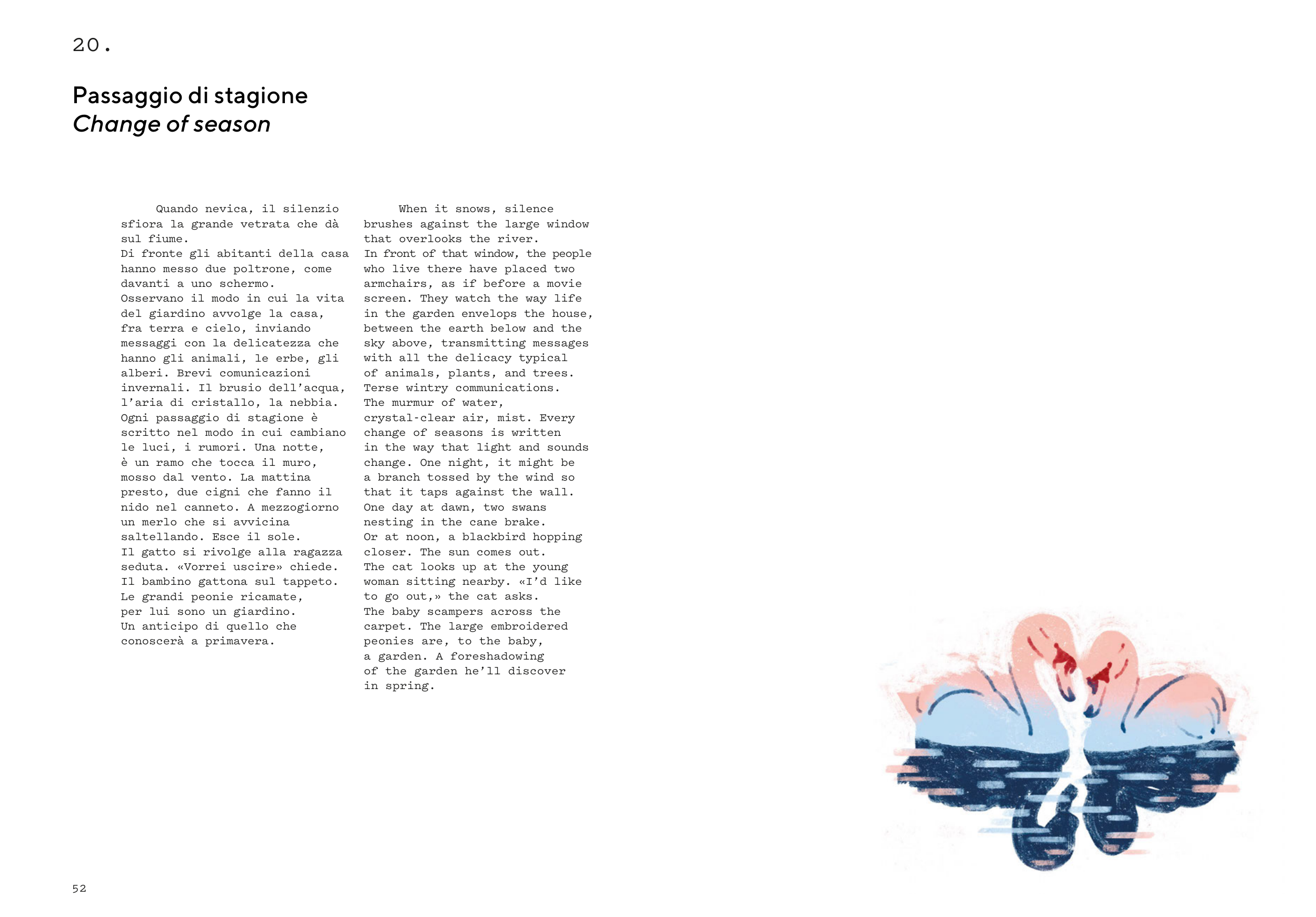
presto, due cigni che fanno il
nido nel canneto. A mezzogiorno
un merlo che si avvicina
saltellando. Esce il sole.
Il gatto si rivolge alla ragazza
seduta. «Vorrei uscire» chiede.
Il bambino gattona sul tappeto.
Le grandi peonie ricamate,
per lui sono un giardino.
Un anticipo di quello che
conoscerà a primavera.
When it snows, silence
brushes against the large window
that overlooks the river.
In front of that window, the people
who live there have placed two
armchairs, as if before a movie
screen. They watch the way life
in the garden envelops the house,
between the earth below and the
sky above, transmitting messages
with all the delicacy typical
of animals, plants, and trees.
Terse wintry communications.
The murmur of water,
crystal-clear air, mist. Every
change of seasons is written
in the way that light and sounds
change. One night, it might be
a branch tossed by the wind so
that it taps against the wall.
One day at dawn, two swans
nesting in the cane brake.
Or at noon, a blackbird hopping
closer. The sun comes out.
The cat looks up at the young
woman sitting nearby. «I’d like
to go out,» the cat asks.
The baby scampers across the
carpet. The large embroidered
peonies are, to the baby,
a garden. A foreshadowing
of the garden he’ll discover
in spring.