6
Making a
more
sustainable
design
Our best practices for a more
sustainable design
sustainable design
Upholstery
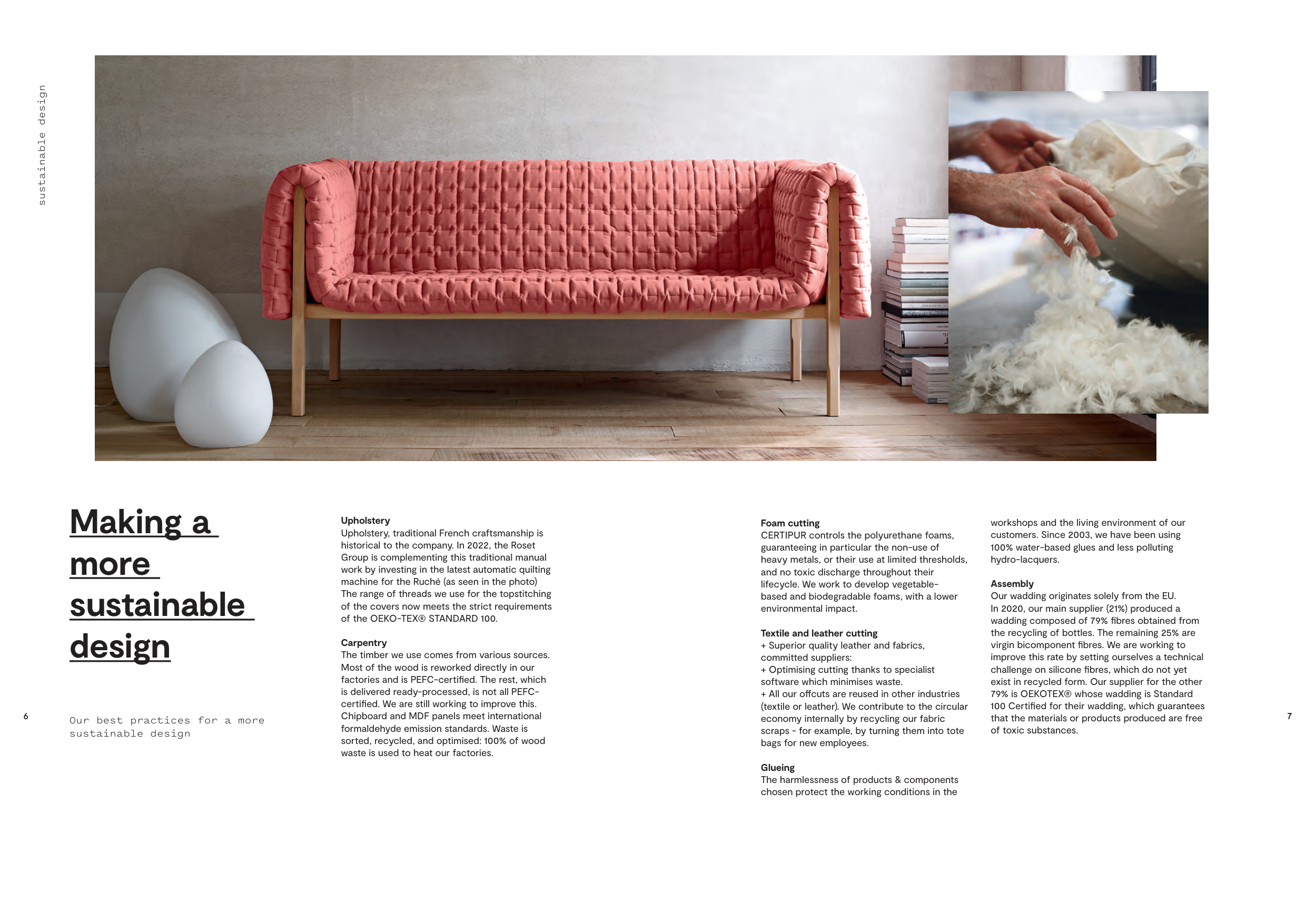
Upholstery, traditional French craftsmanship is
historical to the company. In 2022, the Roset
Group is complementing this traditional manual
work by investing in the latest automatic quilting
machine for the Ruché (as seen in the photo)
The range of threads we use for the topstitching
of the covers now meets the strict requirements
of the OEKO-TEX® STANDARD 100.
Carpentry
The timber we use comes from various sources.
Most of the wood is reworked directly in our
factories and is PEFC-certified. The rest, which
is delivered ready-processed, is not all PEFC-
certified. We are still working to improve this.
Chipboard and MDF panels meet international
formaldehyde emission standards. Waste is
sorted, recycled, and optimised: 100% of wood
waste is used to heat our factories.
7
Foam cutting
CERTIPUR controls the polyurethane foams,
guaranteeing in particular the non-use of
heavy metals, or their use at limited thresholds,
and no toxic discharge throughout their
lifecycle. We work to develop vegetable-
based and biodegradable foams, with a lower
environmental impact.
Textile and leather cutting
+ Superior quality leather and fabrics,
committed suppliers:
+ Optimising cutting thanks to specialist
software which minimises waste.
+ All our offcuts are reused in other industries
(textile or leather). We contribute to the circular
economy internally by recycling our fabric
scraps - for example, by turning them into tote
bags for new employees.
Glueing
The harmlessness of products & components
chosen protect the working conditions in the
workshops and the living environment of our
customers. Since 2003, we have been using
100% water-based glues and less polluting
hydro-lacquers.
Assembly
Our wadding originates solely from the EU.
In 2020, our main supplier (21%) produced a
wadding composed of 79% fibres obtained from
the recycling of bottles. The remaining 25% are
virgin bicomponent fibres. We are working to
improve this rate by setting ourselves a technical
challenge on silicone fibres, which do not yet
exist in recycled form. Our supplier for the other
79% is OEKOTEX® whose wadding is Standard
100 Certified for their wadding, which guarantees
that the materials or products produced are free
of toxic substances.