What are your thoughts on the collaboration with Studio Liaigre
and the decision to publish an interpretation of the Bloc library,
originally designed for the Bibliothèque nationale de France?
Gaëlle Lauriot-Prévost: Liaigre is a brand with a timeless identity,
and its designs embody this quality. I see this as a strength, which
is why this library, also classic in style, complements the brand’s
collection so well.
Dominique Perrault: This library is not just classical; it embodies
a strong classical ethos rooted in Kantian geometry. By this, I
mean a geometric framework grounded in reason, where every
element contributes to the ensemble—much like a book or a
mind.It functions only within a classical language characterized
by symmetry and fundamental geometric shapes. This approach
resonates with Liaigre, whose interior designs are undeniably
warm and inviting while remaining precisely defined. At Liaigre,
geometry and functionality are always at the forefront, reflecting
a clear understanding of interior architecture and design.
The library highlights a strong emphasis on detail and careful
consideration of functionality.
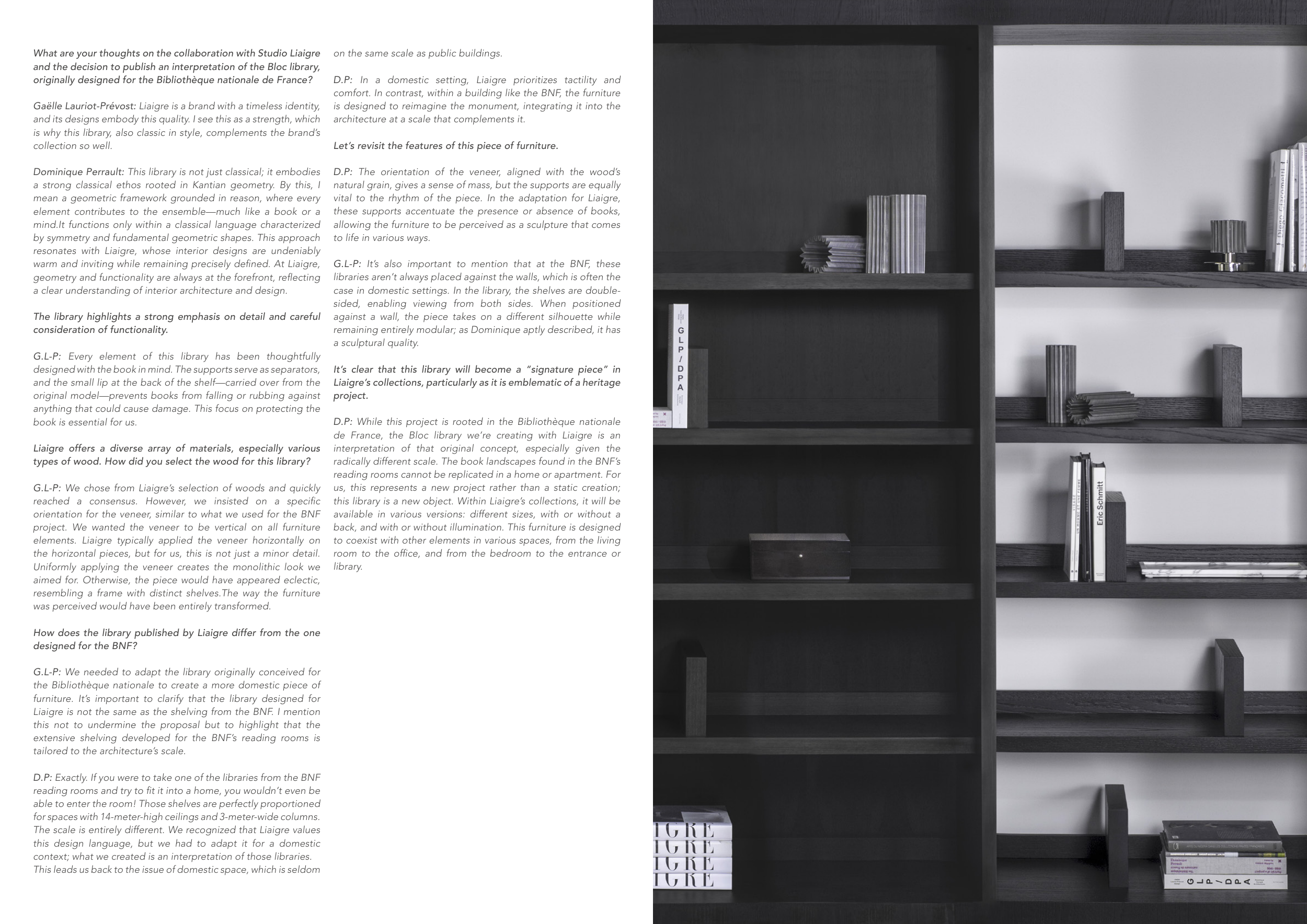
G.L-P: Every element of this library has been thoughtfully
designed with the book in mind. The supports serve as separators,
and the small lip at the back of the shelf—carried over from the
original model—prevents books from falling or rubbing against
anything that could cause damage. This focus on protecting the
book is essential for us.
Liaigre offers a diverse array of materials, especially various
types of wood. How did you select the wood for this library?
G.L-P: We chose from Liaigre’s selection of woods and quickly
reached a consensus. However, we insisted on a specific
orientation for the veneer, similar to what we used for the BNF
project. We wanted the veneer to be vertical on all furniture
elements. Liaigre typically applied the veneer horizontally on
the horizontal pieces, but for us, this is not just a minor detail.
Uniformly applying the veneer creates the monolithic look we
aimed for. Otherwise, the piece would have appeared eclectic,
resembling a frame with distinct shelves.The way the furniture
was perceived would have been entirely transformed.
How does the library published by Liaigre differ from the one
designed for the BNF?
G.L-P: We needed to adapt the library originally conceived for
the Bibliothèque nationale to create a more domestic piece of
furniture. It’s important to clarify that the library designed for
Liaigre is not the same as the shelving from the BNF. I mention
this not to undermine the proposal but to highlight that the
extensive shelving developed for the BNF’s reading rooms is
tailored to the architecture’s scale.
D.P: Exactly. If you were to take one of the libraries from the BNF
reading rooms and try to fit it into a home, you wouldn’t even be
able to enter the room! Those shelves are perfectly proportioned
for spaces with 14-meter-high ceilings and 3-meter-wide columns.
The scale is entirely different. We recognized that Liaigre values
this design language, but we had to adapt it for a domestic
context; what we created is an interpretation of those libraries.
This leads us back to the issue of domestic space, which is seldom
on the same scale as public buildings.
D.P: In a domestic setting, Liaigre prioritizes tactility and
comfort. In contrast, within a building like the BNF, the furniture
is designed to reimagine the monument, integrating it into the
architecture at a scale that complements it.
Let’s revisit the features of this piece of furniture.
D.P: The orientation of the veneer, aligned with the wood’s
natural grain, gives a sense of mass, but the supports are equally
vital to the rhythm of the piece. In the adaptation for Liaigre,
these supports accentuate the presence or absence of books,
allowing the furniture to be perceived as a sculpture that comes
to life in various ways.
G.L-P: It’s also important to mention that at the BNF, these
libraries aren’t always placed against the walls, which is often the
case in domestic settings. In the library, the shelves are double-
sided, enabling viewing from both sides. When positioned
against a wall, the piece takes on a different silhouette while
remaining entirely modular; as Dominique aptly described, it has
a sculptural quality.
It’s clear that this library will become a “signature piece” in
Liaigre’s collections, particularly as it is emblematic of a heritage
project.
D.P: While this project is rooted in the Bibliothèque nationale
de France, the Bloc library we’re creating with Liaigre is an
interpretation of that original concept, especially given the
radically different scale. The book landscapes found in the BNF’s
reading rooms cannot be replicated in a home or apartment. For
us, this represents a new project rather than a static creation;
this library is a new object. Within Liaigre’s collections, it will be
available in various versions: different sizes, with or without a
back, and with or without illumination. This furniture is designed
to coexist with other elements in various spaces, from the living
room to the office, and from the bedroom to the entrance or
library.