Vantaggi
derivanti
dalla posa
A secco
Su sabbia
•
Facile e veloce da posare
•
Modificabile
in ogni momento
•
Riutilizzabile e sostituibile
•
Drenaggio
dell’acqua ottimale
•
Non presenta problemi
di assestamento
•
Posa in assenza
di personale specializzato
•
Privo di costi
per i prodotti collanti
•
Costi e tempi
per la posa ridotti
•
Immediatamente pronto
al calpestio
Collocazioni
consigliate
Per la posa
A secco
Su sabbia
•
Pedane di servizio
e percorsi pedonali
in stabilimenti balneari
•
Giardini
EN_ Advantages of
dry laying on sand
•
Quick and easy to lay
•
Can be changed at any time
•
Reusable and replaceable
•
Excellent water runoff
•
No settling problems
•
DIY laying.
•
No extra costs for adhesives
•
Low laying costs and
fast laying times
•
Immediately ready for use
Recommended locations
for dry laying on sand
•
Pedestrian access paths
and walkways in beach facilities
•
Gardens
FR_ Avantages de la pose
à sec sur sable
•
Facile et rapide à poser
•
Modifiable à tout moment
•
Réutilisable et remplaçable
•
Drainage optimal de l’eau
•
Ne présente pas de problèmes
de tassement
•
Pas besoin de faire appel
à du personnel spécialisé
pour la pose
•
Sans frais de colle
•
Réduction des coûts
et des temps de pose
•
Immédiatement prêt à l’emploi
Emplacements conseillés
pour la pose à sec sur sable
•
Decks et parcours piétonniers
d’établissements balnéaires
•
Jardins
DE_ Vorteile der trockenverlegung
auf sand
•
Einfach und schnell
•
Jederzeit veränderbar
•
Wiederverwendbar
und auswechselbar
•
Ausgezeichnete Wasserdrainage
•
Weist keine Absackprobleme auf
•
Verlegung ohne Benötigung von Fachpersonal
•
Keine Kosten für Kleber
•
Reduzierte Verlegekosten
und-zeiten
•
Sofort begehbar
Anwendungsempfehlungen
für die trockenverlegung auf sand
•
Dienstlaufstege und Fußgängerwege in Strandbädern
•
Gärten.
•
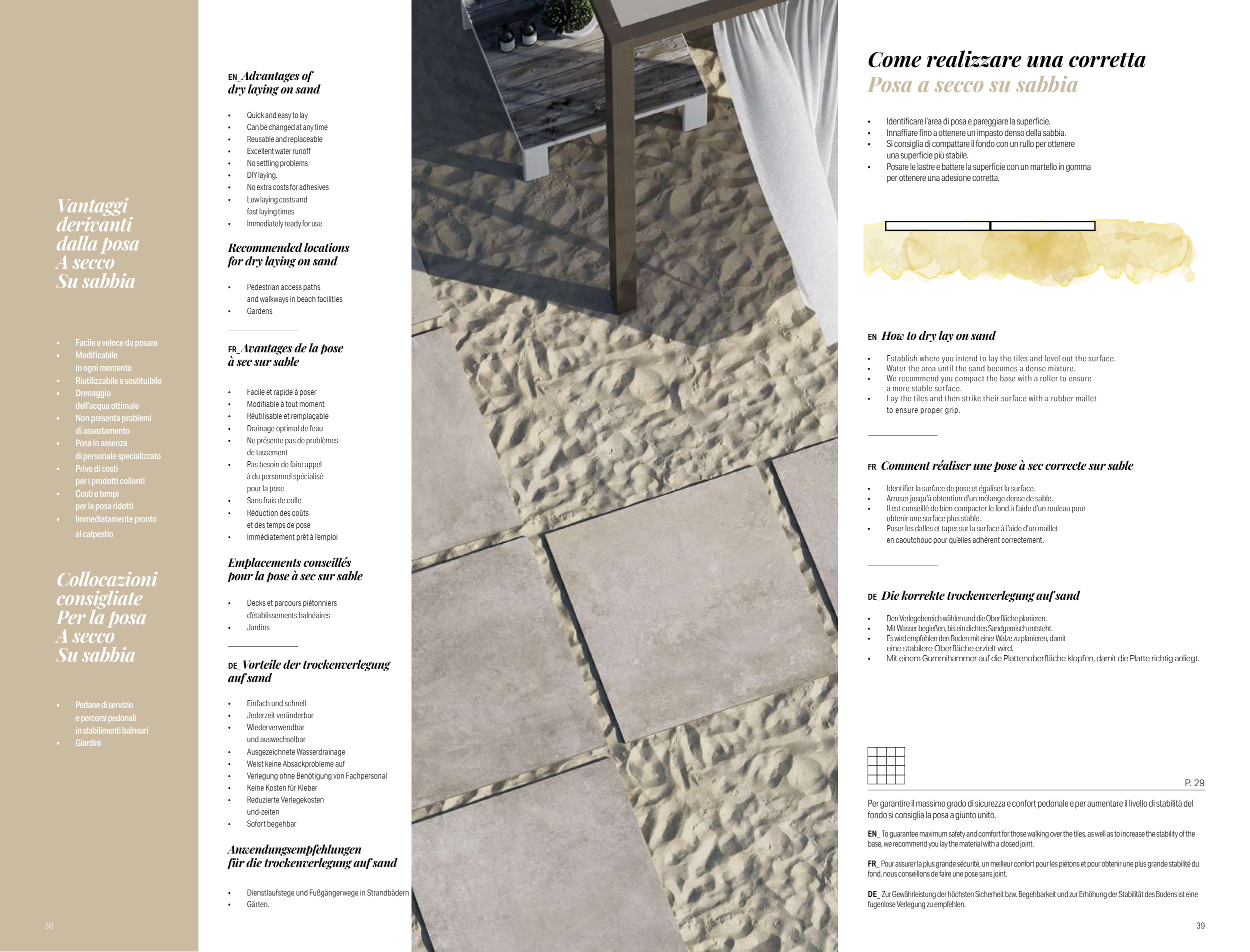
Identificare l’area di posa e pareggiare la superficie.
•
Innaffiare fino a ottenere un impasto denso della sabbia.
•
Si consiglia di compattare il fondo con un rullo per ottenere
una superficie più stabile.
•
Posare le lastre e battere la superficie con un martello in gomma
per ottenere una adesione corretta.
EN_ How to dry lay on sand
•
Establish where you intend to lay the tiles and level out the surface.
•
Water the area until the sand becomes a dense mixture.
•
We recommend you compact the base with a roller to ensure
a more stable surface.
•
Lay the tiles and then strike their surface with a rubber mallet
to ensure proper grip.
FR_ Comment réaliser une pose à sec correcte sur sable
•
Identifier la surface de pose et égaliser la surface.
•
Arroser jusqu’à obtention d’un mélange dense de sable.
•
Il est conseillé de bien compacter le fond à l’aide d’un rouleau pour
obtenir une surface plus stable.
•
Poser les dalles et taper sur la surface à l’aide d’un maillet
en caoutchouc pour qu’elles adhèrent correctement.
DE_ Die korrekte trockenverlegung auf sand
•
Den Verlegebereich wählen und die Oberfläche planieren.
•
Mit Wasser begießen, bis ein dichtes Sandgemisch entsteht.
•
Es wird empfohlen den Boden mit einer Walze zu planieren, damit
eine stabilere Oberfläche erzielt wird.
•
Mit einem Gummihammer auf die Plattenoberfläche klopfen, damit die Platte richtig anliegt.
Come realizzare una corretta
Posa a secco su sabbia
Per garantire il massimo grado di sicurezza e confort pedonale e per aumentare il livello di stabilità del
fondo si consiglia la posa a giunto unito.
EN_ To guarantee maximum safety and comfort for those walking over the tiles, as well as to increase the stability of the
base, we recommend you lay the material with a closed joint.
FR_ Pour assurer la plus grande sécurité, un meilleur confort pour les piétons et pour obtenir une plus grande stabilité du
fond, nous conseillons de faire une pose sans joint.
DE_ Zur Gewährleistung der höchsten Sicherheit bzw. Begehbarkeit und zur Erhöhung der Stabilität des Bodens ist eine
fugenlose Verlegung zu empfehlen.
P. 29
39
38